Kids Birthday Party Photo Sharing: A GDPR Guide for Parents in the EU

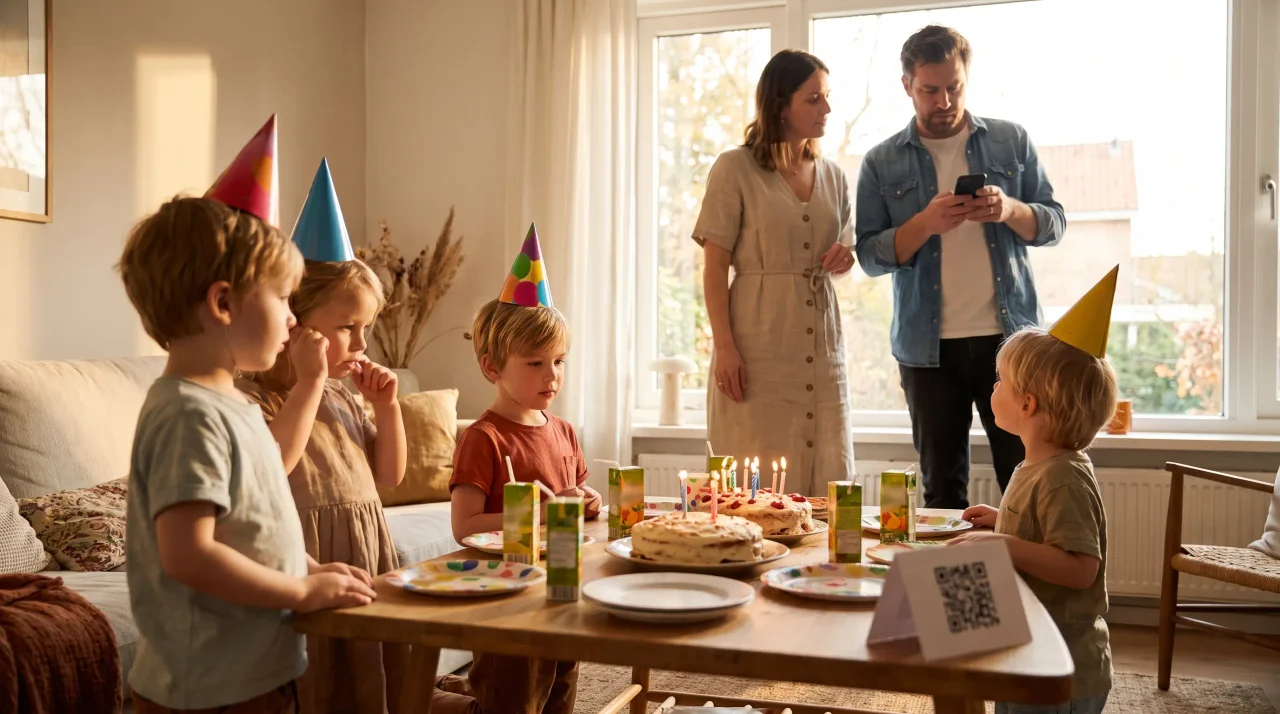
For a private children's birthday party the GDPR's household exemption (Article 2(2)(c)) generally covers keeping the photos privately — but it shields you, not the platform, and it narrows the moment photos leave the private circle. As the host you are the controller: say what you are collecting and why at the moment you collect it, rely on legitimate interests for ordinary party photos, and honour an erasure request within one month.
- The household exemption covers you, not your tool. Whatever service you use is processing that data on its own account.Art. 2(2)(c)
- Ordinary party photos are not special-category data. An image only becomes biometric when something builds a face template from it.Recital 51
- Tell people at the point of collection who is collecting and why — not later, and not in a policy nobody opens.Art. 13(1)
- Act on an erasure request without undue delay and within one month.Art. 17
Twelve kids. One cake. Forty phones out for the candles. And afterwards you have a few blurry shots on your own phone, while everyone else's best photos are scattered across camera rolls you'll never see.
So you collect them. Maybe a WhatsApp group, maybe a shared link. And then a small, very European thought arrives: wait — these are photos of other people's children. Where do they go? Who can see them? Am I allowed to do this?
Good instinct. This guide answers it plainly: what the GDPR actually says about sharing photos from a children's birthday party, what you as the parent-host need to do, and how to set up a party album that's both effortless and safe. It's written for EU parents, with a German and Austrian note where the rules differ.
This is general information, not legal advice. For your specific situation, talk to a qualified data-protection adviser.
- General information, not legal advice: the GDPR frames purely personal or household activity through Article 2(2)(c) and Recital 18.
- CJEU C-212/13 Ryneš shows that this household exemption narrows when processing points outside the private sphere.
- GDPR Article 8 sets the online-services age threshold at 16; Austria DSG §4(4) sets it at 14.
- Disclosure: the author builds Gathmo, named in this article as the shared guest album.
Does the GDPR even apply to my kid's birthday party?
Short answer: it depends on what you do with the photos.
The GDPR has a "purely personal or household activity" exemption (Article 2(2)(c)). Taking photos at your own child's party and keeping them privately — in your own album, shared within a small private circle of family and friends — generally falls under it. The regulation simply isn't aimed at your family photo box.
But the exemption has edges, and they matter:
- It shields the individual, not the platform. The exemption covers you keeping your private photos. It does not exempt any company that provides the means to process the data. So a photo-sharing service is fully inside the GDPR's scope even when you, the parent, are exempt. (GDPR Art. 2(2)(c), Recital 18.)
- It stops at the front door of the private circle. The Court of Justice of the EU read this exemption narrowly in the Ryneš case (C-212/13): processing "directed outwards from the private setting" — pointed at the public, not the household — isn't a purely personal activity any more. Applied to a birthday party: keeping the photos among invited families is one thing; publishing other children's photos openly on the public internet is another, and that can pull you out of the exemption and into the GDPR's obligations. (GDPR Recital 18 + Art. 2(2)(c); CJEU C-212/13 Ryneš, 11 Dec 2014.)
The practical takeaway is simple and reassuring: keep the album private, keep it inside the circle of invited families, and don't post other people's kids publicly. Do that, and you're on the comfortable side of the line.
Photos of children aren't "biometric data" — until something scans the faces
A common worry: isn't a photo of a child especially sensitive "biometric" data?
Not by default. Recital 51 of the GDPR is explicit: photographs are not automatically a special category of data. An image only becomes biometric data — the kind that triggers the stricter rules of Article 9 — when it's "processed through a specific technical means allowing the unique identification" of a person. In plain terms, an ordinary gallery of party photos is just photos. It becomes a different, far more regulated thing the moment a service runs facial recognition to identify or tag individual children. (GDPR Recital 51, read with Art. 9(1).)
So the key question to ask any "find your photos by selfie" feature before you point it at a children's party is: are you building a face template of my child? If yes, that's Article 9 territory and needs a much stronger legal footing — typically separate, explicit consent.
Worth knowing: Gathmo does not run face recognition. Photos are stored and displayed; no face-matching, no face search. (Face-find is on the long-term roadmap, not part of the product today.) For a kids' party, "no face recognition" is a feature, not a gap.
What you, the host, actually need to do
When you're the one collecting guests' photos, you're acting as what the GDPR calls a controller. That sounds heavier than it is. For a private kids' party kept within the household circle, it comes down to a few sensible habits.
1. Have a reason, and be gentle about it
You need a lawful basis to process the photos (GDPR Art. 6(1)). For ordinary, non-face-scanned party photos kept privately, a host can generally rely on legitimate interest (Art. 6(1)(f)) — but the balancing test gives heightened protection where a child is involved, and consent (Art. 6(1)(a)) is the safer, cleaner basis. In real life that means one easy move: tell the other parents. A line in the invitation does it — "We'll have a private photo album; scan the code to add yours. It's only visible to invited families — tell us if you'd rather your child's photos weren't included." That's informed, freely given, and a perfectly normal thing to say.
2. Tell guests what's happening at the moment they upload
The transparency rule (Art. 13(1)) says that when you collect personal data directly from people, you tell them — at that moment — who's collecting it, why, and on what basis. For a party album, that's a short notice on the upload page: who runs the album (you), what it's for (the birthday), how long it's kept, and that they can ask for a photo to be removed.
3. Be ready to delete on request
Any guest — or parent of a child in a photo — can ask you to erase their data, and you must act "without undue delay" and within one month of the request (extendable by two further months only for genuinely complex cases). (GDPR Art. 17(1) + Art. 12(3).) On a private album this is usually trivial: find the photo, delete it. The point is to make sure you can — far easier on a service with a real delete button than in a WhatsApp group where the image has already been forwarded fifteen times.
4. Don't keep them forever
Two principles work together: data minimisation — collect only what you need — and storage limitation — keep it only as long as you need it (GDPR Art. 5(1)(c) and (e)). A party album doesn't need to live on a server indefinitely; a defined retention window, after which the gallery is cleared, is exactly the behaviour the law wants.
The Germany and Austria footnote: the age question
If you've ever wondered why German parents are especially careful here, this is part of why. For online services offered directly to a child, consent is only valid from age 16 by default; below that, a parent has to give or authorise it. Member states may lower the bar, but not under 13. Germany kept it at 16. Austria lowered it to 14 (§ 4(4) DSG). (GDPR Art. 8(1).)
For a parent-run birthday album this mostly stays in the background — you, the adult host, operate the album, and the other adults upload. But it's why the DACH market treats children's photos with extra seriousness, and a good reason to keep the album invite-only rather than open to the world. What parents should know about photo safety at a kids birthday covers the everyday decisions that sit under the legal ones.
Where the photos live actually matters
Here's the part most "share photos at a party" tools quietly skip: which country your children's photos sit in.
If a service stores data outside the EU — most commonly on US servers — that's an international transfer, and it has to clear specific legal hurdles (an adequacy decision, or Standard Contractual Clauses plus a transfer assessment) under Chapter V of the GDPR. Keeping data in the EU sidesteps that machinery entirely. (GDPR Art. 45–46; CJEU C-311/18 Schrems II.)
This is a real differentiator, not marketing. Among the popular QR-code photo-sharing tools, residency genuinely varies — we checked each provider's own pages on 2026-06-08:
- US-hosted (as of June 2026, per their own statements): GuestCam (US cloud storage), Kululu (Google Cloud / Firebase in the US), plus Wedibox and Fotify (US companies; Fotify is a Delaware LLC).
- EU/EEA-hosted (as of June 2026): EventPics (Austrian operator, EU storage), Lense (EU servers), Weddies and FridaySnap (German servers, stated). JoinMyMoment names EU sub-processors in Germany and France.
- Not confirmed: several tools — including Qrowd Pics, Guestlense and EventShare — don't clearly state where data is hosted (US-based / EU residency not confirmed). If a service won't tell you, treat that as your answer.
Gathmo stores all media in the EU — object storage in the EU jurisdiction, database in Frankfurt — with data-processing agreements in place with its processors. For a children's party, that means the photos never leave EU-resident infrastructure.
How to run a safe, private kids' party album in practice
Putting the legal points into a setup any parent can do:
- Use a private, link-or-PIN album — not a public feed. Keep it visible only to people who have the link, and don't index it publicly. This keeps you firmly inside the household-circle side of Ryneš.
- Say it on the invite. One sentence: there's a private album, here's how to add photos, tell us if you'd rather opt out. That covers transparency and consent in the friendliest possible way.
- Pick a tool that moderates before publishing. Gathmo screens uploads with AI moderation plus a human review queue, so nothing odd lands in the gallery unseen by you.
- Choose EU hosting on purpose. See the section above. For children's photos, this is the box worth ticking.
- Set a retention window and let it expire. On Gathmo, retention runs from 30 days on the Free tier up to 1 year on the top tier — download the keepers and the gallery clears itself, which is storage limitation done for you.
- Place the QR code where parents will actually scan it. A table card at ~3–5 cm scans comfortably from a seated distance; a standing A5 sign wants ~4–7 cm. Keep a clear margin around the code, dark-on-light for contrast, and test-print one before the party.
What about the voice and video messages?
Birthdays aren't only photos. Plenty of parents love collecting little spoken birthday wishes — from the grandparents who couldn't travel, from the cousin abroad. The same rules apply: tell people what it's for, keep it in the private circle, host it in the EU. Gathmo's voice messages are available on every tier (30 seconds on Free; unlimited on paid tiers); automatic transcripts of those messages are a top-tier and business feature, not on the lower tiers. Among the QR-style competitors, only JoinMyMoment also offers voicemail transcripts — they're rare, not standard.
Choose an EU-hosted, private photo platform
Select a tool that stores data in the EU, keeps albums private (not publicly searchable), and lets you delete the album when done. Gathmo stores data in Frankfurt and all albums are private by default.
Notify parents in the invitation
Add one sentence to the party invitation: photos of children will be collected in a private album shared only with attending families. This satisfies basic transparency expectations even under the GDPR household exemption.
Enable moderation before the event
In the Gathmo host dashboard, enable host-approval moderation so all uploads require your review before they appear in the album. This gives you full control and prevents any unexpected content from reaching the collection.
Delete the album after sharing with families
Once you have shared curated photos with attending families, delete the album from the dashboard. On the free tier, the album closes automatically after 30 days; on paid tiers, delete manually. This limits unnecessary data retention.
Frequently asked
Within a genuinely private family setting, the household exemption gives latitude. But the moment a child's photo is published outside that private circle — openly online, for instance — the person publishing it can fall within the GDPR, and you can object and request removal. The safe norm: ask first, keep it private, honour opt-outs. (GDPR Art. 2(2)(c) + Recital 18; CJEU Ryneš.)
That's a personal call, but posting publicly is exactly the "directed outwards from the private setting" act that Ryneš says isn't a purely household activity. A private, invite-only album is a much safer home for other people's children than a public post.
Ask one question first: does it build a facial-recognition template? If it does, it's processing biometric data under Article 9 and needs explicit consent — a high bar for children. Gathmo deliberately doesn't do face recognition. (GDPR Recital 51, Art. 9(1).)
Yes. You should action it without undue delay and within one month (Art. 17(1) + Art. 12(3)). A tool with a clear delete control makes this painless.
Under the GDPR, photographs of children are personal data. For a private birthday party where you share photos only with parents who attended, legitimate interest is the most commonly relied-upon basis — parents reasonably expect photos to be taken, access is limited to those present, and deletion is easy to action. The risk is higher when sharing goes beyond the event circle: public social media, class group chats, or photo apps accessible to strangers. For a private album shared only with attending families, keep access limited, use a short retention window, and delete on request.
GDPR applies to all personal data from birth — there is no age minimum for protection. However, the special consent age for digital services (Article 8) is 16 in most EU countries (some set it at 13). For event photos, the relevant question is not digital-service consent but whether the processing has a lawful basis. For a private kids' birthday album, process under legitimate interest (kept private, short retention, easy deletion) or under explicit parental consent. Either way, always honour a parent's deletion request promptly.
For a private party where photos are shared only with attending families, most EU supervisory authorities treat this as a personal or household activity exempt from GDPR Art. 2(2)(c). The exemption has limits: if you post photos to a public social media profile, share with people outside the party group, or run a commercial children's event, the exemption may not apply. The safest approach is to note at invitation stage that photos will be shared via a private link with attending families only, and to honour any deletion request from a parent promptly. A Gathmo private album shared by link only — not indexed or public — sits comfortably within the personal/household exemption for most EU jurisdictions.
 Guide
Guide10 Creative Ways to Display the QR Code at a Birthday Party
The best QR code displays at birthday parties go where guests already look: table cards, the cake table, framed entrance signs, and balloon holders. Placement at eye level drives scans — design matters less than position.
 Guide
GuideMilestone Birthday Ideas: Capture Every Guest Memory
Plan a 50th, 60th, or 70th with QR photo collection, video wishes, and a live wall. Since 7 in 10 photos are never revisited, collect memories as they happen.
 Guide
GuideBirthday Video Messages: How to Collect Them From Friends Who Can't Make It
Not everyone can be in the room. The friend who moved to Berlin. The cousin in Brisbane. Grandma, who'd love to come but can't manage the trip. They all want to say happy...