GDPR and Event Photos: What Every Host Needs to Know in 2026


A photo that identifies a person is personal data. As the host you need a lawful basis for it — usually legitimate interests at a private party, more often consent at a company event. A private, invite-only album carries light obligations; a public gallery or any company event carries the full set. Four duties never go away: tell people, be able to delete, be more careful with children, and keep no more and no longer than you need.
- Tell guests at the point of collection who is collecting, why, and for how long — then, not later.Art. 13
- Act on an erasure request without undue delay and within one month.Art. 17
- Children's photos need more care, and the online-services age threshold is 14 to 16 depending on the country.Art. 8
- Keep only what you need, only as long as you need it — storage location and retention belong to the same question.Art. 5
If you're collecting photos and videos from guests at your wedding, party, or company event, you're handling other people's personal data — and in the EU that means GDPR applies. The good news: for an ordinary private event, the rules are far more reasonable than the acronym suggests. Here's what actually matters, in plain language, with the relevant articles cited so you can check them yourself.
Not legal advice. This is a plain‑English summary of the law for event hosts, citing the regulation directly. For a specific situation — especially a corporate or public event — talk to a qualified data‑protection adviser.
- General information, not legal advice. Every provision named here appears in the full text of Regulation (EU) 2016/679.
- CJEU C-212/13 Ryneš reads the household exemption strictly once processing points outside the private sphere.
- Disclosure: the author builds Gathmo, named in this article as the shared guest album.
1. Is an event photo even "personal data"? (Usually yes)
A photo that identifies a person is personal data. But here's the nuance that trips people up: a photograph is not automatically "special category" (biometric) data. Under Recital 51 of the GDPR, an image only becomes biometric data when it's run through "a specific technical means allowing the unique identification" of someone — i.e. facial recognition. So a normal shared photo album is ordinary personal data; an app that face‑matches guests to group their photos is processing biometric data and faces a much stricter regime (Art. 9), normally requiring explicit consent. (GDPR Recital 51; Art. 9(1))
Takeaway: a simple QR photo album is low‑risk. Face‑recognition photo finders are not — if you use one, get explicit opt‑in.
2. What's your legal basis? Consent vs. "legitimate interest"
To process guests' photos you need a lawful basis under Art. 6. Two are realistic for a host:
- Legitimate interest (Art. 6(1)(f)) — you can generally rely on this for ordinary photos at an event you're hosting, provided your interest isn't overridden by guests' rights. The law specifically flags extra care "where the data subject is a child."
- Consent (Art. 6(1)(a)) — the safer basis, and the required one where the balance tips against legitimate interest or where special‑category data (face recognition) is involved. Consent must be "specific, informed and freely given." (GDPR Art. 6(1))
Takeaway: for a private wedding or party, legitimate interest usually covers a guest photo album. Lean on clear consent when children are prominent, when you'll publish photos publicly, or whenever you're unsure.
3. The "it's just my private party" exemption — and its limit
GDPR has a "purely personal or household activity" exemption (Art. 2(2)(c), Recital 18). A private individual collecting photos at their own birthday or wedding, shared only with guests, generally falls outside GDPR's full reach. But the exemption is narrow: the moment photos are published publicly or systematically cover people beyond your household, it no longer applies — the CJEU made this clear in Ryneš (C‑212/13, 2014). And it never applies to a business running an event. (Art. 2(2)(c); Recital 18; CJEU C‑212/13)
Takeaway: a private, invite‑only album = low obligation. A public gallery, or any company event, = full GDPR.
4. Tell your guests (the one thing hosts forget)
Under Art. 13, when you collect data directly from people you must tell them — at the time — who's collecting it, why, and on what legal basis (and, if you're relying on legitimate interest, what that interest is). For an event, this is as simple as a line on your QR sign and on the upload screen: "Photos you upload are collected by [host] to create a shared event album; hosted in the EU; you can ask for any photo of you to be removed." (GDPR Art. 13(1))
5. Guests can ask for their photos to be deleted — within one month
The right to erasure (Art. 17) lets a guest ask you to delete their data (for example, after they withdraw consent). You must act without undue delay, and within one month of the request (Art. 12(3)), extendable by two further months only for genuinely complex cases, with notice. So whatever tool you use should make deleting a specific photo easy. (GDPR Art. 17(1); Art. 12(3))
Takeaway: pick a platform where you (or the guest) can remove a photo quickly — a one‑month legal clock is real.
6. Children's photos need extra care
For online services, Art. 8 sets a consent age that varies by country — Germany keeps it at 16, Austria at 14. At a kids' party, the practical answer is simple: get the parents' agreement before collecting and especially before sharing photos of their children, keep the album private, and delete on request immediately. (GDPR Art. 8(1); BDSG (DE); § 4(4) DSG (AT))
7. Where your photos are stored matters: EU vs. US
This is where tool choice becomes a compliance decision. Sending EU residents' photos to a US‑hosted service is an international transfer governed by Chapter V. After Schrems II (C‑311/18) struck down Privacy Shield, transfers leaned on Standard Contractual Clauses; the EU‑US Data Privacy Framework then restored an adequacy route in 2023 — though it remains subject to legal challenge. The cleanest way to avoid the entire question is to keep the data in the EU. (GDPR Chapter V; CJEU C‑311/18; Commission Implementing Decision (EU) 2023/1795)
Most event‑photo apps are US‑hosted. A few — including Gathmo (EU/Frankfurt) and EventPics (Cloudflare R2 EU) — host in the EU, which sidesteps the transfer analysis for EU events. (research‑foundation/02 — eu‑residency tab, captured 2026‑06‑08)
8. Keep only what you need, only as long as you need it
Art. 5 requires data minimisation and storage limitation — collect what's necessary and don't keep it forever. In practice: set an album expiry, and delete the collection when the event's purpose is served. A platform that auto‑expires albums (rather than silently archiving them) makes this automatic. (GDPR Art. 5(1)(c),(e))
9. For businesses: you need a DPA with your tool
If you're running a company event, the platform is processing employee/guest data on your behalf — that's a controller–processor relationship, and Art. 28 requires a written Data Processing Agreement covering the scope of processing, security, sub‑processors, assistance with data‑subject rights, and deletion at the end of the service. Ask any vendor for their DPA before you sign; a serious B2B tool will have one ready. In Germany, employee‑data processing also engages BDSG § 26.
What this looks like in real event scenarios
For a private wedding, the lowest-risk setup is usually simple: keep the album invite-only, show a short notice next to the QR code, avoid face recognition unless guests actively opt in, and let people ask for removal. The couple should not need a legal workflow for every candid photo, but they should avoid turning a private album into a public gallery without thinking through consent.
For a kids' birthday party, the same basics apply, with a higher standard of care. Parents should know where photos are going, who can see the album, and how long it stays online. A private QR album is very different from posting every child's face on a public social network. If a parent asks you not to include their child, remove the photo and move on.
For a company offsite or conference, treat the process like a small data-processing project. Decide who the controller is, confirm the platform's DPA, place a clear upload notice on the QR sign, avoid unnecessary face recognition, and use a defined retention window. If employees are involved in Germany, HR should also be aware of the BDSG § 26 angle.
For a public or ticketed event, assume GDPR applies in full. You may also need venue signage, staff instructions, and a moderation workflow so uploaded images do not expose people who did not expect to be featured. The more public the event, the less you should rely on "everyone knows photos happen at events" as your privacy plan.
A simple notice you can put next to the QR code
You do not need legalese on a table card. You need clarity. A practical notice can be short:
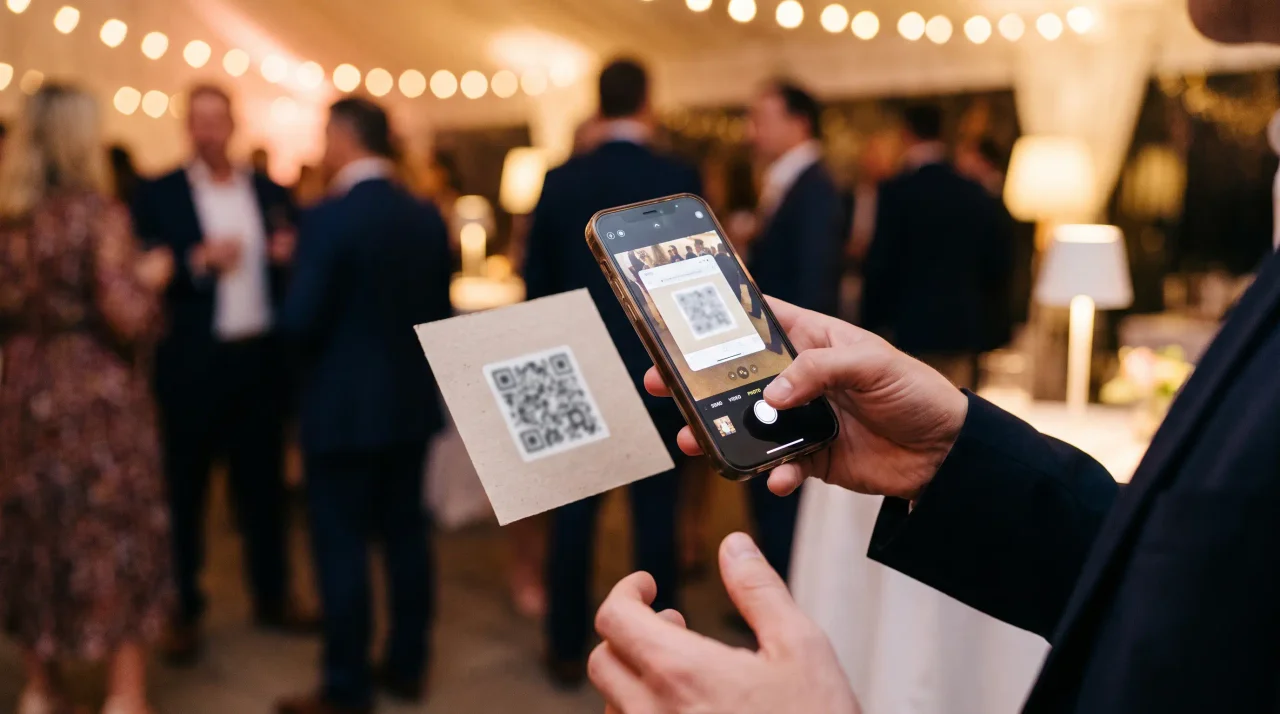
Photos and messages you upload will be collected by [host name] for this event album. The album is private, hosted in the EU, and available to invited guests. If you want a photo of you removed, contact [email/phone].
For a corporate event, add the company name and link to the full privacy notice. For a wedding or private party, the contact can be the host. For children's events, mention that parents can request removal for their child. The point is that the guest understands the basic exchange before uploading: who collects the media, why, where it lives, and how to object.
Identify your role as data controller
As the person running the event and deciding what photos to collect, you are the data controller. The photo platform is your processor. Your obligations under GDPR are those of a controller: lawful basis under Art. 6 and transparency under Art. 13.
Choose a legal basis and communicate it
For private personal events the GDPR household exemption applies and no formal compliance steps are required. For business events, identify a lawful basis (legitimate interest or consent) and include a transparency notice in the invitation.
Select a platform with EU hosting and a DPA for business events
For business events, confirm your platform stores data in the EU and provides an Art. 28 DPA. Gathmo uses Frankfurt-based EU storage and provides DPAs on paid plans. US-hosted platforms require SCC compliance steps for EU personal data.
Set and enforce a retention limit
Decide how long the album will stay live and delete it when that period ends. On Gathmo, the free tier closes automatically after 30 days; paid tiers require manual deletion from the dashboard. Log the deletion date for your records.
Frequently asked
Not always. For ordinary private event albums, legitimate interest or the household exemption may be enough depending on the situation. Consent becomes more important when photos are published publicly, children are central, the event is commercial, or biometric processing such as face recognition is used.
Usually, yes. A purpose-built album gives the host one place to manage access, retention, deletion, and downloads. A WhatsApp group spreads copies across many phones and makes removal harder. That does not automatically solve every GDPR question, but it gives you a clearer control point.
No. EU hosting helps because it avoids the international-transfer question, but GDPR compliance also depends on notice, lawful basis, retention, deletion, security, and vendor contracts. Think of EU hosting as a strong default, not a complete compliance program.
Ask where data is hosted, whether they provide a DPA, how long albums are retained, how deletion requests work, whether sub-processors are listed, and whether face recognition or AI moderation is used. A serious B2B vendor should answer these without improvising.
Legitimate interest (Art. 6(1)(f)) is the most commonly used basis for corporate event photography where photos are shared only with participants or used for internal communications attendees would reasonably expect. The key test is balancing: the host's interest in documenting the event versus the reasonable expectations of attendees and the risk of harm. For employees at a company event, legitimate interest is generally defensible. For public conferences, legitimate interest covers documentation and internal use but not unrestricted publication. Add a brief notification — a line on the event programme or registration confirmation — to make the basis transparent.
A brief notice at registration or on entry is the practical standard: Photos and recordings may be taken at this event for [internal communications / event documentation / company social media]. To opt out or request deletion, contact [email]. Keep it one to two sentences — this is notice under Art. 13, not a full privacy policy. For corporate events, add it to the invitation or event registration page. For in-person events, a sign at the entrance is accepted practice. Attendees who know photos will be taken can choose to opt out, which satisfies the GDPR's transparency principle without requiring explicit consent for every shot.
Under GDPR, the standard legal basis for event photography is legitimate interests (Art. 6(1)(f)) rather than consent, when three conditions are met: the photos are for a clear and proportionate purpose (documenting the event, internal communications); guests are informed (a line in the programme or on signage stating photos will be collected satisfies Art. 13 transparency); and photos are not used for advertising without a separate notice. Consent is harder to manage in practice — it must be as easy to withdraw as to give, meaning withdrawal requires deleting that individual's photos. Legitimate interests is the more workable basis for most events. Check with your DPA if you have specific or complex situations.
 Guide
GuideHow to Collect Photos from Event Guests Without an App (Step-by-Step Guide)
Here's the moment every host knows: the event was perfect, everyone had their phones out — and a week later you're chasing fifteen group chats trying to gather the photos. The...
 Guide
GuideWhite-Label Event Photo Sharing: What Agencies Should Look for in 2026
If you run events for clients — as a planner, venue, production agency, or photographer — you've probably noticed the gap. Your clients want every guest photo, video, and voice...
 Story
StoryWhy EU Data Residency Matters for Your Event Album
When you collect photos, videos, and voice messages from guests, you're collecting personal data about real people — your friends, your colleagues, your family. Most event...