GuestCam vs Gathmo: which guest photo and voice app wins in 2026?




The verdict
Both are good; they aim at different buyers. Choose GuestCam if you want a simple, established, pay-once tool with one flat price whatever the event, you like its AI face-search, and an audio-only guestbook plus US-based hosting is no obstacle for you. Choose Gathmo if EU hosting and fuller GDPR documentation matter, if you want recorded video messages (not just voice) collected alongside the photos, if Surprise Mode or a multi-mode live wall appeals, or if you would rather try a free tier before paying. Either way you keep full-resolution originals of the night -- just pick the trade-offs that fit your event.
| Feature | Gathmo | GuestCam |
|---|---|---|
| Core idea | Whole-event capture + voice & video guestbook + live wall | No-app QR album + audio guestbook |
| No app / no signup (guests & host) | ●yes | ●yes |
| Guest photos & video | ●full-resolution | ●full-resolution |
| Voice guestbook | ●browser, every plan | ●browser + tablet "PhoneBooth" |
| Video guestbook messages | ●yes | –audio only |
| Dial-in phone voicemail | Not needed -- browser-native, worldwide | Premium / +$30 add-on, US & Canada only |
| Live display | ●live wall, multiple modes | ●live slideshow |
| Surprise Mode | ●yes | –none |
| AI face-search | Browse by album | ●MagicFind (+$45) |
| Hosting / privacy | EU-hosted (Frankfurt), GDPR-native, DPA on request | US-based cloud; no published GDPR / DPA |
| Free tier | ●set up & test free | –no free tier |
| Pricing | Free + EUR 29 / 69 / 89 per event | USD 49 / 97 one-off |
| Storage window | Up to 1 year (Grand) | 12–14 months |
Choose Gathmo if…
- EU hosting, GDPR and a Data Processing Agreement matter for your wedding, planner or client
- You want recorded video messages, not only audio, collected with the photos
- Surprise Mode or a multi-mode live wall appeals to you
- You would rather try a free tier before you pay anything
- You run varied events -- weddings, birthdays, corporate, parties -- not just one
Choose GuestCam if…
- You want a simple, established tool with one flat pay-once price for any event
- GuestCam’s MagicFind AI face-search is a feature you will actually use
- An audio-only guestbook is all you need -- no video messages
- US-based hosting is not a concern for your guests
- A single long upload window matters more to you than a free tier
Disclosure first, because you have earned it: I work on Gathmo, one of the two products here. So this is not a neutral review site. GuestCam is a genuinely strong, established tool -- it claims more than 15 million captured memories and a 4.9 rating across 190-plus reviews -- and the fastest way to lose your trust would be to pretend otherwise. The goal is narrower than selling you mine: help you pick the one that fits your event.
Start with what is actually the same, because a lot of it is. Both are no-app QR collectors: guests scan a code, their browser opens, they upload -- no download, no signup -- and you, the host, run everything from a web dashboard with no app either. Both take unlimited guests, photos and video, hand back full-resolution originals in a one-click ZIP, show a live slideshow or wall during the event, let you moderate uploads before they appear, and -- importantly -- both offer a voice guestbook. So "no app" is not the thing that separates them. Set it aside.
The first real fork is where your guests' photos and voices actually live. GuestCam states on its own security page that data is hosted with US-based cloud storage, and it publishes no GDPR statement, no EU data-residency guarantee and no data-processing agreement -- it points EU questions to email support. Gathmo is EU-hosted (Frankfurt, on AWS eu-central-1), GDPR-native, with consent capture and a Data Processing Agreement available on request. For a private wedding among friends, either is fine in practice. The more guests, and the more a professional planner or a corporate client is involved, the more that paperwork matters -- and that is the cleanest difference between the two. See our GDPR guide for EU event media.
The second fork is what "guestbook" means. GuestCam's is audio only: a browser voicemail on every plan, a "PhoneBooth" mode where guests tap a message into your own tablet (the retro handset in the photos is a decorative prop, not a working phone), and a real dial-in phone number that is Premium-only or a paid add-on and -- this is the catch -- available in the US and Canada only. Gathmo captures both voice and video guestbook messages in the same flow, entirely in the browser, with no geographic limit, and adds automatic transcription on the top tier. If a recorded video message from the people who could not travel matters to you, that is a real gap.
After that it is a trade of extras. GuestCam has MagicFind, an AI face-search add-on that is genuinely useful for big galleries. Gathmo answers with Surprise Mode for collecting messages before a surprise event, and a live wall with multiple display modes. Neither is strictly better; they are different bets. On money, both are pay-per-event with no subscription -- GuestCam has no free tier and charges 49 USD (Standard) or 97 USD (Premium) one-off, while Gathmo has a free tier to set up and test, then 29, 69 or 89 EUR per event, where you only pay up for what you need (the live wall from 69 EUR, transcription and a custom domain at 89 EUR). See how Gathmo works and what each plan includes.
Frequently asked
No. Like Gathmo, GuestCam guests upload in their phone browser by scanning a QR code or opening a link -- no app and no signup -- and hosts manage the album from a web dashboard. App-free is not the difference between the two tools; both are. The real differences are hosting, the video guestbook, Surprise Mode and pricing.
GuestCam states on its own security page that data is hosted with US-based cloud storage, and it publishes no GDPR statement, EU data-residency guarantee or Data Processing Agreement, directing EU questions to email support. That does not make it unusable in Europe, but the host carries the compliance burden. Gathmo is EU-hosted in Frankfurt, GDPR-native, and offers a GDPR Art. 28 DPA on request -- which is why EU couples and professional planners tend to prefer it.
No -- GuestCam's guestbook is audio only. It offers in-browser voicemail on all plans, a tablet “PhoneBooth” mode (the retro handset shown is a decorative prop, not a working phone), and a dial-in phone number that is Premium-only or a paid add-on and limited to the US and Canada. Gathmo collects both voice and video messages in the same browser flow, worldwide, with transcription on the top tier.
They are shaped differently. GuestCam has no free tier and charges a one-off 49 USD (Standard) or 97 USD (Premium), plus add-ons like MagicFind face-search (45 USD) and the dial-in number (30 USD). Gathmo has a free tier to set up and test, then per-event plans at 29, 69 and 89 EUR, where the live wall starts at 69 EUR and transcription, live streaming and a custom domain come with the 89 EUR tier. Both are pay-per-event with no subscription -- the cheaper option depends on which features you actually need.
For EU events, Gathmo is the natural alternative: EU-hosted, GDPR-native with a DPA, plus a video guestbook and Surprise Mode that GuestCam does not offer. If you only need cheap, pay-once photo collection without recorded messages, knipsmig is another EU option worth comparing. Check current features and pricing on each site before you decide.
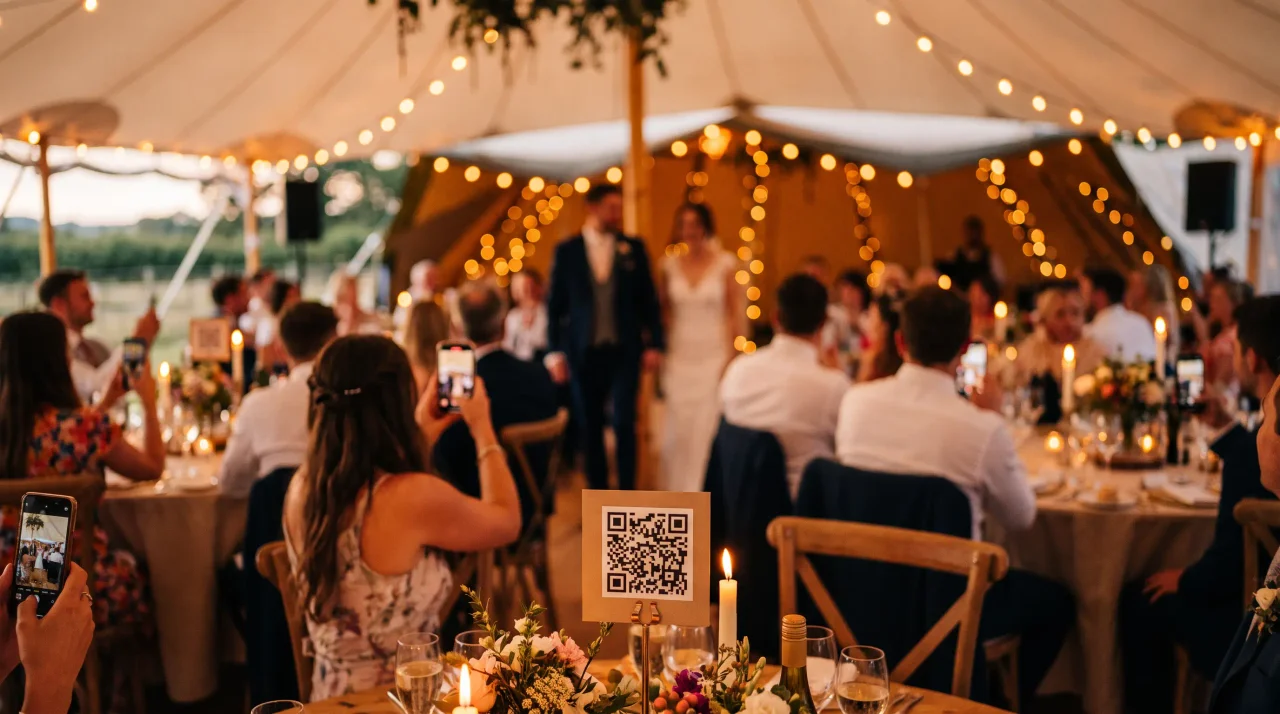 Guide
GuideHow to collect guest photos at your wedding: the complete 2026 guide
Six ways to collect your wedding guests' photos -- ranked honestly -- plus the QR setup, sign placement and timing that actually get the most uploads. The complete 2026 guide.
 Comparison
voxu.fm vs Gathmo: which QR wedding guestbook is right for you?
voxu.fm is a focused QR wedding guestbook; Gathmo captures the whole event -- photos, video, voices and a live wall -- from one code. An honest head-to-head, including where voxu wins.
 Comparison
knipsmig alternative: Gathmo vs knipsmig, compared honestly
knipsmig is a clean, well-priced QR photo and video collector. Gathmo adds an audio and video guestbook, a live wall and named EU hosting. An honest side-by-side.