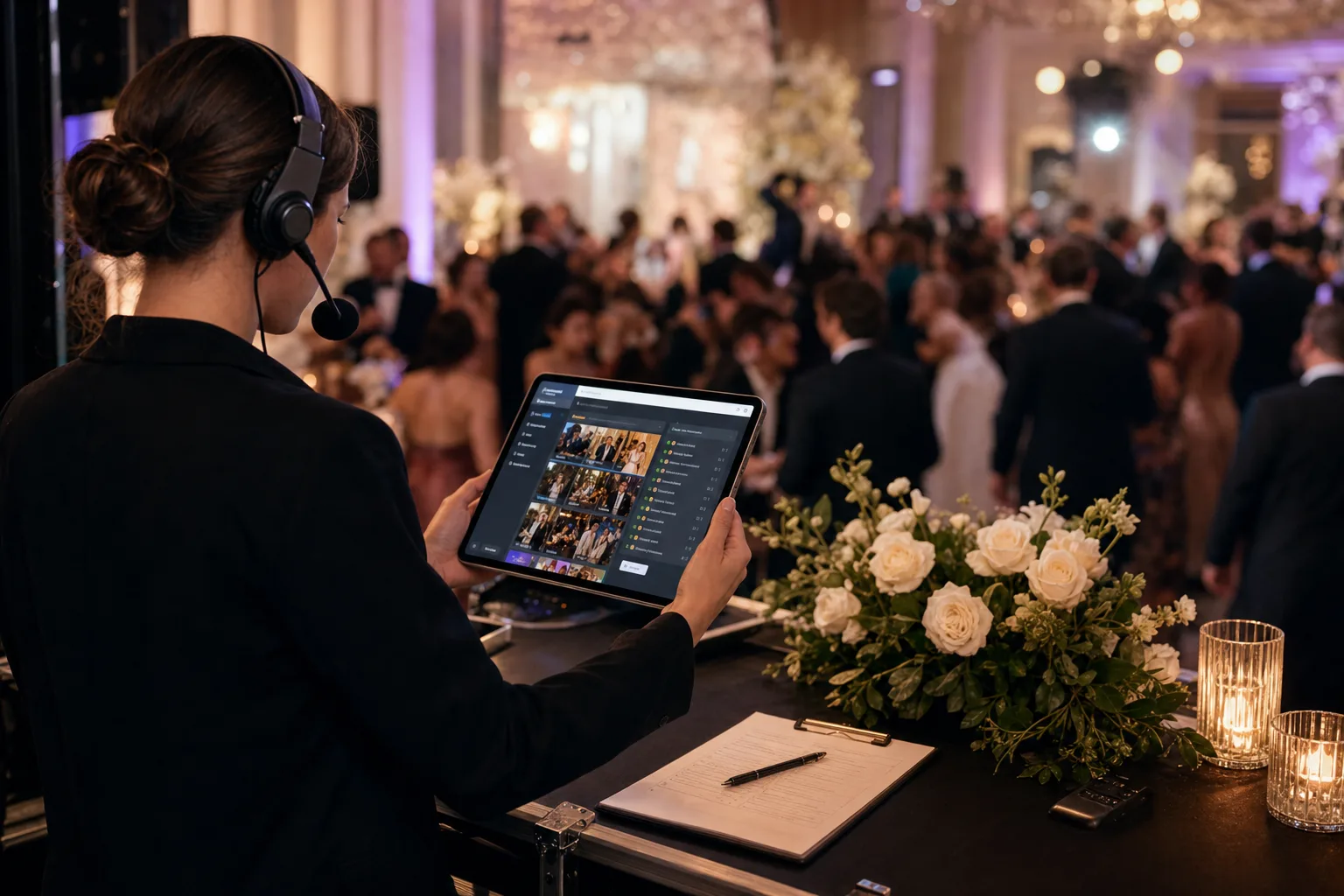

The business case is not that photos are nice: it is that ad-hoc sharing produces assets nobody can find, license or reuse, while structured collection produces a searchable library for internal comms, recruiting and the intranet at a per-event cost you can put in a budget line. Settle the compliance question first — without it there is no case at all.
- Ad-hoc sharing produces photos nobody can find or reuse. That is the cost being paid today, invisibly.the hidden cost
- Structured collection gives internal comms and recruiting a library instead of a search through chat threads.a library
- The cost is per event and predictable, which is what makes it a budget line rather than a favour.per event
- The compliance gate comes first: without a lawful basis and a processor agreement there is no business case.gate first
Every internal event your organisation runs — the summer offsite, the all-hands, the holiday party — produces a quiet asset that almost always goes to waste: hundreds of photos, scattered across employees' camera rolls, that nobody ever collects and nobody ever sees again. That is not a sentimental observation; it is a budgeting one. You signed off a real number for the event — venue, catering, AV, speakers, travel, your team's hours. The experience lasted an afternoon. The content it produced — the stuff that fills three newsletters and a careers page and keeps the culture warm for weeks — is sitting on forty phones, invisible, slowly buried under screenshots.
For HR and internal-communications leads, structured employee event photo sharing is one of the lowest-cost, highest-leverage moves available. It does not need a bigger event budget — just a way to capture what the event already produced, put it somewhere central, and use it. This article makes the business case you can take to a finance-minded stakeholder for treating event photos as an asset to manage rather than an afterthought to lose. It also covers the part every EU organisation has to get right, because the compliance gate is real and it comes before the ROI.
A note on scope: this is a business-case and planning guide, not legal advice. Where we touch on data protection we cite the regulation; for anything binding on your organisation, run it past your own data protection officer or counsel.
- Popsa reports that 7 in 10 photos taken are never looked at again.
- Disclosure: the author builds Gathmo, named in this article as the shared guest album.
Why ad-hoc photo sharing quietly fails
Most organisations already have a "photo-sharing process." It just isn't one — usually a WhatsApp group, a few people emailing favourites to the comms inbox, and a vague promise that someone will "put them somewhere." It reliably under-delivers, and the failure is structural, not a matter of effort:
- The photos are never collected. The default outcome for a camera-roll photo is oblivion: around 70% of camera-phone photos are never revisited (Popsa, The Memory Economy, 2025). A photo an employee took and never sent has, for the organisation, effectively never existed.
- Group chats work against you. The instinctive fix runs into a documented problem — News.com.au reports on group-chat anxiety and notification fatigue. A channel that exhausts people doesn't collect contributions; photos there vanish up the scroll, get compressed, and live scattered across a dozen phones with no central copy.
- Nobody owns the output. Ad-hoc sharing produces no single, complete, downloadable set — just whatever a few enthusiastic colleagues happened to send, not something you could hand a designer for the recruitment deck. (For scale, roughly 1.9 trillion photos were taken worldwide in 2024 (PetaPixel photo-volume estimate summary, 2025); your event made its own small share, and almost all of it drains away.)
The net effect: you paid for the event twice — once in budget, once in the unrealised value of what it produced — and recovered almost none of the second.
What "structured" photo sharing actually means
The alternative is not a bigger production — it's three things: one place to collect (a single gallery every attendee contributes to directly, ideally by scanning one QR code on their phone, with no app and no account, because lower friction means a higher contribution rate); one owner with control (a host in HR or comms who reviews, approves, and exports the complete set, so the organisation owns the asset rather than forty individuals); and one compliant boundary (a defined legal basis, a notice at the point of upload, a retention period, and a deletion route, so the asset is one you can actually use).
A tool like Gathmo delivers exactly these: guests scan a QR code and upload photos, video, and voice messages in the browser with no app and no signup; the host reviews and approves; the full album exports as one download. We'll return to the compliance boundary — first, the return.
The ROI of employee event photo sharing
"ROI on event photos" can sound soft. It isn't, once you separate it into four distinct returns a finance-minded stakeholder recognises.
1. You recover an event you already paid for
The event's cost is already sunk. Structured photo sharing adds a marginal cost measured in tens of euros and a few minutes of setup, and in exchange it turns a one-afternoon experience into a durable content asset that keeps working for weeks. The comparison isn't "cost of the tool versus zero" — it's "cost of the tool versus the value of an event whose entire output would otherwise be lost." Against a four- or five-figure spend, the line item is a rounding error that protects the rest of the budget's return.
2. You feed internal comms a pipeline of authentic content
Internal comms runs on content, and the most credible content is the kind employees relate to: real colleagues and real moments, not stock imagery. A post-event album is a ready-made supply — one offsite can feed the next newsletter, the intranet homepage, the Monday recap, the year-in-review, and the "life here" section of the careers site. Authentic event photos get reused across channels in a way a hired photographer's twenty polished frames rarely do: there are more of them, they cover more people, and they feel like the company rather than a brochure.
3. You make people feel seen — the point of the event
Internal events exist to build connection and culture; the photos extend that goal rather than being a by-product of it. When an employee sees themselves and their team in a shared album, the event's emotional half-life lengthens and the connection built in the room gets a second life on screen.
Be honest about the evidence, though. The link between engagement and business performance is heavily studied: Gallup's Q12 meta-analysis — drawn from 736 studies across 347 organisations, covering 183,806 business units and more than 3.3 million employees — found top-quartile-engagement units outperform the bottom quartile by 23% in profitability, 18% in productivity (sales), and 14% in productivity (production records and evaluations) (Gallup, Q12 Meta-Analysis, 11th edition, 2024). What's not established by any credible study is a direct causal line from "we shared the photos" to a profitability number. So make the honest claim: internal events are a lever for engagement, and structured photo sharing extends each event's reach — it strengthens an investment you're already making, it doesn't manufacture a profit figure on its own.
4. You get a participation signal you can measure
Because every contribution to a central gallery is logged, you can see what share of attendees actively uploaded something — a clean, real-time proxy for how involved the room was, captured during the event rather than reconstructed from a survey two weeks later. That single figure turns a soft "it went well" into a number you can report and compare across events. We cover the methodology in a companion guide, how to measure guest engagement at a corporate event.
A simple ROI framework you can actually use
You don't need a complicated model — just a back-of-the-envelope calculation a budget holder will accept:
- Anchor the cost you're protecting — the all-in cost of the event (venue, catering, AV, travel, speaker fees, internal hours). This is the return you're preserving.
- Estimate the asset created versus captured — how many photos and videos attendees realistically took (at a well-attended event, hundreds) versus how many actually reach a central, usable place under your current process (honestly, often "a handful"). The gap is the value leaking away.
- Value one comms placement — what one piece of authentic, ready-to-use content is worth to your comms function — and multiply by the placements a single album feeds (newsletter, intranet, recap, careers page, year-in-review). Even at a conservative value, the total clears the cost of the tool comfortably.
- Subtract the marginal cost. For a single internal event, Gathmo's per-event tiers run Free / €29 / €69 / €89 by guest count and features, with the €69 Celebrate tier sized for a typical company party or offsite (unlimited guests). For organisations running events year-round, B2B subscriptions start at €79/month equivalent (Studio). Put either next to the four- or five-figure event it protects, and the framework answers itself.
The point isn't false precision. It's to move the conversation from "nice to have" to "here's the asset we're losing, here's what recovering it costs, here's what it returns" — a conversation procurement-minded stakeholders say yes to.
Want the worksheet, not just the framework? We've packaged this as a one-page Corporate Event Engagement ROI Guide with a fill-in worksheet — event cost, attendee count, photos captured (baseline vs structured), and the value of one comms placement. Book a demo to get it alongside a look at your branded gallery.
The compliance gate comes first
This is the part that separates a defensible business case from a liability: you're photographing employees, which brings the GDPR squarely into play, and the ROI argument is worthless if the activity isn't compliant. The obligations are well-defined and manageable, but not optional, and they come before the return. What every HR or comms lead should know, cited to the regulation:
- Ordinary event photos are generally not "special category" data. A photograph becomes biometric (special-category) data only when "processed through a specific technical means allowing the unique identification or authentication of a natural person" — i.e. facial recognition (GDPR Recital 51; Art. 9). Collecting and displaying photos doesn't cross that line, which is why a platform that doesn't do face-matching keeps you on the simpler side of the rules. (For the record, Gathmo does not offer face recognition — it is not a launch feature.)
- You need a lawful basis, and consent needs care at work. Processing must rest on a GDPR Art. 6 basis. Under German law, employee data may be processed for employment-related purposes where necessary (BDSG § 26(1)) — but that's often a poor fit for what are essentially morale and marketing photos, so freely-given, documented consent (with a genuine right to refuse without disadvantage) is typically the appropriate route. It must be a deliberate choice, not an assumption.
- Employees must be told, at the point it happens. Where you collect data directly, you must give a clear information notice at the time of collection — controller identity, purpose, legal basis (GDPR Art. 13(1)) — meaning a visible privacy notice at the moment of upload, not buried in a policy nobody reads. A tool that captures consent and surfaces a notice on upload does this for you.
- You need a retention period and a deletion route. Data must be kept no longer than necessary (Art. 5(1)(e)), and an employee can request erasure, which you must action without undue delay and within one month, extendable by two further months where genuinely complex (Art. 17(1); Art. 12(3)). "We keep the photos forever on a shared drive" is not a compliant plan.
- Where the data lives matters for procurement. If your IT or legal team gates vendors on data residency, not all event-photo tools host in the EU: several consumer-grade tools are explicitly US-hosted — GuestCam and Fotify (Lumenlio, LLC, Delaware) state US data hosting (as of June 2026) — and others don't disclose where data sits at all. Gathmo hosts event data in the EU (Frankfurt) with processor DPAs in place, and a DPA is available to corporate customers on request — the artefact procurement asks for under GDPR Art. 28(3).
None of this is a reason to avoid collecting event photos; it's the reason to use a purpose-built, EU-resident tool with consent capture, defined retention, and a DPA rather than a WhatsApp group and a shared drive, which give you none of those protections and all of the risk. Cleared properly, the compliance gate is itself part of the business case — the difference between an asset you can publish and a problem you can be fined for. For the full treatment, see GDPR and Employee Event Photos: What HR Needs to Know.
What it looks like in practice (an illustrative example)
To make the framework concrete — and to be clear, this is an illustrative scenario, not a named case study — picture a 150-person summer offsite. The comms lead sets up one branded event gallery the week before and prints a QR code for each lanyard plus a couple of A-frame signs (print tip: a lanyard QR code should be at least 2 × 2 cm, 2.5 × 2.5 cm recommended for arm's-length scanning, and always test-print a proof before the full run). A short privacy notice appears the moment an employee opens the upload page.
Through the afternoon, attendees scan and upload from their own phones; the lead approves submissions before anything goes wider; afterward the full album exports as one download, feeding a Monday recap, an intranet gallery, careers-page images, and a year-in-review clip — and a participation figure (the share of the 150 who contributed) answers the "did it land?" question. Marginal cost: one event on a per-event plan. Return: a recovered asset, a content pipeline, a culture moment with a second life, and a number — from an event already paid for in full.