How to Run a Live Photo Wall at a Conference or Trade Show

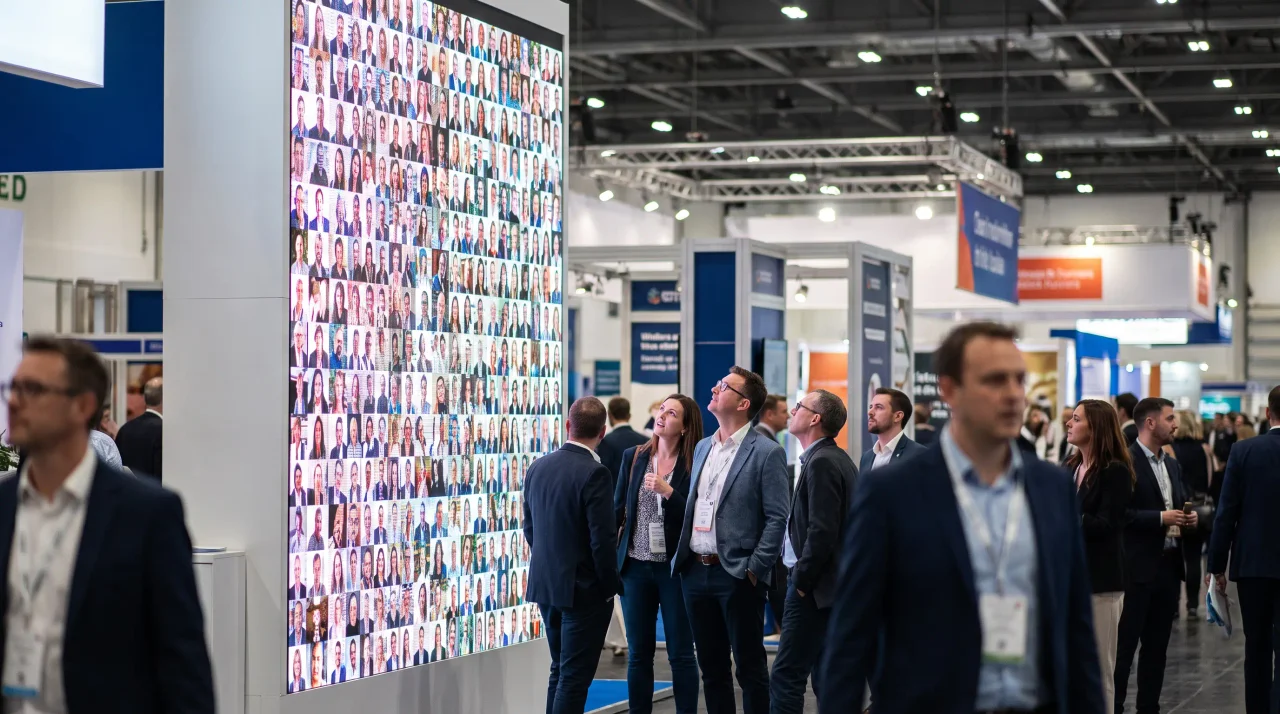
A live photo wall at a conference needs four things and about half an hour: a screen that can open a web page full-screen, stable internet, a QR code sized for the room, and a moderation decision made before doors open. On a B2B stand the moderation decision is the one that matters — an unreviewed wall in front of clients is the risk procurement will raise.
- A screen that opens a web page full-screen, and internet you have actually tested on the stand.screen + wifi
- Size the code for the room: the 10:1 rule means a code read from 2.5 metres needs about 25 cm.10:1
- Decide moderation before doors open. On a stand in front of clients, hold-for-approval is the default.approve first
- The slideshow starts at Celebrate; a true live stream is on Grand.from €69
A live photo wall is one of the cheapest pieces of stagecraft you can add to a conference or trade show — and one of the few that asks the audience to participate rather than just watch. Attendees scan a QR code, upload from their own phones, and their shots appear on the screen above the stage or at the booth within seconds. The room sees itself, sponsors see their banner in the background of dozens of candid photos, and your comms team walks away with an organised, downloadable archive instead of chasing colleagues for "that one good shot of the keynote."
The catch, for a corporate event, is that a photo wall is also a live feed of identifiable people projected on a large screen in a professional setting. That raises questions a party planner never has to ask: Who controls this data? Where is it hosted? Can I stop an off-brand image before it hits the screen? Will procurement and legal sign off before I put the tool on every badge lanyard? This guide answers both halves — the practical setup and the procurement-grade controls that make a live wall safe to run at a conference, trade show, or multi-day exhibition in the EU. It is written for event managers, marketing teams, and the agencies that run these events for clients. If you only need the branded gallery itself, setting one up for a trade show in under 30 minutes is the short version.
- Disclosure: the author builds Gathmo, named in this article as the shared guest album.
What is a live photo wall (and how does it differ from a slideshow)?
A live photo wall is a screen at your event that fills with attendee photos as they are uploaded, in near-real time. Guests scan a QR code, upload from their phones, and within seconds their image rotates onto the display. No cables, no AirDrop, no "email it to me later."
A few terms get used interchangeably, and the difference matters when you are specifying a tool:
- Live slideshow — uploaded photos rotate on the screen on a refreshing loop. This is the standard "photo wall" most events run, and for a single keynote room or a booth it is usually all you need.
- Live stream / broadcast wall — the gallery is broadcast as a live feed, so attendees who are not in the room — on a second stage, in an overflow space, or spread across a large exhibition hall — can watch the same feed on their own screens. This is the version for multi-room and large-floor events.
- Photo mosaic wall — uploads tile together into one large composite image or grid. Same upload mechanic, different display style, often used for a sponsor logo reveal.
With Gathmo, the live slideshow is included on the Celebrate tier (€69 per event) and up, and a true live stream broadcast is available on the Grand tier (€89 per event); the Free and Essential tiers collect to an album rather than driving a live wall. For agencies running this across many client events, the same live capability sits inside the B2B subscription tiers (Studio €79/mo, Agency €199/mo, Enterprise from €699/mo). (Gathmo tier facts: Gathmo pricing.)
One honest note on the market: a live broadcast feed is rarer than it sounds. Plenty of tools offer a live slideshow; a genuine live-stream broadcast — where remote attendees watch the same feed in real time — is not something the mainstream competitors offer as of June 2026. If your event spans multiple rooms or a large floor, that distinction is the whole decision.
Why run a live photo wall at a B2B event at all?
Because attention is the product you are buying, and a wall converts passive attendees into contributors. It earns its place three ways: engagement (a screen of the audience's own photos gives people a reason to look up, scan, and stay — and at a booth, pulls foot traffic without a hard pitch); sponsor and brand value (every shot near a branded backdrop puts a logo in front of the room, and you can hand sponsors a downloadable set afterwards as proof of presence); and a real content archive (one organised, downloadable album for the recap, next year's sales deck, and the newsletter, instead of reconstructing the event from scattered phones weeks later). The underlying problem it solves is measurable: around 70% of camera-phone photos are never revisited).
One caution: be wary of any vendor or blog quoting a single magic "participation rate." Real numbers depend on your audience and signage. Treat the wall as a tool that makes participation easy and visible, and measure your own rate rather than trusting an invented benchmark.
What you need to set up a live photo wall at a conference
The hardware is almost certainly already in the room:
- A screen or projector — the main-stage LED wall, a booth monitor, or a breakout-room projector. Anything that can display a full-screen browser, or connect to a device that can.
- A device to drive the wall — a laptop, tablet, streaming stick, or a venue display's built-in browser, opening the display link full-screen. For a multi-day event, use a device that can stay on and plugged in, not someone's personal laptop they need back at lunch.
- A stable internet connection — wired Ethernet for the display device wherever the venue offers it, since convention-centre Wi-Fi is notoriously contended. Attendees upload over their own mobile data or the event Wi-Fi.
- QR codes, sized for where they go. This is where most corporate setups quietly fail — the code is too small for the distance. More on sizing below.
- A moderation plan — at a public-facing B2B event you do not let unreviewed images hit a stage screen. Decide in advance: pre-screen everything, or rely on AI plus a host queue.
That is the entire rig. The skill is not technical; it is placement and control. The sequence runs: apply your brand first (upload your logo, set your accent colour, and — where the plan supports it — connect a custom domain so the upload page and gallery read as your event, not the vendor's), open the live display link full-screen on your screen device, place your QR codes, turn on moderation, announce the wall from the stage, and export the full album afterwards. With Gathmo, custom domains are available on the Grand tier and across the B2B subscription tiers; end-to-end white-label — your brand on everything guests see — is an Agency-and-above capability. (Gathmo pricing.)
Where to put the QR code (and how big it needs to be)
A live wall lives or dies on whether people can scan the code from where they are standing. The governing rule is the 10:1 distance-to-size ratio: the minimum size of the QR code is roughly the maximum scan distance divided by ten. A code read from 2 metres needs to be about 20 cm; from 5 metres, about 50 cm. (QR sizing facts: Uniqode QR size guide.)
For the placements a conference or trade show actually uses:
- Badge lanyards and business-card inserts — at least 2 x 2 cm, ideally 2.5 x 2.5 cm, for a comfortable arm's-length scan (~20–30 cm).
- Table cards / table tents in a seated session — about 3–5 cm, for a seated scan at ~30–50 cm.
- A-frame and standing posters in the foyer or by the booth — about 10–25 cm, for viewing at ~1–2.5 m.
- Stage-flanking banners and large-format signage — an 8–12 inch (~20–30 cm) code for an audience 8–10 feet back; bigger if the seats are further. Do not put the only code on the main screen mid-slideshow — give people a static, always-visible code they can scan whenever they look up.
Three rules prevent the most common failures. Keep the quiet zone clear — codes need a blank margin of at least four modules on all sides, and a busy branded banner needs more. Use a dark code on a light background; avoid inverted (light-on-dark) codes, which many scanners struggle with — a real risk on a dark-themed stage banner. And use error-correction Level H if you overlay a logo, then test-print at the final size and scan it under the actual venue lighting before a full run — a code that scans on your monitor can fail on glossy stock or under stage lights. Use a dynamic QR code for event signage so the destination can be managed and the same printed code reused across a multi-day or recurring event. (QR specs: Uniqode QR size guide.)
Keeping the wall on-brand: moderation and approval
This is the difference between a consumer party tool and something you can put on a stage. On a public-facing screen with your logo and your sponsors' logos in frame, you cannot afford an unreviewed image going live. Two layers do the work:
- Automated pre-screening. AI moderation flags inappropriate or off-brand content before a human sees it. Gathmo runs visual moderation (Hive) plus automated transcription review for audio. (Gathmo pricing.)
- A host approval queue. Nothing reaches the screen until your team approves it. For a keynote stage, run the wall in approval-required mode; for a lower-stakes booth, let approved uploads through automatically with AI screening as the backstop.
Worth knowing when you compare tools: moderation is not universal here. Several competitors offer no content moderation at all as of June 2026 — fine for a private party, a genuine liability on a corporate stage. If the wall carries your brand, treat a real moderation queue as a hard requirement.
The part procurement cares about: data control and GDPR
A live photo wall is, in data-protection terms, the live collection and display of images of identifiable people. The moment your organisation collects, stores, or projects photos of identifiable attendees or employees, the GDPR applies — and "it was just the trade-show booth" is not a defence your data protection officer will accept. Here is what to have in order, and what to demand from any vendor.
Not legal advice. This section explains the relevant GDPR provisions for general guidance and cites the regulation directly so you can verify each point. It is not a substitute for advice from your own data protection officer or counsel.
Show a clear information notice at the point of upload. Where personal data are collected directly from people, the controller must, at that time, provide defined information — who the controller is, the purposes and legal basis, and (where you rely on legitimate interest) the specific interests pursued (GDPR Art. 13(1)). For a live wall, that means a visible privacy notice on the upload page, not a policy nobody reads.
Know your lawful basis. Processing event photos needs an Article 6 basis. For ordinary, non-special-category images a controller can often rely on legitimate interest (Art. 6(1)(f)) after a documented balancing test, but consent (Art. 6(1)(a)) is the safer basis and is required where that balance fails (GDPR Art. 6). One caveat for internal events: where attendees are your own employees, regulators doubt consent is ever truly "freely given" given the dependence in the relationship — Germany's BDSG § 26 addresses employee data directly, and outward-facing or promotional photos usually call for explicit, opt-in consent with a genuine right to refuse without disadvantage. (GDPR official text.)
Avoid turning the wall into biometric processing. Ordinary photos are not special-category data — Recital 51 confirms images become biometric data only "when processed through a specific technical means allowing the unique identification or authentication of a natural person." A plain photo wall that displays and stores images stays out of Article 9. But a tool that runs facial recognition to group or "find" attendees by face processes biometric data for unique identification, which Article 9(1) prohibits without a specific ground such as separate, explicit consent. Several competitors lead with face-recognition photo-finding; useful at a wedding, it converts your corporate collection into Article 9 processing. Gathmo does not offer facial recognition at launch (a Phase 2 roadmap item, not a live feature), which here is a feature, not a gap — it keeps your wall out of biometric territory by default. (Gathmo pricing; GDPR official text.)
Get a Data Processing Agreement, and check where the data lives. When a SaaS processes personal data on your behalf, that relationship must be governed by a written DPA setting out the subject-matter, duration, nature and purpose of processing, and the processor's obligations (GDPR Art. 28(3)). Ask for it before you sign. And check data residency: keeping data in the EU avoids third-country transfer mechanics (SCCs, transfer-impact assessments) entirely. Gathmo offers a DPA on request and hosts in the EU (Frankfurt) with processor DPAs; on the B2B tiers a DPA is included. (Gathmo pricing.) Among competitors, EU data residency is the exception, not the rule — several US-based tools host outside the EU, and for others it is not clearly confirmed. If your attendees include employees or anyone who would rather their image not sit on a non-EU server, that distinction is the decision.
Set a retention period and honour deletion requests. The GDPR requires data minimisation and storage limitation — personal data kept only as long as necessary (Art. 5(1)(c) and (e)) — and any attendee can request erasure of their image, which you must action without undue delay and within one month, extendable to three (Arts. 17 and 12(3)). In practice that means defined, automatic retention windows and a clean deletion workflow, so a "please remove my photo" email is a two-click action, not a manual hunt. Gathmo applies tier-based retention windows and supports deletion on request. (GDPR official text; Gathmo pricing.)
Running a live wall for clients: the agency angle
If you run events for clients rather than for your own company, the live wall is something you can resell under your own brand. The requirement is end-to-end white-label: a custom domain per client, your branding on the upload page and gallery, and the platform invisible as the underlying vendor. With Gathmo, that is the Agency tier (€199/mo, end-to-end white-label, unlimited custom domains) and Enterprise (from €699/mo, full white-label plus SSO and API); the Studio tier (€79/mo) covers logo-and-accent branding for smaller operations. (Gathmo pricing.)
This is genuinely rare. A true full-reseller white-label — where the gallery is yours, not the vendor's — is offered by only a handful of providers as of June 2026, and those are generally not EU-hosted. An EU-resident, DPA-backed, fully white-label live wall is the combination that lets an agency offer the feature to GDPR-sensitive corporate clients without exposing the tooling underneath. See Gathmo for agencies for how the multi-client setup works.
Set up the event and live wall URL before the show opens
Create a Gathmo Celebrate or Grand event and copy the live photo wall display URL from the dashboard. Open this URL full-screen on the device connected to the venue display before delegates arrive.
Configure moderation settings
Enable host-approval moderation so uploads appear on the wall only after your review. At a corporate event this prevents inadvertent content from reaching the public display. Approved photos appear within seconds of your tap.
Display the QR code prominently at the venue
Place large QR signs (15-20 cm) at each entrance and on presenter slides. Include the album link in the event app or printed programme. A brief MC mention during the opening session is the highest-leverage driver of participation.
Prompt attendees with a specific capture brief
Tell attendees what to photograph: scan to add a photo of your networking moment, your session, or the product you are most excited about. A purpose-driven prompt produces more varied content than a generic add-your-photos instruction.
Frequently asked
The right tool for a B2B event combines a live wall with what a party app skips: a moderation queue (so nothing off-brand hits the stage screen), EU data residency with a DPA available (GDPR Art. 28, so procurement and legal sign off), a clear information notice at upload (Art. 13), defined retention with a deletion workflow (Arts. 5, 17), no facial recognition by default (which keeps you out of Article 9 biometric processing), and — if you run client events — end-to-end white-label. Gathmo is built around that combination; many competitors are US-based or host outside the EU. Our hub keeps a data-verified comparison: Best Event Photo Sharing Apps in 2026.
Create the event and apply your branding, open the live display link full-screen on your stage or booth device, place correctly-sized QR codes on lanyards and signage, turn on moderation, and announce it from the stage. With Gathmo, attendees scan a QR code or open a short link and upload straight from the phone browser — no app, no account — and approved photos appear on the wall within seconds. Afterwards you download the whole archive in one file. For an audience that will not install anything for a single event, the no-app flow is the difference between high participation and a dead screen.
For a single keynote room or a booth, a live slideshow is enough. If your event spans multiple rooms, an overflow space, or a large exhibition floor where you want remote attendees watching the same feed, you need a true live-stream broadcast — which Gathmo's Grand tier provides and most competitors do not offer at all.
A live event photo wall collects attendee photos in real time and displays them on a venue screen -- projector, large display, or stage background. Attendees scan a QR code, the browser opens, they upload a photo, and it appears on screen within seconds. For B2B events, the critical additions are a moderation queue so the host approves photos before they go public, and custom branding on the wall itself. Gathmo's Celebrate tier (69 EUR per event) provides a live photo slideshow; Grand (89 EUR) provides a real-time live stream that updates continuously.
Good moderation for a B2B live wall has two layers: a host-approval queue where each upload is reviewed before appearing on screen, and brief guidance on the upload card such as professional photos for the event hashtag wall. Gathmo's host dashboard shows pending uploads in review before they go live; the approval step adds 10-30 seconds of lag but prevents off-brand content from reaching the stage. For large trade shows with hundreds of expected uploads, assign a dedicated moderator rather than asking the event organiser to handle it alongside everything else.
Minimal equipment: a display (projector, large screen, or TV) connected to a laptop or tablet via HDMI or Chromecast, and a stable internet connection. The laptop runs the live wall URL in full-screen mode; as guests upload, photos appear on screen automatically. Optional additions: a dedicated laptop just for the wall (frees the event team from needing to keep that browser open), a backup mobile hotspot in case venue WiFi is unreliable, and a display adapter if the venue screen uses a different connector. For a Gathmo live wall on the Celebrate tier (69 EUR), the slideshow refreshes every few seconds. On Grand (89 EUR), the live stream refreshes in near-real-time.
Enable host approval in the Gathmo dashboard: every upload enters a review queue, and you approve or reject before it appears on screen. This adds roughly 10 to 30 seconds of review lag but eliminates off-brand or inappropriate content reaching the stage. For a B2B conference, assign a dedicated moderator (not the event organiser who is managing everything else) with a tablet running the approval dashboard. Add a brief note on the upload card -- professional photos for the event hashtag wall -- to set expectations. AI-based moderation (flagging obvious NSFW content) is a supplement, not a substitute for human review at a client-facing event.
 Story
StoryOffice Holiday Party Photo Sharing: The Compliant Way to Collect Team Photos
The office holiday party is the one event of the year where everyone has their phone out. By the end of the night your team has captured hundreds of photos and clips — and...
 Guide
GuideHow Event Agencies Can Offer Branded Photo Experiences Without Building Their Own Tech
Your clients already expect you to handle the photographer, the AV, the stage, the signage, and the post-event recap. Increasingly, they also expect a guest-facing photo...
 Guide
GuideCompany Offsite Photo Ideas: How to Capture Team Building Memories That Actually Get Shared
Here is the pattern almost every company offsite follows. The team spends two days hiking, cooking, problem-solving, or just escaping the office. Everyone takes photos....