New Year's Eve Photo Wall: How to Project a Live Gallery at Your Countdown Party

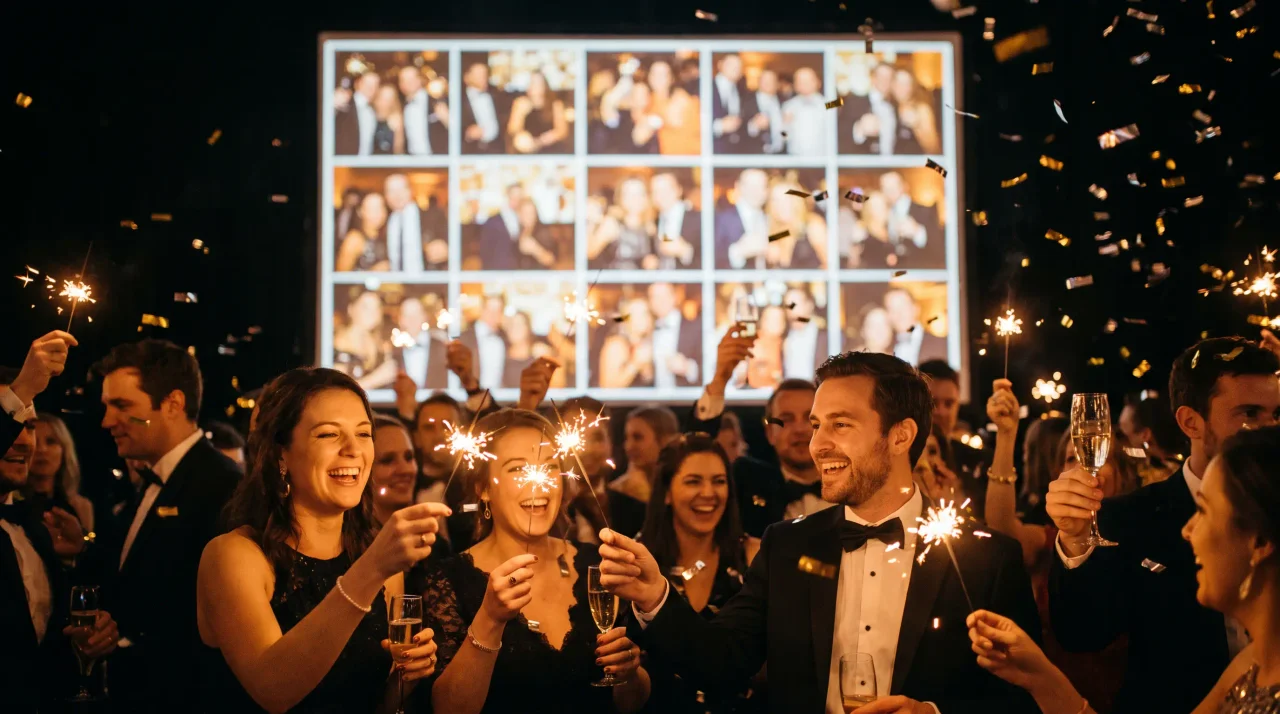
Here's the problem with New Year's Eve: the best ten seconds of the whole year happen all at once, and every phone in the room is pointed at them. The countdown hits zero, the room erupts, forty cameras fire at the same instant — the kiss, the confetti, the faces lit by sparklers. Then the night rolls on, and by January 2nd those forty versions of midnight are scattered across forty camera rolls, and you'll see maybe three.
A New Year's Eve photo wall fixes that on the spot. Guests upload from their phones, the shots land on a big screen seconds later — so the room watches its own midnight happen, live — and you keep every frame in one gallery the next morning. No app for your crew. No account for anyone. A screen, a browser, and a QR code.
This guide is the New Year's-specific version: how to project a gallery built around the countdown, and how to handle the one moment of the year when every guest uploads at the same second. (Want the general, any-night walkthrough? We've got a full step-by-step on setting up a live photo wall.)
What a New Year's Eve photo wall actually is
A photo wall is a screen at your party that fills with guest photos as they're uploaded — automatically, in near-real time. Guests scan a QR code, upload from their phones, and within seconds their shot rotates onto the display. No cables passed around, no "AirDrop me that one," no group chat everyone mutes by 11 p.m. On New Year's specifically, it does something a regular slideshow can't: it turns the countdown into a shared screen moment. The room is already looking up — at the TV, the clock — so the same screen that counts down to midnight is the one that fills with everyone's midnight, seconds after it happens.
A few names get used for the same idea. A live slideshow rotates uploaded photos on a loop, refreshing as new ones land — the everyday party-and-countdown version, and what most "photo wall" setups actually are. A live stream / broadcast wall goes further: the gallery is broadcast live, so people who aren't in the room can watch the same feed on their own screens — useful if your New Year's spans two floors, two flats, or a crowd across a venue.
With Gathmo, the live slideshow is on the Celebrate tier (€69) and up, and the broadcast live stream is on the Grand tier (€89). The Free and Essential tiers collect to an album rather than projecting a wall — so if a gallery on the big screen at midnight is what you want, those are the tiers to look at. (Gathmo pricing.) And worth knowing if you're comparing tools: a true live-stream broadcast wall is genuinely uncommon — across the party apps we tracked, a live slideshow is fairly standard, but broadcasting the gallery as a feed people can watch from their own screens is the exception. (provider public pages reviewed June 2026.)
Why bother with a wall on New Year's Eve?
Because New Year's is the one night where "I'll collect the photos later" goes most spectacularly wrong. It certainly feels like the most-photographed night of the year — but those photos rarely survive in usable form. Around 70% of camera-phone photos are never revisited (Popsa, The Memory Economy, 2025). Multiply that by a room full of people all shooting the same ten seconds, and the great midnight photo you're picturing is, statistically, already lost in someone's roll.
A wall flips that. It surfaces the shots while the night is on, when reactions are loudest, and pulls everything into one gallery you download in the morning instead of begging the group chat all of January. There's a New Year's bonus, too: the wall gives the long, slow early evening something to do — people arrive, it's already glowing, and by midnight everyone knows how to upload.
Setting it up, step by step
The steps describe the Gathmo flow; the same logic applies to most QR-based tools, but the tier names and settings here are Gathmo's.
- Create the event and pick a tier with the wall. Name it (the year's right there, use it). The live slideshow is on Celebrate (€69, unlimited guests, clips up to 10 minutes / 600 seconds); the broadcast live stream is on Grand (€89, unlimited guests, clips up to 15 minutes / 900 seconds) — pick Grand if your party is big, spread out, or might grow as plans merge on the 31st. The event gives you an upload link and a QR code. (Gathmo pricing.)
- Get the wall on your screen early. Open the wall's display view from the dashboard and put the browser full-screen. Gathmo runs the wall and live stream over Cloudflare Stream, so the heavy lifting isn't on your laptop. Do this before guests arrive — an empty wall showing the QR code is itself the invitation.
- Share the QR code and short link. Print the QR for where people gather; drop the short link in the group chat for tappers. Guests land on the upload page in their browser — no app, no account (Gathmo issues an anonymous, event-scoped guest token that lasts a few hours). That matters double on New Year's: nobody opens the App Store with a glass in hand at 11:59.
- Test before the doors open. Scan your own code, upload a test shot, and watch it land. Crucially, check a phone on mobile data, not just home Wi-Fi, can reach it — that's what most guests are on. And scan a printed proof from the distance and lighting you'll actually use before running a stack (Uniqode): a code that scans on your monitor can fail on glossy card under colored party lighting.
Handling the midnight spike: the one thing that's different on NYE
Every other night, uploads trickle in. On New Year's they don't — they arrive in a wall of simultaneous taps the instant the clock strikes twelve, because everyone shot the same thing at once. A few ways to keep that from bottlenecking:
- Lean on auto-publish for the countdown window. If you've been running a manual review queue earlier (sensible for a big crowd), switch to auto-publish right before midnight so the confetti shots hit the screen without waiting on you — you'll be hugging people, not approving photos.
- Don't sweat the rotation. A good live slideshow keeps cycling new uploads; you don't need every midnight photo on screen in the first thirty seconds. They all land in the gallery regardless — the wall is the live show, the gallery the complete record.
- Keep shooting past midnight. The best candids are often the loose, joyful ones in the half-hour after the countdown. Leave the wall up and let it keep filling.
Keeping the wall clean: moderation
A wall on a big screen is a wall everyone can see, so you decide what reaches it. Gathmo gives you AI moderation plus a human review queue — visual content screened automatically, with a queue you can review — on the paid tiers. (Gathmo pricing.) Auto-publish lets uploads appear automatically (AI catching the obvious problems) — best for a crew you trust and for the live-feeling countdown. A manual review queue holds uploads until you or a co-host approve them — best for a bigger or more public night where one bad photo on the screen is a problem. A simple rule for the 31st: queue it during the long early stretch if the crowd is large or semi-public, then flip to auto-publish for the countdown so midnight lands on the screen in real time.
Placing the QR code, and getting the wall on screen
A live wall is only as good as the number of people uploading — and your guests already know how to scan: 68% of consumers used a QR code in the last year (QRKit summary of TEAM LEWIS consumer QR research, 2024), and 84% of respondents had scanned a QR code before, with 32% most recently scanning one in the previous week.nfcw.com/2020/09/25/368172/survey-four-in-ten-us-and-uk-consumers-ready-to-use-qr-codes-for-payments/), 2020).
Size the code for the scanning distance — the 10:1 rule, minimum size ≈ max scan distance ÷ 10 (Uniqode): roughly 3–5 cm on a seated table card, 4–7 cm on an A5 stand, and 10–25 cm on a poster or A-frame. Put it where people pause — entry, the bar, near the screen, and wherever the crowd gathers for the countdown; multiple codes beat one. Keep it dark-on-light (avoid inverting to light-on-dark — New Year's signage loves a black-and-gold that works against you here), leave a clear quiet-zone margin of at least four modules, and raise error correction to Level H (~30%) if you overlay a logo. (Uniqode QR size guide.)
Getting the wall onto a TV is a browser problem, not an AV one: an HDMI cable from a laptop is the most reliable, or open the display link on a streaming stick or smart-TV browser. Put the browser full-screen and disable sleep and screensaver so it doesn't blink off thirty seconds before the countdown — and give the display device a wired or strong Wi-Fi connection, since that's what keeps the feed live while the room's bandwidth is under load at 12:00 sharp.
Capture the voices of midnight too
While the wall collects what midnight looked like, you can collect what it sounded like — off the same scan, no extra hardware. Gathmo includes an in-browser voicemail booth on every tier (30 seconds on Free; unlimited on paid tiers). Guests tap the voice tab, hit record, and leave a message — a resolution, a toast, a slightly emotional 12:30 a.m. ramble. On the Grand tier (and B2B plans), those voice drops also come with automatic transcripts, so you can read them back, not just listen.
This pairing is rare: among the party tools we tracked, an in-browser audio guestbook at a party is the exception — most photo-wall apps collect images only. So the screen holds the confetti, and the booth holds the "I'm so glad you're all here" someone leaves at quarter past twelve. (Gathmo pricing; provider public pages reviewed June 2026.) Full detail on the voicemail booth feature.
A quick note on consent and guest privacy
A photo wall on a screen everyone can see is, in data-protection terms, you processing other people's images — so a little courtesy goes a long way. Under the GDPR, a host can often rely on legitimate interest (Art. 6(1)(f)) for ordinary party photos, but the cleaner approach is a clear notice at the point guests upload (Art. 13). A short line on or near the QR sign — "Photos you upload may appear on the screen; tell the host if you'd like one removed" — covers it. Gathmo also hosts media in the EU (Frankfurt), so uploads stay on EU infrastructure rather than getting shipped overseas. (General information, not legal advice. GDPR points: GDPR official text, Art. 6(1)(f), Art. 13.)
Create the event and get the live wall URL
Log into Gathmo, create the NYE event on the Celebrate or Grand tier, and copy the live photo wall display URL from the dashboard. This is the URL you will open full-screen on the display device at the party.
Set up the display device before guests arrive
Connect the display device to the venue screen or projector. Open the live wall URL in full-screen mode and test that it refreshes correctly when a photo is uploaded. The screen is now ready and needs no further interaction.
Enable quick-approval moderation
In the event settings, enable moderation and open the Gathmo dashboard on your phone. As guests upload, you receive a notification and can approve with a single tap. Approved photos appear on the wall within seconds.
Brief a few guests to upload early
Tell three or four trusted guests about the live wall before others arrive. When the first photos appear on the wall mid-evening, it triggers a wave of uploads from other guests who see it working in real time.
Frequently asked
No. Guests scan the QR code or tap the link and upload straight from their phone's browser — no app to install, no account to create. Gathmo issues a short-lived, event-scoped guest token, so they go from scan to upload in one step. Exactly what you want at 11:59.
Gathmo's Free tier collects photos to an album but doesn't project the live wall. The live slideshow starts on Celebrate (€69) and the broadcast live stream is on Grand (€89). If a gallery on the big screen at midnight is the goal, you'll want one of those. (Gathmo pricing.)
That's the spike to plan for. Switch to auto-publish for the countdown so confetti shots don't wait in a queue, and give your display device the strongest connection in the room. Every photo lands in the gallery regardless of what's on screen at any second — the wall is the live show; the gallery is the complete record.
Yes — the in-browser voicemail booth is on every Gathmo tier, off the same QR code. On Grand and B2B plans, the voice drops also come with automatic transcripts.
Four steps: create a Gathmo event (free takes two minutes), choose the Celebrate tier for the live slideshow or Grand for a live stream, generate your QR code and put it on table cards and the bar, then open the live wall link full-screen on your TV or projector before midnight. Guests scan, upload, and their photos appear on the wall in seconds. The hardest part is the screen setup -- HDMI or Chromecast from any laptop works. Everything else is automatic.
For a party where you want live photos on a screen as the night unfolds, Gathmo is the strongest fit in the no-install category: live slideshow from Celebrate (69 EUR), live stream on Grand (89 EUR), voice drops on every tier including free. If budget is the only constraint and you do not need a live wall, Kululu or Fotify are cheaper options with a free tier -- but neither has an audio guestbook. Free tier is free forever; no subscription required for a single event.
Four steps: (1) Create a Gathmo event on Celebrate tier (69 EUR) and open the live wall URL from the host dashboard; (2) Connect a laptop to the venue screen via HDMI or stream via Chromecast; (3) Put the live wall URL in full-screen mode in the browser; (4) Place QR table cards around the party space so guests can scan and upload. The wall updates automatically as guests upload — no refreshing required. For the midnight countdown, have guests scan and upload during the countdown: the first photos of midnight appear on screen within seconds. For a home New Year's Eve party, a regular TV connected to a laptop handles this without any special equipment.
 Guide
GuideHouse Party Photo Album: How to Collect Everyone's Shots in One Place
Here's how a house party ends. The last guest leaves around 2am, the playlist is still going, and somewhere between forty phones are the best shots of the night — the arrival...
 Guide
GuideClass Reunion Photo Sharing: How to Collect Every Memory From One Night
Here's the thing about a reunion: it's one night, and then it's gone. Ten years, twenty, more — and the whole class is finally in one room again. Someone you haven't seen since...
 Story
StoryGraduation Party Photo Ideas: 10 Shots That Actually Capture the Day
The graduation photos that matter most — the cap toss, the family hug, candid moments between friends — live on a dozen different phones. A QR code shared album collects them all into one place your grad keeps forever.