The Photographer's Guide to Offering a Wedding Guest Photo Album to Clients

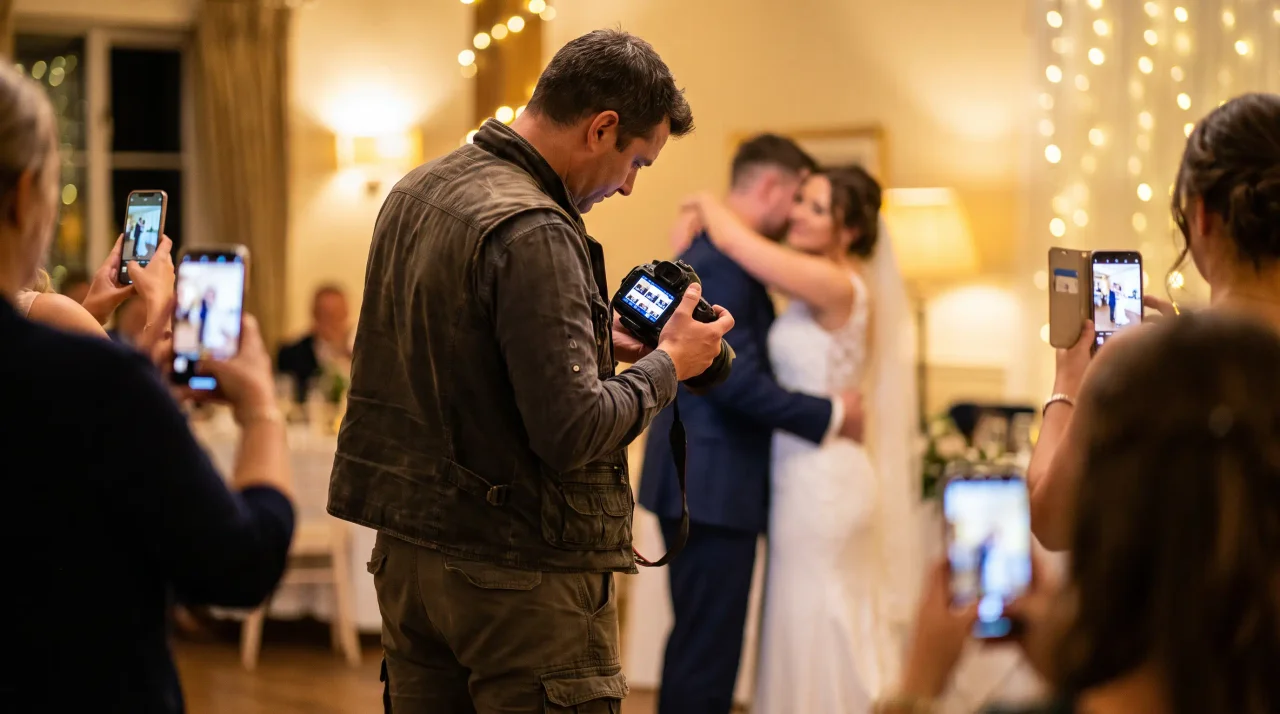
There is a part of every wedding you cannot be in two places to shoot. While you are framing the first dance, a guest at table nine is catching the groom's father wiping his eyes. While you are working the golden-hour portraits, the bride's college friends are taking the photo she will actually set as her phone wallpaper. Those images live on a hundred guest phones, scattered, and most of them are never sent to anyone — research on the wider photo economy suggests around 70% of camera-phone photos are never revisited at all (Popsa / The Memory Economy).
You can't shoot those moments. But you can be the person who collects them — and hand your couple a single, beautiful album that holds your gallery and their guests' candids side by side. Offered well, a wedding guest photo album is one of the easiest add-ons you can put into a package: it costs you almost nothing in shoot time, it solves a problem your couples genuinely have, and — done on the right platform — it carries your studio's name, not a third party's.
This guide is for wedding photographers who want to add a guest photo (and voice message) album to their offering: how to price it, how to position it without cannibalising your own gallery sales, and how to set it up so it looks like part of your studio.
This article is written for wedding professionals. For couples planning their own wedding, see our guide to collecting every guest photo from every phone instead.
Why guest albums are a natural fit for a photography package
The objection most photographers raise first is the one worth answering first: "Won't guest snapshots compete with the gallery I'm selling?"
In practice, the opposite is true. Guest photos and your photographs do different jobs, and couples know it. Your gallery is the considered, edited, technically excellent record — the images that go on the wall and in the album. The guest collection is the unfiltered, behind-the-scenes, everyone-was-there layer: the table conversations, the dance floor at midnight, the reaction shots from angles no single photographer can cover. One claimed industry figure puts the average guest photo count at several hundred images per wedding (Snapeen, illustrative) — we'd treat that number as illustrative rather than a benchmark, but the point stands: there is a lot of candid material out there, and right now most of it evaporates.
A guest album doesn't compete with your gallery. It frames it. The couple opens one link, sees your hero images at the top, and scrolls into the warm chaos their friends captured. You become the person who delivered the whole day, not just the parts you were standing next to.
Three reasons it slots cleanly into a package:
- It costs you almost no shoot time. You set up the event once, drop QR signs on the tables, and the collection runs itself during the reception while you're working.
- It's a margin add-on, not a labour add-on. Unlike a second shooter or an extra album spread, the cost to you is a per-event fee, not hours of editing.
- It's a retention and referral engine. Every guest who scans your QR sign sees your studio name. A wedding is, among other things, a room full of future couples.
What "white-label" actually means — and why it matters here
If you've looked at guest photo tools before, you'll have noticed that most let you "remove branding" or upload a logo. That is not the same as white-label, and the difference is the whole reason a guest album is worth offering as your product rather than just recommending an app.
Across the consumer wedding-photo tools we verified in June 2026, branding control is almost always cosmetic — a logo swap or a colour change on a page that still lives on the vendor's domain. GuestCam, for example, offers custom logo and colours only as a pricing-on-request add-on, and lists no custom domain (as of June 2026; source: guestcam.co). Kululu's control is a "Remove Kululu Branding" toggle, Wedibox describes co-branding through a partner programme, and WedUploader limits customisation to album colours — none of them give you a true custom domain (as of June 2026; sources: kululu.com, wedibox.com, weduploader.com). For a couple that's fine. For a studio, it means the experience you're selling has someone else's name on the address bar.
Gathmo approaches this differently because it has a dedicated B2B (reseller) product built for exactly this case. The white-label depth scales with the tier:
- Studio (€79/month equivalent) — your logo and brand accent on the album, 1 custom domain, up to 10 events per year on one seat.
- Agency (€199/month equivalent) — end-to-end white-label, unlimited custom domains, 5 seats, up to 50 events per year, plus API access.
- Enterprise (from €699/month equivalent) — full white-label with SSO/SAML and branded SMS, for high-volume studios and venues.
(12-month prepayment is pay-for-ten-months — two months free. Source: Gathmo pricing.)
The practical upshot: on Studio your couples scan a sign, land on your branded album at your domain, and never see the word "Gathmo." That's the difference between recommending a tool and selling a service.
The audio guestbook: the upsell couples didn't know to ask for
Here is where you can genuinely differentiate the package — and where Gathmo's weddings story is strongest.
Alongside photos and video, guests can record a voice message in the browser — no app, no hardware, no rented telephone handset, no awkward booth in the corner. They scan, tap record, and leave a message. The couple receives them in a dedicated Voice Messages section of the album, each with a waveform player. On the Gathmo Grand tier (and on all B2B tiers), each message also comes with an automatic transcript (source: [Gathmo pricing, GATHMO-032/033](/weddings)).
This matters for two reasons. First, the competitor register captured on 2026-06-08 records JoinMyMoment with an in-browser audio guestbook and transcript support, while many other consumer tools do not list transcripts. Second, voice messages are the part of the day that never makes it into your film or your gallery. When you offer it as part of your package, you're not selling a feature — you're adding a keepsake format alongside the photos.
For a photographer, that's an easy line in a proposal: "Your album includes a voice guestbook — your guests can leave you spoken messages, transcribed and kept alongside the photos." It costs you nothing extra to enable, and it's the detail couples remember.
A note on accuracy, because over-promising hurts: Gathmo does not offer face-recognition photo search or RSVP — both are on the product roadmap (Phase 2), not in the current product (source: [Gathmo pricing, GATHMO-043/044](/weddings)). If a couple specifically wants selfie-based photo finding today, that's a competitor's lane (for example GuestCam's MagicFind add-on) — be honest about it. You'll keep more trust by being precise.
How to price a guest album in your package
There's no single right answer, but three models work in the field:
- Bundled and invisible. Fold the cost into your existing package price and present the guest album as a standard inclusion. Best when you want the feature to drive bookings ("every wedding I shoot includes a guest album with a voice guestbook") rather than line-item revenue. Your cost is one event off your monthly Studio or Agency allowance.
- A named add-on. List "Guest Photo & Voice Album" as a clearly-priced extra — say a fixed fee on top of the package. Couples opt in, and because the perceived value (a complete, hosted, branded album of everyone's memories) is high relative to the simplicity of delivery, the margin is comfortable.
- A premium-tier differentiator. Reserve it for your higher packages. The guest album becomes one of the reasons to choose your mid- or top-tier collection over the entry one.
On the cost side, the maths is straightforward. On Gathmo Studio, the annual plan is €790 a year (pay for ten months, two free) for up to 10 events — so if you run all ten weddings, the platform cost works out to roughly €79 per wedding, comfortably below what most studios would charge as an add-on. Run more weddings, and Agency (€199/month equivalent, up to 50 events/year) brings the per-event cost down further while adding unlimited custom domains and extra seats for a second shooter or an assistant (source: [Gathmo pricing, GATHMO-020](/weddings)). Whatever model you pick, price the outcome — a complete day, beautifully held in one place — not the software.
Setting it up so it looks like your studio
The setup is the same regardless of how you price it. The parts worth getting right:
Brand the album first. On Studio, add your logo and accent colour and point a custom domain (or subdomain) at the album so the address your couples and their guests see is yours. This is a one-time setup per studio, not per wedding.
Get the QR signage right. This is the one physical thing you hand the venue, and poor print sizing can reduce scan reliability. A few specs worth following, drawn from print best practice:
- Size for the distance. A seated guest reads a table card from roughly 30–50 cm, which calls for a QR code around 3–5 cm square; an A5 stand or a welcome sign at the entrance (read from ~40–70 cm) wants 4–7 cm (CITE-20260608-3012/3013).
- Keep the quiet zone. Leave a clear blank margin of at least 4 modules around the code — don't let your florals or your studio logo crowd it (CITE-20260608-3003).
- Dark code on a light background, and if you drop your logo into the centre, use the higher error-correction level so the code still reads (CITE-20260608-3006/3010).
- Always test-print and scan it at the real size, on the real stock, under venue-style lighting, before the day (CITE-20260608-3019).
Lean on "no app, no signup." The single biggest source of guest friction at weddings is asking people to download something. Gathmo guests scan and land straight in the browser upload screen — works on every phone, at every table, in every age group, which matters when the U.S. International Trade Administration reported Germany smartphone penetration at 90.1% in 2023. For you, that means fewer "how do I use this?" questions on the day and a higher share of guests who actually contribute.
The privacy conversation — and why it builds trust
Wedding photos are intimate: family, children, elderly relatives, emotional moments. The couple is trusting you with all of it, and increasingly — especially with German and French clients — they will ask where it's stored. Being ready for that conversation is a selling point, not a chore.
Two things to know, and to be able to say plainly:
Where the data lives. Gathmo stores event media with EU data residency: object storage in an EU jurisdiction, the primary database in Frankfurt, and EU compute (source: [Gathmo pricing, GATHMO-042](/weddings)). Keeping the data inside the EU is the cleanest path, because it avoids the extra machinery that transfers to a third country otherwise require — adequacy decisions or Standard Contractual Clauses with a transfer-impact assessment (GDPR Chapter V, Art. 45–46; Schrems II, C-311/18). The competitor register records GuestCam with US-based cloud storage; verify hosting directly for any vendor you put in front of couples.
Who is responsible for what. When you collect guests' photos on behalf of your couple, the data-protection roles need to be clear. The host (your couple, or you, depending on how you structure it) acts as a controller; the platform acts as a processor; and under the GDPR that relationship should be governed by a written data-processing agreement covering the nature and purpose of the processing, security measures, and deletion of the data at the end of the service (GDPR Art. 28(3)). Photos, on their own, are generally not special-category data — a face in a photo only becomes biometric data when it's run through a technical means for unique identification, such as facial recognition (GDPR Recital 51). Because Gathmo's current product does not do face recognition, your couple's ordinary photo album stays on the simpler side of that line.
This is general information, not legal advice — for a specific package structure, confirm your controller/processor setup with a qualified adviser.
A note on storage that ends — and why couples like it
One detail couples appreciate, and that sets a professional offering apart from a free consumer app: the album doesn't sit on a server forever by default. Gathmo's per-event retention is defined (and longer on higher tiers), and the GDPR itself frames this as good practice — personal data should be kept in identifiable form no longer than is necessary for the purpose (storage limitation, Art. 5(1)(e)). For your couples, that translates into a clean promise: their guests' memories are collected, delivered, downloadable in full quality, and then handled responsibly — not quietly archived and monetised. Make sure you give couples (or yourself) a full-quality batch download of everything before any album closes, so the memories live on in your delivery, not just on the platform.
Putting it together
A wedding guest photo album is the rare add-on that's almost pure upside for a photographer: minimal shoot-time cost, a real problem solved, a clear margin, and — on a true white-label platform — your studio's name on every screen a guest sees. Add the voice guestbook and you're offering something most couples have never been offered before. Get the QR signage and the privacy story right, and it becomes a quiet differentiator in every proposal you send.
If you're ready to offer it under your own brand, Gathmo's reseller tiers are built for exactly this — Studio at €79/month equivalent to start, Agency at €199/month equivalent as you scale, with full EU hosting and the audio guestbook included.
→ See how Gathmo works for photographers and studios
→ Create your first wedding album — free to start
Want to understand the couple-facing side first? Read how to collect every guest photo from every phone and why every wedding needs an audio guestbook. For a broader, cross-vertical look at every tool on the market, see our honest comparison of the best event photo-sharing apps in 2026 on the hub.
Present the guest album as a complementary service
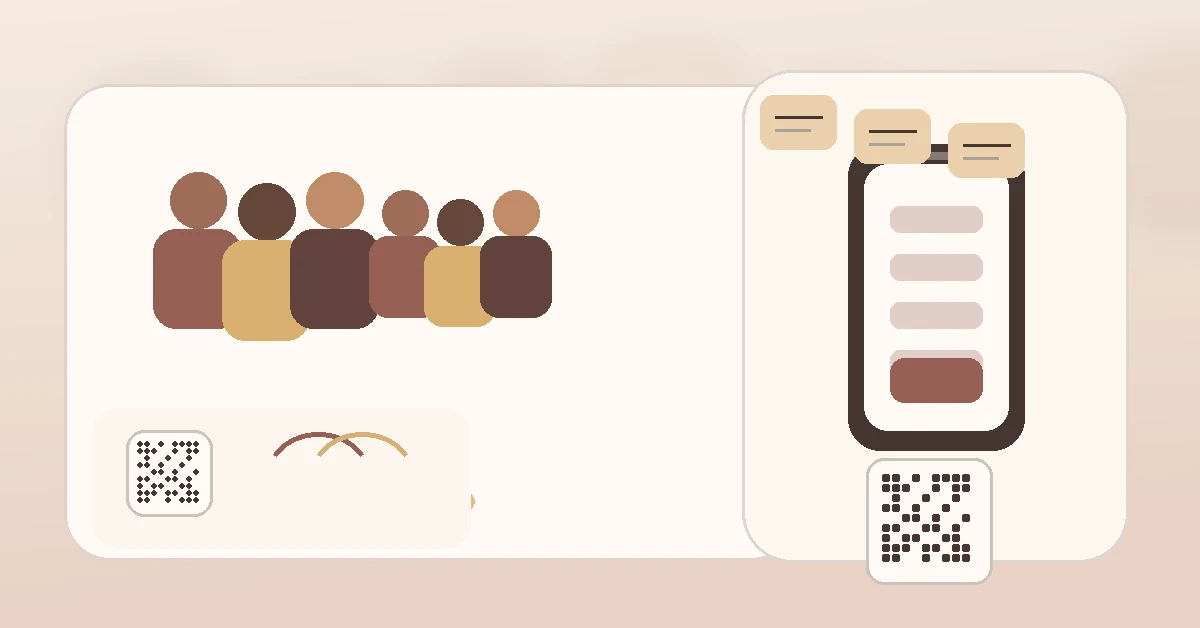
Frame the QR-based guest album to the couple as a supplement to professional photography: 'Your guests will take hundreds of candid photos throughout the day. A QR album collects them all for you -- no app required for guests, nothing for you to manage on the day.'
Set up the Gathmo event and include it in your pre-wedding delivery
Create the Gathmo event as part of your pre-wedding delivery alongside the shot list and timeline. Provide the couple with printed QR cards for their stationer and the live wall URL if they are using a reception display.
Brief the couple on the host dashboard
Show the couple the Gathmo host dashboard before the wedding so they know where to find uploads and how to moderate. They do not need to do anything on the day; the album collects in the background. After the honeymoon, they download the archive.
Deliver the guest archive alongside your professional edit
Deliver the Gathmo archive ZIP alongside your professional photo delivery. The combined package -- your edited images and the guest-contribution archive -- is a more complete keepsake than either alone, and positions you as the photographer who thought of everything.
Frequently asked
No — they do different jobs. Your gallery is the edited, considered record couples buy and frame; the guest album is the candid, everyone-was-there layer your couples can't get any other way. Offering both positions you as the person who delivered the whole day.
Yes, if you choose a true white-label platform. On the platform's Studio tier (€79/month equivalent) you add your logo, accent colour, and a custom domain, so couples and guests see your brand — not the event album's. Most consumer wedding-photo apps only offer cosmetic logo swaps on their own domain (as of June 2026).
On the album Studio, the annual plan is €790/year (up to 10 events), so the platform cost works out around €79 per wedding if you run all ten, before whatever you charge clients. Agency (€199/month equivalent, up to 50 events/year) brings the per-event cost down further and adds extra seats and unlimited custom domains.
No. Guests scan a QR code and land straight in their phone's browser to upload photos, videos, and voice messages — no app and no signup. That's the single biggest factor in how many guests actually contribute.
Yes — the audio guestbook is in-browser (no rented telephone or booth), and on the upload flow's Grand and B2B tiers each message comes with an automatic transcript. Among consumer competitors, transcripts are rare.
Three recommendations that align the photographer's and the couple's interests: (1) Frame the guest app as a supplement, not a substitute -- the photographer covers the formal, artistic, edited work; the guest app collects the candid, unedited layer that the photographer cannot be in two places to catch simultaneously; (2) Recommend a QR app that requires no guest login -- participation rates are 3 to 5 times higher versus app-required tools, producing more useful candids alongside the professional gallery; (3) Advise on timing -- have the couple send the album link to guests in the thank-you note so late photos (from guests who held back during the ceremony) arrive in the same place as everything else.
Three things that improve the guest upload experience: (1) Scan the QR code during the reception, not after -- photos uploaded at the event appear in the live wall and reach the couple while the energy is still high; (2) Upload your best 3 to 5 photos rather than every shot -- guests who share a curated selection consistently produce more useful content than those who upload all 50 from a burst; (3) If there is an audio guestbook prompt, record a message as well as uploading photos -- voice messages take 30 seconds and are the most treasured output for most couples. No app required on Gathmo: scan, upload, done.
 Guide
GuideHow to Add a Live Photo Slideshow to Your Wedding Reception (No Tech Team Required)
There's a moment that happens at the best receptions. Halfway through dinner, someone glances up at the screen and sees a photo from twenty minutes ago — the bride laughing at...
 Comparison
Wedibox Alternative: When a No-Install Wedding Album Works Better
If you're comparing Wedibox with other event photo-sharing tools, the useful question is not simply "which one is cheapest?" It is whether the tool matches the event you are...
 Comparison
GuestPix Alternative: Compare Guest Photo Collection Without App Installs
If you're comparing GuestPix with other event photo-sharing tools, the useful question is not simply "which one is cheapest?" It is whether the tool matches the event you are...