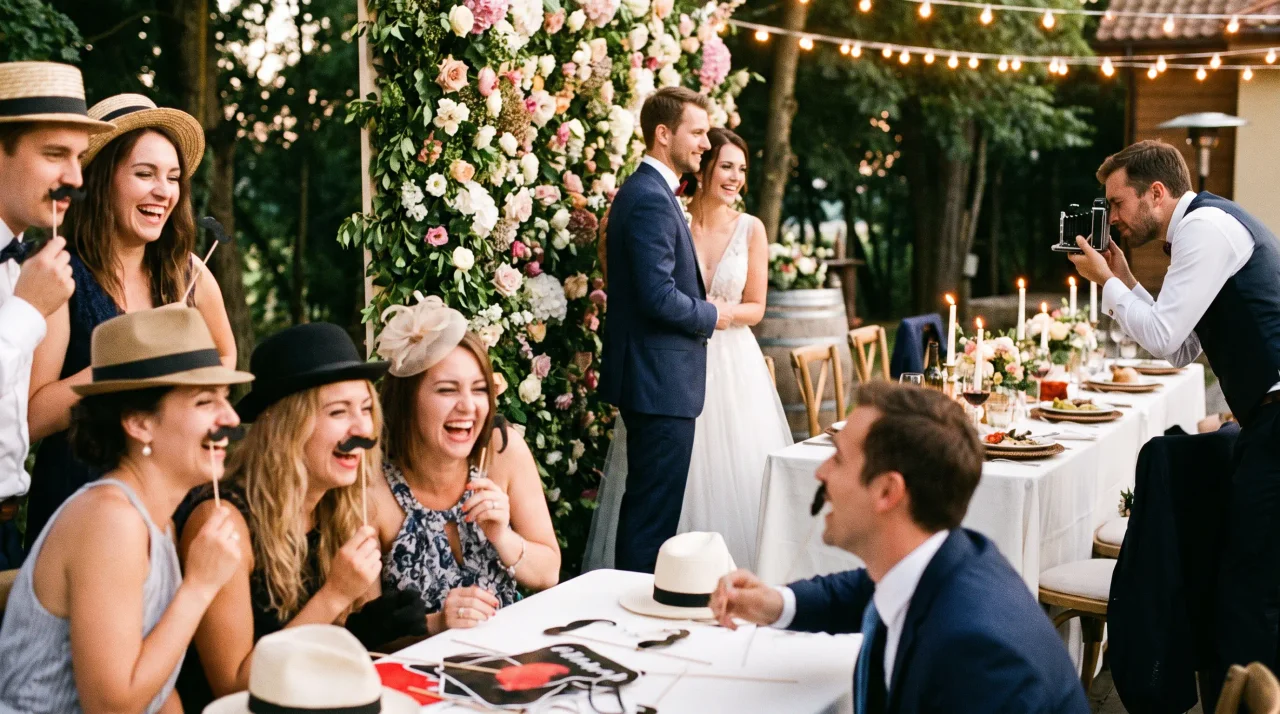

The photobooth has done its job for a decade now. A backdrop, a basket of feather boas, a strip of four pictures your guests pocket and you never see again. It's fun. It's also, by now, expected — and it captures only the corner of the room standing in front of it.
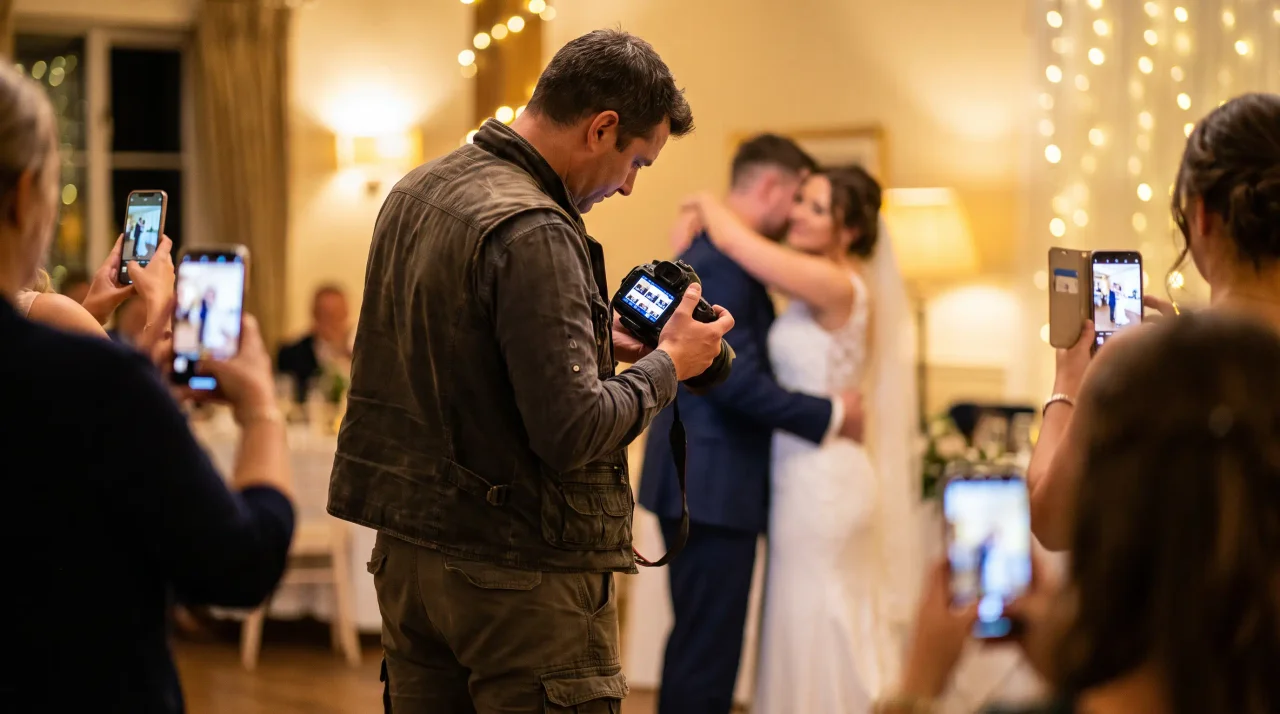
Your reception is so much bigger than one booth: the table where your university friends are crying with laughter, the slow circle of your grandparents dancing at the edge of the floor, the quiet two minutes you steal on the terrace. Those moments are happening on two hundred phones at once, and most of them will never reach you. Research on how we use our cameras suggests around 70% of camera-phone photos are never revisited in any meaningful way (Popsa, 2025). On the most photographed evening of your life, that's a lot of memories left stranded.
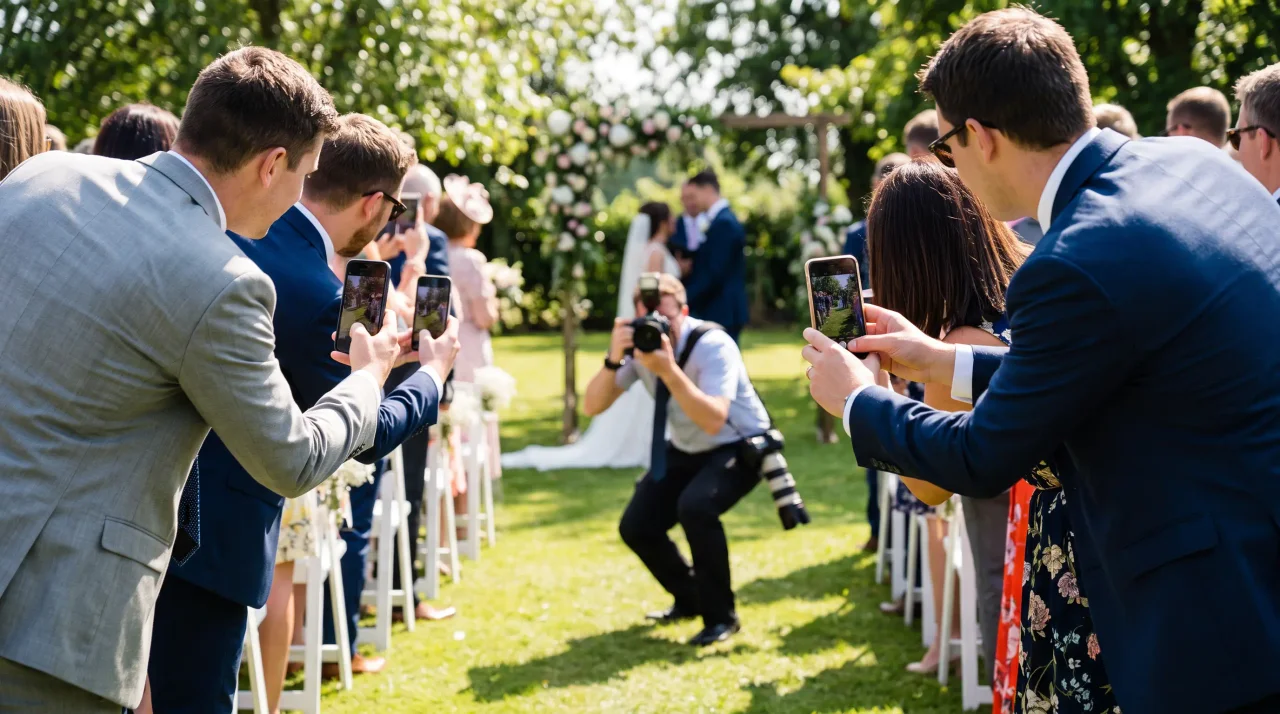
So here are ten wedding reception photo ideas that go beyond the photobooth — ways to capture the whole room, every guest, and even the sound of the night, without renting a single piece of hardware. Most of them run on one thing your guests are already holding.
First, the thing that makes all of these work: a QR code
Almost every idea below depends on one small piece of setup: a QR code that opens straight to an upload page — no app to download, no account to create. Guests point their phone camera at it, tap the link, and they're on the upload screen in their normal browser. That's it.
It works because the technology is genuinely mainstream now. 84% of respondents had scanned a QR code before, and 36.40% scan one at least weekly (NFCW QR survey summary, 2020), and nearly everyone in the room is holding the only device they need — the U.S. International Trade Administration reported Germany smartphone penetration at 90.1% in 2023.
This is how Gathmo works: guests scan your wedding QR code or open your short link and go straight to the upload screen — no app, no signup — and every photo, video, and voice message lands in one private album that's yours. Keep that in mind as you read; it's the quiet engine behind ideas one through ten.
1. A photo "mission" card on every table
Hand each table a small card with three or four gentle prompts: "Photograph someone you've never met tonight." "Catch the couple when they don't know you're looking." "Get the dance floor from above." It turns passive guests into a roomful of candid photographers, each chasing a slightly different angle than your professional ever could.
Pair the prompts with the QR code on the same card and you've solved both problems at once — what to shoot, and where to send it. It's the modern version of the disposable cameras couples used to scatter on tables, except nothing gets left in a drawer and nothing comes back blurry.
2. A "first look from the back" wall — guests' angles, not the photographer's
Your photographer shot the ceremony from the front. Your guests shot it from the pews, the aisle, the back row where your great-uncle was quietly weeping. Ask guests to upload their ceremony photos specifically, and you'll assemble a view of your wedding you could not otherwise have seen — the reactions behind you while you faced forward. The picture of your dad's face as you walked in is almost never taken by the person hired to look at you.
3. Replace the paper guestbook with voices
Here is the idea that will mean the most in ten years, and it's the one the photobooth can never touch.
A paper guestbook gets you signatures and a few "congrats!" scrawls. An audio guestbook gets you the actual sound of the people who came. Your grandfather's toast trailing into a laugh. Your best friend's voice cracking halfway through a blessing. The message someone leaves at 1 a.m. that they'd never say to your face sober.
With Gathmo, guests record a voice message straight from the same upload screen — no telephone handset to rent, no booth, no hardware. They tap record, speak, and it lands in a dedicated Voice Messages section of your album with a waveform player. Voice messages are included on every Gathmo tier (recording lengths run 30 seconds on Free; unlimited on paid tiers); on the Grand tier, each message also arrives with a full written transcript, so the words are preserved alongside the voice.
This is rarer than you'd expect. A recorded audio guestbook exists at a handful of wedding tools, but transcribing those messages is genuinely uncommon across the market. It's the part of the day that never makes it into the wedding film — and the part you'll reach for on an anniversary, to hear a voice exactly as it was that night.
4. Prompt cards that ask for more than "congratulations"
Whether you're collecting photos, video, or voice, the quality of what you get back depends on what you ask. "Leave us a message" produces a polite sentence. A specific prompt produces a memory.
Try printing a few prompt cards for the tables:
- "Tell us your favourite memory of the two of us — out loud."
- "Sing the first ten seconds of a song that reminds you of us."
- "Leave a message for us to open on our tenth anniversary."
- "Give the newlyweds one piece of advice you actually mean."
The third one is quietly powerful: a small time capsule of voices, recorded tonight, saved for a decade from now. None of it requires anything more than the phone already in your guest's hand.
5. A live slideshow on the big screen
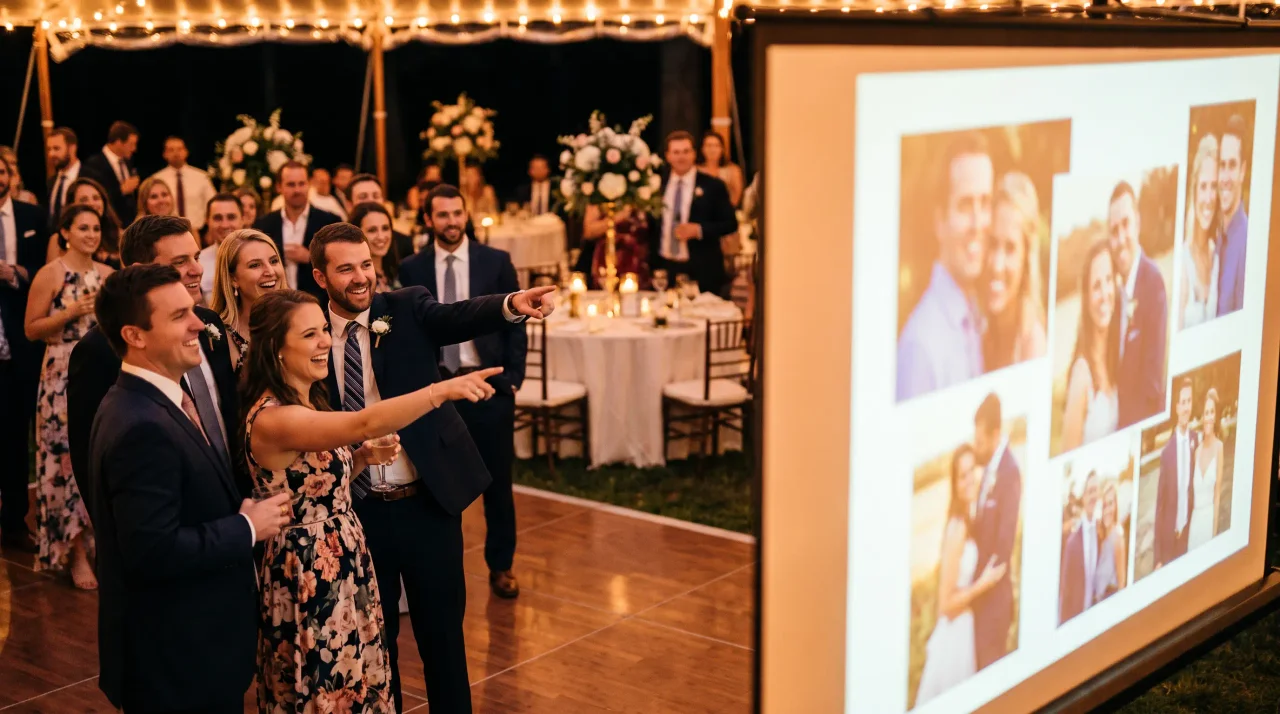
Few things pull a room into the moment like seeing the last hour appear on a screen. As guests upload, their photos surface on a slideshow projected near the dance floor or behind the band — a self-refreshing wall of the night as it happens. It nudges the shy ones to contribute ("oh, that's where the photos go") and turns sharing into part of the entertainment. With Gathmo, the live slideshow is included from the Celebrate tier (€69) upwards, and runs from the same album your guests are uploading to — no AV crew required. (Prices as of June 2026.)
6. A "golden hour" call to your guests
There's a ten-minute window at most receptions when the light goes amber and everything looks like a film still. Have your MC or celebrant make a single announcement: "For the next ten minutes, the light is perfect — go outside, take photos, and upload them to our album." You'll get a flood of the most beautiful, least posed images of the day — and it costs nothing beyond the QR code already on the tables.
7. The kids'-eye-view album
Give the children at your wedding a job. A few of the older ones, armed with a parent's phone and the QR code, become your unofficial junior photographers for an hour. What comes back is uncapturable any other way: the cake from exactly thirty centimetres away, the underside of the table, the grown-ups caught mid-laugh from waist height. It keeps the kids delightedly occupied and gives you a perspective no adult would ever think to shoot.
8. A late-night "after the band stops" drop
The professional photographer usually goes home before the night truly ends. But the last hour — shoes off, ties loosened, the closest friends still on the floor — is often where the warmest, most unguarded photos live. Leave the QR code live and let guests keep uploading into the small hours; because everything flows into one album, the after-party captures itself.
This is where the no-app point matters most. By 1 a.m., nobody is downloading software or making an account. A scan-and-upload link is the only kind of sharing that still works when the night is winding down.
9. A private album you control — and share on your terms
Wedding photos are intimate. They include children, elderly relatives, and emotional moments your guests might never want floating around the public internet. A reception photo idea is only a good one if it respects that.
With Gathmo, your album is private to you unless you choose to share it, so you decide whether guests see each other's uploads live during the reception or whether the collection stays just for the two of you. Everything is stored on EU servers in Frankfurt, under GDPR — a meaningful difference for European couples, and for the German and French families in the room, from tools hosted in the US. (Several popular wedding-photo apps are US-based, with EU data residency not confirmed; it's worth asking before you choose.) And collecting photos this way doesn't involve facial-recognition scanning, which under GDPR can turn ordinary photos into specially protected biometric data (GDPR Recital 51) — a wedding album that simply gathers and shows the pictures avoids that entirely. (This is general information, not legal advice.)
10. The "everything in one place" download — so the night is actually yours
The final idea isn't about the reception at all. It's about the morning after, and the years after that. Most photo ideas fall apart at the same point: the photos exist, but they're scattered across two hundred phones, and getting them back is a job nobody finishes.
Choose a tool that gives you the whole collection back in one click. With Gathmo, every paid tier includes a batch ZIP download of the entire album at original, full quality — not the squashed versions a group chat would leave you with. Guest photos add up fast; one wedding-photo vendor estimates a typical wedding generates somewhere in the range of 500–1,200 guest photos in the first 24 hours (illustrative figure from Snapeen; not an independently verified benchmark). Your album also stays live for a generous window — for example, 183 days / 6 months on the Celebrate tier (€69) and 1 year on the Grand tier (€89) — so there's no rush. Pull the ZIP, back it up somewhere permanent, and the whole night — photos, videos, and voices — is yours to keep, forever.
Putting it together: one code, ten ideas
Notice what all ten share. There's no booth to rent, no hardware, no app for your guests to fight with — a single QR code on your tables and signs is the whole apparatus. Everything else is just the prompts, the timing, and the small creative nudges that turn a roomful of phones into the most complete record of your wedding you'll ever have.
A few practical notes if you're printing the signs yourself. Size the code to where it'll be read: around 3–5 cm on table cards for a seated guest (QR Insights), 4–7 cm on an A5 welcome-table stand, and 10–25 cm on a large A-frame near the entrance or dance floor (Uniqode). Keep a clear blank margin of at least four "modules" — the little squares — around the code so phones read it cleanly (DENSO WAVE / ISO/IEC 18004), use a dark code on a light background (QR Designer), and test-print one and scan it from where guests will stand before printing the rest (Uniqode).