Birthday Party Ideas for Tweens: 22 That Fit 10 to 12

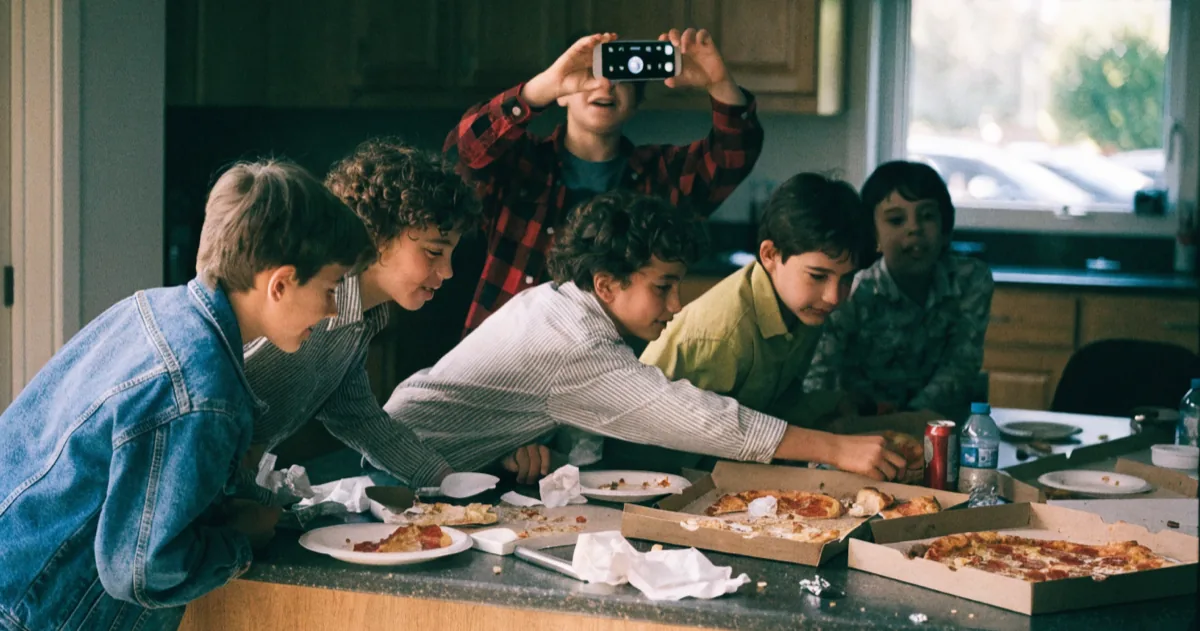
There is a year in every childhood when the party stops being for the parents. The bouncy castle, the themed plates, the games where an adult holds a whistle — all of it worked last year and none of it works now. Nobody announces the change. You find out from a face.
That year usually falls somewhere between 10 and 12, and it is the hardest party to plan, because your child now has opinions, an audience, and no ability to tell you what they want. Search for birthday party ideas for tweens and you get forty of them in six buckets labelled "high-energy" and "creative", which is a list, not a decision.
So this is sorted differently. Three shapes first — because where it happens and who supervises decides more than any theme does — then 22 ideas inside those shapes, each with the thing that goes wrong with it. And one section on what actually happens to the photographs at this age, which is stranger than it sounds.
Key takeaways - Pick the shape before the theme. Home-by-evening, sleepover, and out-of-the-house are three different parties with three different failure modes. - A 10th and a 12th are not the same event. Roughly three in ten 8- and 9-year-olds have their own phone; among 12- and 13-year-olds it is about seven in ten. - Every idea below has a drawback printed next to it. A list where nothing has a downside is a list nobody has run. - Two rules make games work at this age: nobody is eliminated, and nobody performs alone unless they volunteered. - The party will be photographed almost entirely by guests, and almost none of it will reach the person whose birthday it was.
What changes between 9 and 12?
The audience changes. That is the whole difference, and everything else follows from it.
Up to about nine, a birthday party is performed for the adults in the room; the child is the occasion. From ten onwards the party is performed for the friend group, and the friend group has just become the thing that matters most. The CDC's parenting guidance for middle childhood puts it plainly: between 9 and 11 children "form stronger, more complex friendships and peer relationships," it "becomes more emotionally important to have friends," and they "experience more peer pressure" (CDC, Positive Parenting Tips: Middle Childhood 9–11). The same sheet notes that children this age become more aware of their bodies as puberty approaches.
Put those two together and you get the real constraint on a tween party: the cost of embarrassment has gone up, and it is now paid in front of witnesses whose opinion your child cares about more than yours. That is why "babyish" is not a taste objection. It is a social risk assessment.
The other thing that changes is measurable, and it is the reason a 10th and a 12th birthday are not the same party at all. Common Sense Media, which defines tweens as 8- to 12-year-olds, found 43% of them owned a smartphone in 2021, up from 24% in 2015. Broken down by single year of age, the split inside the band is severe: about three in ten 8- and 9-year-olds have their own phone, against roughly seven in ten 12- and 13-year-olds (The Common Sense Census: Media Use by Tweens and Teens, 2021).
The tween band straddles the point where owning a phone crosses over from a minority thing to a majority thing. A 10-year-old's guest list and a 12-year-old's guest list are not carrying the same hardware, and the same plan — "the kids will take their own photos", "they'll sort out the music", "they can message each other about it" — produces two completely different afternoons two grades apart.
| Nearer 10 | Nearer 12 | |
|---|---|---|
| Phones in the room | A minority | A majority |
| Who plans it | You, with a veto from them | Them, with a budget from you |
| Structure needed | Most of the afternoon | The first hour, then get out of the way |
| Games | Still welcome, if nobody is out | Only if they don't look like school |
| Biggest risk | Boredom | Embarrassment |
Pick the shape before you pick the theme
There are three shapes a tween party can take, and the theme is a decoration on whichever one you choose. Choosing the theme first is how people end up with a spa party that needed four adults and had one.
| Shape | Works with | Adult attention it needs | Where it falls apart |
|---|---|---|---|
| At home, over by evening | 6–12 guests | One adult present, one on call | The unplanned half hour in the middle |
| Sleepover | 3–6 guests | One adult awake late, one awake early | The next 24 hours, for everyone |
| Out of the house | 4–10 guests | Two adults, mostly for transport | Cost, and losing control of the pacing |
One question decides the shape more than budget does: is this drop-off? Ask your child, because at this age they will have a view and it is usually the deciding one. Then settle it before the invitations go out, because it changes the adult-to-child ratio you need, and because a parent who expected to stay and discovers otherwise in your hallway is a bad start to three hours.
Whatever you pick, hand the theme inside it to the birthday child. The shape is a logistics decision and yours. The theme is a taste decision and theirs, and this is the first year that distinction is worth respecting out loud.
Eight ideas for a party at home
Home is the cheapest shape and the one with the most failure modes, because you own the pacing. Every idea below assumes 6 to 12 guests and roughly three hours.
1. Mystery-box cook-off
Four teams, four identical boxes of ingredients, one hour, and an adult who tastes everything with a straight face. It fills time, it produces the food, and it is the rare activity that 10-year-olds and 12-year-olds both take seriously.
The catch: your kitchen afterwards. And you need enough of each ingredient for four boxes, so shop the day before, not that morning.
2. Blacklight party
Two UV tubes, white clothing requested on the invitation, highlighter pens, and the overhead lights off. It costs almost nothing and it photographs unusually well.
The catch: it needs darkness, so it works from about October to March and not at 4pm in June.
3. Redub a film scene
Pick a three-minute scene from something everyone knows, mute it, and let teams write and record new dialogue over it. Then watch all four versions back.
The catch: the writing takes longer than they expect and the recording takes less. Budget 40 minutes for the script and 10 for the take.
4. An obstacle course they build
Give them the garden, the garage, and a rule that nothing may be climbed higher than a chair. They build it, then they time each other on it.
The catch: the building is the activity, and it is over in 45 minutes. Have something ready for after.
5. A one-room escape room
You hide five clues that chain into a padlocked box with the cake in it. It takes an evening to write and about 40 minutes to solve.
The catch: whoever reads fastest solves everything. Split the clues so each one needs a different skill — one to read, one to count, one to look behind something.
6. Tie-dye, or one colour only
Plain white T-shirts and dye, outdoors. The variant that works better at the top of this age band is a single-colour rule: everything they make that afternoon has to be one agreed colour.
The catch: the shirts need to dry, which means guests leave without them unless you plan a handover.
7. A bracket on the wall
Any game at all — table tennis, Mario Kart, a card game, thumb wars — drawn as a knockout bracket on a big sheet of paper on the wall. The bracket is doing the work, not the game.
The catch: it is elimination, which is the one thing that usually fails at this age. Fix it by running a losers' bracket so nobody is finished until the very end.
8. Silent disco
Three cheap sets of headphones and three phones on three playlists, or a proper rental if the budget allows. It is loud for them and silent for you, which is a genuine gift after two hours.
The catch: below about 11 it is often more baffling than fun. This one skews to the top of the band.
Five ideas when it is a sleepover
A sleepover's real cost is not the night. It is the next day, for every household that sent a child.
The American Academy of Sleep Medicine advises that "children 6 to 12 years of age should sleep 9 to 12 hours per 24 hours," and puts that figure forward as the amount needed "on a regular basis to promote optimal health, daytime alertness and school performance" (AASM child sleep duration advisory). A sleepover will not hit that, and pretending otherwise is how you end up with a 7am meltdown you did not plan for. Treat the sleep debt as a known cost, tell the other parents what time you expect lights out, and keep the guest list to three or four so the deficit is survivable.
9. A midnight-ish breakfast
Pancakes at 11pm, announced in advance. It gives the night a scheduled peak, which stops the whole thing from drifting into a slow argument about who is going to sleep first.
The catch: it moves lights out later by design. Only run it if you have already given up on an early night.
10. Build the sleeping place
Not a bought tent — a built one. Sheets, clothes airers, dining chairs, fairy lights, and the rule that everyone has to be able to sleep in whatever they make.
The catch: it collapses at about 2am. This is fine and mildly funny at 2am, provided nobody is under it.
11. A horror ladder
Three films or three episodes, ordered from mildest to least mild, with a stated agreement that they stop at whichever rung the group wants. Announced as a ladder, stopping is a group decision instead of one child admitting they're scared.
The catch: know your guests, and tell the other parents what is on the list. One frightened 10-year-old at 1am becomes a phone call.
12. The quiet hour, written down
A signed contract, literally on paper: from a stated time, one hour of no talking. Whoever speaks first has to make breakfast. It is a game rather than an instruction, which is why it tends to land where "go to sleep" does not.
The catch: it works once. Do not try it twice in one night.
13. A pancake bar in the morning
Batter made the night before, three toppings, and the birthday child running it. Parents arriving at 9am to a fed child is worth more goodwill than the entire rest of the party.
The catch: you are the one making batter at 11pm. Do it before the guests arrive.
The exit clause.
Announce on the invitation that any guest can go home at any point in the evening, no explanation needed. Said in advance it is a normal option; negotiated at 10pm with a crying 10-year-old and a woken parent, it is a crisis.
Six ideas out of the house
Going out buys you supervision and costs you control. Somebody else runs the activity, which is the point, but you also cannot slow it down, extend it, or change it when it is not working.
Before the obvious one: trampoline parks turn up on most tween party lists, and they are one of the few venues with published injury data behind them. US emergency department visits for trampoline park injuries rose from an estimated 581 in 2010 to 6,932 in 2014, and park patients were markedly older than home-trampoline patients — mean age 13.3 years against 9.5 — with park injuries more likely to warrant hospital admission (odds ratio 1.76) (Kasmire et al., Pediatrics, 2016). The older average is the part that matters here: the injured population at these venues is this age band, not younger children. It is not a reason never to go. It is a reason to check the venue's rules on double-bouncing and on mixing sizes in one court, and to warn the other parents that you are going there.
14. Escape room
The best-fitting commercial venue for this age. It is 60 minutes, it has an obvious structure, and it makes a group of six feel clever together.
The catch: per-head cost, and most rooms cap at six to eight. Book the room, then build the guest list around it, not the reverse.
15. Climbing gym
Two hours, taught by an instructor, physically hard enough that they eat afterwards. It handles a wide range of confidence in one group, which few venues do.
The catch: waivers, signed by each guest's own parent in advance. Chasing eight signatures on the morning is its own party.
16. Bowling with invented scoring
Bowling on its own is thin. Bowling where the birthday child writes the scoring rules — left-handed frames worth double, gutter balls worth a point, one banned word — is a different evening entirely.
The catch: the rules must be written and posted before the first frame, or the last hour is a rules argument.
17. A town scavenger hunt
A list of 20 photo tasks, teams of three, one adult per team walking behind at a distance, meeting point and hard deadline agreed in advance.
The catch: it needs one adult per team, and it needs a place where letting them roam 30 metres ahead is reasonable.
18. Pottery or paint studio
Two calm hours, everyone leaves with an object, and it suits a group that does not want to be shouted at by an instructor.
The catch: fired pieces come back in a fortnight, so the party ends without the thing they made. Say so at the start.
19. Cinema, plus the hour after
The film is not the party — it is the thing they do before the party. Book somewhere within walking distance for after, because the entire social content of a cinema trip happens in the hour that follows it.
The catch: two hours of your budget buys zero conversation. Never let the film be the whole plan.
Three ideas when the guest list is three people
A short guest list at this age is a choice, not a failure. Friendships in middle childhood get stronger and more complex, and having them becomes more emotionally important (CDC) — so plenty of children would rather have two people for a whole day than nine for three hours. If yours asks for that, take the offer.
20. A day out they choose
One activity, chosen by the birthday child with a budget stated up front, with two friends. A city, a match, a concert, a long walk with good food at the end.
The catch: it costs per head what a party costs in total, so the small number is the budget.
21. Hotel night at home
Room service on a tray, a "do not disturb" sign that is actually honoured, films, and nobody coming in. The whole idea is that the adults stay out.
The catch: honouring it. If you walk in twice, it is just a sleepover.
22. A yes day, with three rules
For one day the answer is yes, subject to three limits set in the morning: a spending cap, a geographic boundary, and one non-negotiable. Write the three rules down.
The catch: write them down. Verbal rules on a yes day are relitigated hourly.
Games that hold a room of eleven-year-olds
Two rules cover almost everything. Nobody is eliminated, because being out means twenty minutes of standing at the edge watching your friends, which at this age is genuinely miserable. And nobody performs alone in front of the group unless they volunteered — the same child who will sing in the car will not sing in a circle of nine classmates.
Games that survive both rules:
- Minute-to-win-it stations. Six 60-second challenges around the room, rotating in pairs. Everyone is doing something at all times.
- Ranking arguments. Twelve items on cards — sandwich fillings, film characters, school subjects — and the group has to agree an order. Loud, entirely verbal, and it costs a pen.
- Werewolf or mafia. A reliable choice at this age, and one of the few games that gets better as the group gets bigger. Needs one confident narrator, who can be an adult.
- Guess the intro. Five seconds of each track, teams shout. Let the birthday child build the playlist, which makes it their party twice over.
- Human bingo. A grid of facts to find owners for. Works specifically when the group does not all know each other.
- One long game for the back half. A chained puzzle, a treasure hunt, a build challenge — something that runs 45 minutes without you. Put your biggest idea in the back half, where you will have the least energy left to steer.
The guest list, the phones and the food
Three logistics decide more than the theme does.
The guest list.
If your school has a whole-class invitation convention, check whether it still applies at this grade — several do not carry it past elementary. Either way the list will be discussed at school by Tuesday. Decide who is coming before you say anything to anyone, and let your child own the decision — they know the group's politics far better than you do. The one thing worth insisting on is that the list is settled in one sitting, not revised for a fortnight.
Phones.
Pick a posture and put it on the invitation, so no guest arrives with the wrong expectation. Three that work:
- Free. Simplest, and honest. Expect a stretch where everyone is on a screen together.
- One basket. Phones in a bowl by the door, back at the end. Works well at 10 and 11, badly at 12, and never if the parents were not told.
- One photo round. Ten minutes, phones out, everybody takes pictures; then away. This is the one to use if you want photographs of the party at all.
Food.
On a list of ten, assume one allergy. A survey of more than 38,000 children found that nearly 8% of US children have a food allergy — one in 13, or roughly two in every classroom (FARE, Food Allergy Facts and Statistics). Ask on the invitation rather than in the hallway, and build the menu so the allergic child eats the same meal as everyone else rather than a special plate, which at this age is worse than the allergy.
Where the photos go, and why the birthday child never sees them
Here is the part almost nobody plans for, and it is specific to this age.
The party will be photographed, thoroughly, by guests — the more so the nearer to 12 you are. And then nearly all of those pictures stay exactly where they were taken, because the mechanism that normally moves photographs between people — social platforms — is one most of the guest list is not legally old enough to be on.
Thirteen is the line, and it is drawn in law before it is drawn in any app's settings. The US Children's Online Privacy Protection Act defines a "child" as "an individual under the age of 13" (15 U.S.C. § 6501), and 13 is where the platforms put their own floor: Snapchat states outright that "the minimum age to have a Snapchat account is 13 years old" (Snapchat Support). And the usage data matches: only 38% of tweens have ever used social media at all, with 18% using it daily (Common Sense Media, 2021).
So "they'll share it in the group chat" quietly assumes a group chat most of the guests are not in, on a service most of them cannot legally join, reached from a phone plenty of them do not own. The pictures do not vanish. They sit in one camera roll each, going nowhere, and the child the party was for ends up with the four their own parent took.
The fix is unglamorous: one place everyone can put things into, that needs no account and no app. A shared album everyone can add to from a single link solves it in the way this age group actually needs — a guest with a phone opens the link and uploads, a guest without one hands their pictures to a parent who does, and the ones who want to leave a video or a voice message instead of a photo can do that into the same album. Print the link, or its QR code, and tape it to the snack table where every guest passes it. Then do the ten-minute photo round, once, while everyone is still in the same room.
Do it at the start rather than the end. At the end, half of them have already gone home.
A timeline that holds for three hours
Three hours, four blocks, and one spare activity you can drop without anybody noticing it was ever planned.
| Time | What is happening |
|---|---|
| 0:00–0:30 | Arrivals. Something to do immediately for whoever is first, because the first guest alone with the birthday child is the most awkward 20 minutes of the day. |
| 0:30–1:15 | The first activity. The loud one. |
| 1:15–1:45 | Food. It is also the rest. |
| 1:45–2:40 | The long game — the thing that runs itself. |
| 2:40–3:00 | Cake, then the wind-down while parents arrive. |
Two notes. Plan one activity more than you need and pick in advance which one you would cut, so cutting it is a decision and not a panic. And put cake near the end rather than the middle: it is the natural closing marker, and it gives the arriving parents something to walk in on.
What to do this week
Pick the shape. Home-by-evening if you want the most control and the lowest cost; a sleepover if the guest list is short and you have written off the following morning; out of the house if you would rather buy supervision than run it. That one decision removes about three quarters of the ideas on this page, which is the point.
Then hand the theme to the birthday child, with a budget and the shape as the boundary. This is the first year that division — you own the logistics, they own the taste — is worth saying out loud, and it is a large part of why the party will land at all.
And set up the album before anyone arrives. Nine phones will photograph the whole afternoon, and without one place to put them, none of it reaches the person it was for.
Sources
- CDC, Positive Parenting Tips for Healthy Child Development: Middle Childhood (9–11 years old) — <https://dhhr.wv.gov/HealthCheck/providerinfo/developmentaltoolkit/parenteducationhandouts/Documents/PosParentingTips9-11.pdf>
- Common Sense Media, The Common Sense Census: Media Use by Tweens and Teens, 2021 — <https://www.commonsensemedia.org/sites/default/files/research/report/8-18-census-integrated-report-final-web_0.pdf>
- American Academy of Sleep Medicine, Child Sleep Duration Health Advisory — <https://aasm.org/advocacy/position-statements/child-sleep-duration-health-advisory/>
- Kasmire KE, Rogers SC, Sturm JJ, Trampoline Park and Home Trampoline Injuries, Pediatrics 2016;138(3):e20161236 — <https://pubmed.ncbi.nlm.nih.gov/27482060/>
- Food Allergy Research & Education (FARE), Food Allergy Facts and Statistics — <https://www.foodallergy.org/resources/facts-and-statistics>
- 15 U.S. Code § 6501, Definitions (COPPA) — <https://www.law.cornell.edu/uscode/text/15/6501>
- Snapchat Support, What's the minimum age to use Snapchat? — <https://help.snapchat.com/hc/en-us/articles/44260062429460-What-s-the-minimum-age-to-use-Snapchat>
Frequently asked
Eleven sits in the middle of the band, which makes it the most forgiving age. A home party with 8 to 10 guests and two structured activities works; so does a small group at an escape room or climbing gym. Ask which of the three shapes they want before you propose any theme — at 11 they will have a real answer, and it is usually not the one you would have guessed.
At 12, plan the first hour and then get out of the way. Most of the room will have a phone, the group can organise itself, and heavy structure reads as school. Out-of-the-house options land well here, as does a home party with one strong activity, good food and space to just be together. A short guest list is common by 12, and it is usually the birthday child's own preference rather than a shortage of friends.
Match the number to the shape, not to the class list. Six to twelve for a party at home, three to six for a sleepover, and whatever the venue caps at when you go out — usually six to eight. A short list is normal at this age, and plenty of children would rather have two people for a whole day than nine for three hours.
Three hours for a party at home, which is long enough to include food and one long activity without needing filler. Out-of-the-house parties are set by the venue, typically 90 minutes to two hours, plus an hour afterwards for the part they will actually remember. Sleepovers should end with a scheduled breakfast rather than an open-ended morning.
Decide it, then put it on the invitation. Any of the three postures works — free, one basket by the door, or one ten-minute photo round — and all three go wrong when a guest arrives expecting a different rule. If you want photographs of the party to exist afterwards, the photo round is the one to run, along with a single place everyone can upload them to.
 Guide
GuideSurprise Birthday Party Ideas: 24 That Stay Secret
Twenty-four surprise birthday party ideas sorted by the reveal, the cover story and the format that hides best — plus the two things every other list skips.
 Guide
Guide90th Birthday Party Ideas: Plan the Room, Then Pick the Theme
Twelve 90th birthday party ideas, five formats to run them in, and the sound, light and print calls that decide whether the guest of honour enjoys it.
 Guide
Guide18th Birthday Party Ideas: 18 Themes and How to Run Them
Eighteen themes for an 18th birthday party, sorted by the format each one needs, plus the one thing a US 18th cannot legally include and what to serve instead.