Christmas team building activities that work when half the team is on a call

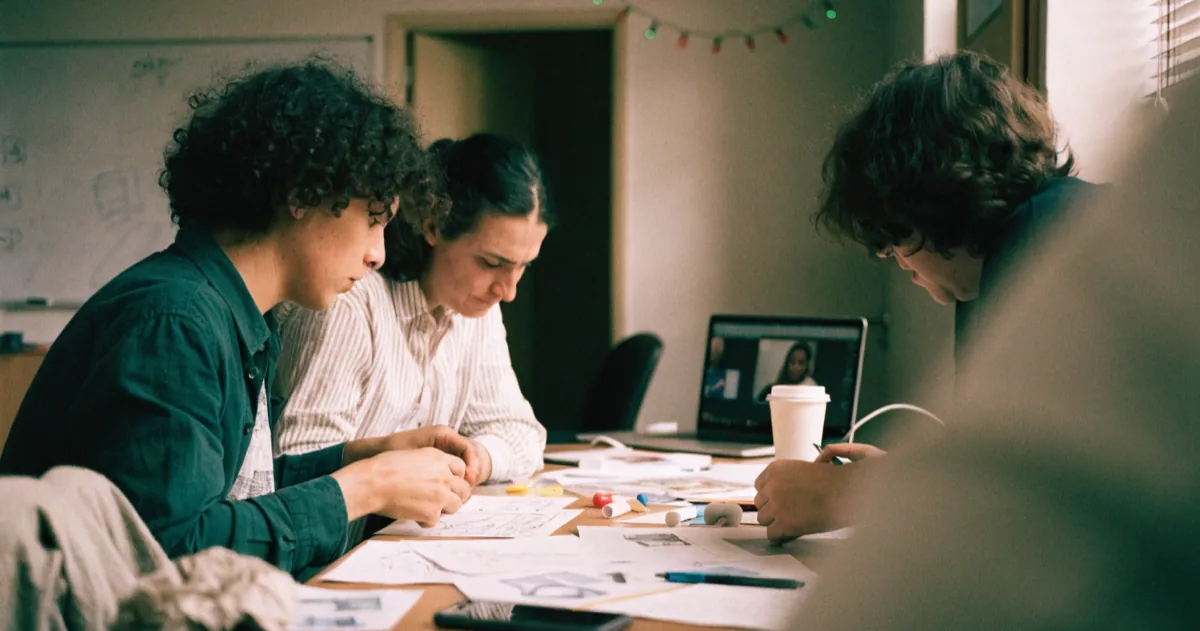
The lists are not short of ideas. One of the top results offers forty-five of them. What none of them tells you is how long any of it takes, what it costs, how many people it holds, or what happens to it when four of your team are on a video call and the other eight are around a table.
Which is the only part you actually need. You have one slot, probably no budget, and a room that is in two places at once.
So here are fourteen, grouped by the question that decides everything else — does everyone have to be there at the same time? — and each one carrying the four facts the lists leave off.
- Sort by when, not where. Same-slot or no-slot is the split that matters; virtual versus in-office is downstream of it.
- A split room is the normal case now. 51% of remote-capable US employees work hybrid, the largest single group (Gallup).
- Free is also the normal case. 17% of companies planned to cut holiday spending in 2024, against 8% the year before (Challenger, Gray & Christmas). Eleven of the fourteen below cost nothing at all; only two need a budget.
- Build the session on the gathering, not the observance. 88% of US adults celebrate Christmas, so roughly one colleague in eight does not (Gallup).
Sort by when people have to be there, not where
A Christmas team building activity
is a structured group task run during working hours in December, whose purpose is that the team works better afterwards. That is what separates it from a Christmas party game, which is entertainment at an evening event and is judged only on whether people enjoyed the evening. Both are worth doing. They answer different questions, they get different slots, and an idea that is excellent at one is usually mediocre at the other — which is why so many of these lists feel like they were written for somebody else's problem.
The categories every list uses — virtual, in-office, hybrid — describe your seating plan. They do not describe your problem. Your problem is the calendar.
An activity that needs everyone at once needs a hole in twelve people's diaries during the busiest fortnight of the year, and it needs the two people in another time zone to still be awake for it. An activity that does not need everyone at once needs nothing except a place to put things. That difference is worth more than any amount of theming.
Start there, and the "virtual" question mostly answers itself. The share of remote-capable US employees working hybrid fell from 55% to 51% over two quarters, and 51% is still the largest single group (Gallup, "Hybrid Work in Retreat? Barely.", based on a random sample of 17,660 US adults working full or part time, surveyed 7–16 May 2025, ±1.1 percentage points). The split room is not an awkward edge case you plan around. It is the default, and an activity that only works when everyone is at the same table is the edge case.
Three further facts then decide between activities inside a category, and they appear as columns in every table below rather than as a section of their own: what it costs, whether it survives a video call, and whether it assumes Christmas.
It is worth being clear about why this is worth the slot at all, because "team building" has been used to justify a lot of bad afternoons. Just two in ten US employees report having a best friend at work (Gallup). Whatever else December is, it is the one month where a work calendar has room for people to talk to each other about something other than work. That is the resource. Do not spend it on a quiz nobody remembers.
Christmas team building activities for a split room
These five work with people in two places at once, for one shared reason: what they produce is made out of words, not out of an object on one particular table.
An activity that survives a video call
is one whose output can be described rather than shown — a story, a guess, a thank-you, a drawing each person makes separately. Anything whose output is physical and singular — a gingerbread house, a decorated tree, one table's worth of wrapping paper — silently demotes everyone who is not in the building to an audience.
| Activity | Minutes | Costs | Works on video | Needs Christmas |
|---|---|---|---|---|
| Identical instructions, different snowflakes | 15 | Nothing | Yes | No, winter is enough |
| One thing I learned this year | 30 | Nothing | Yes | No |
| The specific thank-you | 20 | Nothing | Yes | No |
| A quiz the team writes about itself | 25 | Nothing | Yes | Optional |
| Blind build, in pairs | 25 | Nothing | Yes, with breakouts | No |
Minutes are planning figures — the blocks I would put on a calendar, not measurements. They run long more often than short.
Identical instructions, different snowflakes
Everyone takes a sheet of A4 and closes their eyes, or turns the camera off. You read one set of folding and tearing instructions. Nobody may ask a question. Everyone opens their eyes to a completely different snowflake.
It takes fifteen minutes, costs a sheet of paper, and it is the rare December activity with an actual point at the end of it: twelve people received the same brief and produced twelve different things, and not one of them was being careless. Anyone who has ever written a ticket recognises the feeling immediately.
One thing I learned this year
Three minutes each, no slides, and the sign-up sheet stays voluntary — the moment it becomes a rota it is a performance review with mince pies. Six speakers fills thirty minutes comfortably.
The rule that makes it work is that it does not have to be about work. The person who learned to solder, the person who finally understood their mortgage, the person who read forty books: those are the ones people talk about in January.
The specific thank-you
Each person names one specific thing one named colleague did this year. One rule, and it is the whole activity: no adjectives about the person, only the thing they did. Not "Sam is so helpful". "Sam rewrote the deploy script the week I was on leave and did not tell anyone."
Twenty minutes for a team of ten. It is the quietest thing on this list and the one people remember, because specificity is the part that is hard to fake and impossible to give to the wrong person.
A quiz the team writes about itself
A week ahead, ask everyone for one question about themselves with an answer only two or three people would know. You read them out; the room guesses. Twenty-five minutes.
This is not general-knowledge trivia and it is better than it, because nobody arrives already good at it. It also solves the problem of the new starter who joined in September and knows six names: by the end they know something about everyone, and nobody had to run an icebreaker at them.
Blind build, in pairs
Pairs, one screen share or one desk each. One person has a simple object — a stapler, a mug, a paperclip sculpture they just made — and describes it without naming it. The other builds or draws it from whatever is in front of them. Then swap.
Twenty-five minutes including the comparison at the end, which is the funny part. It needs breakout rooms if you are on a call, and it is the only activity here that works better mixed, with each pair split across the two locations.
Free Christmas team building activities for the office
Free is not the small-company case. In Challenger, Gray & Christmas's 2024 survey of 173 HR and business leaders, 17% of companies planned to reduce spending on their holiday party, against 8% the year before (Challenger, Gray & Christmas). If you have been told there is no budget, you are in the majority, and it is not a reflection on your team.
These four need the building and nothing else.
| Activity | Minutes | Costs | Works on video | Needs Christmas |
|---|---|---|---|---|
| Decorate someone else's desk | 40 | Nothing | No | Loosely |
| The walk-and-talk, in threes | 30 | Nothing | No | No |
| A wrapping station for a local charity | 2 hours, drop in | Nothing to you | No | Yes |
| The December dish table | 60 | Each person a little | No | No |
Decorate someone else's desk
Names out of a hat. You decorate the desk of whoever you drew, using only what is already in the building — printer paper, a highlighter, whatever is in the stationery cupboard. No spending, and that constraint is what makes it good rather than what limits it.
Forty minutes. The output is that everyone arrives at a desk somebody thought about, which is a better morning than a tinsel budget buys.
The walk-and-talk, in threes
Thirty minutes, out of the building, groups of three drawn at random, one prompt to start them off. Threes rather than pairs, because a pair that runs out of things to say has nowhere to go and a group of four splits into two pairs within a hundred metres.
It is the only activity here that suits the people who quietly dread all of the others, and in December it has the additional advantage of being the one time of day anyone sees daylight.
A wrapping station for a local charity
A table, two hours, a stack of donated gifts from a local toy appeal or shelter, and people drop in when they can. Nobody has to be there for the whole thing, and the room fills up anyway.
Check with the charity first: many run their own wrapping rules, and some would rather have the two hours of your time on a different task entirely. Ask before you buy paper.
The December dish table
Everyone brings one dish and the story of who taught them to make it. The story is the activity; the food is the excuse.
Be honest that this one is not free — it costs every participant the price of an ingredient list and an evening. Say so when you invite people, and make it plainly optional, or the person who cannot afford it this month has to invent an excuse.
Activities with no start time at all
An asynchronous team building activity
is one that runs over days instead of in a slot, so that taking part costs each person a minute whenever they happen to have one. This is the category the lists do not have, and for a distributed team it is the most useful one. Nobody has to be in the same 45 minutes. Nobody in another time zone gets a 9pm invitation. The person on parental leave who wants to be included can be, and the one who does not can quietly skip it without anyone tallying attendance.
| Activity | Runs for | Costs | Works on video | Needs Christmas |
|---|---|---|---|---|
| A December photo prompt a day | 3 weeks | Nothing | N/A | No |
| The voice-note year in review | 1 week | Nothing | N/A | No |
| The anonymous appreciation wall | 2 weeks | Nothing | N/A | No |
A December photo prompt a day
One small prompt per working day, posted somewhere everyone can see: your desk right now, the worst mug in your kitchen, what you can see out of the nearest window, the oldest thing on your desk, your commute today, something you made this year. Fifteen prompts covers three working weeks.
It works because the barrier is one photo and the entry cost is ten seconds, which is the only reason anyone participates in anything in December. It is also the single activity here that produces something the team still has in February.
The mechanism matters more than the prompts. If the photos land in a chat thread they are gone by the second week, buried under standup notes; if they land in five different chat threads they were never collected at all. What this needs is one album everyone can add to — one link, no accounts to create, and the person on their phone at a train station adds to the same place as the person on a laptop. Photos, short videos and voice notes all going to one address is what turns fifteen days of prompts into a thing rather than fifteen days of scrolling.
The voice-note year in review
Everyone records thirty seconds — the best thing about this year, or one moment they would keep. Voice, not text, and the difference is not small: people are funnier and more honest out loud than they are in a message box, and it takes them less time. It is the same reason spoken guest messages outlast written ones at a wedding — a voice carries the person, and a typed line carries the sentiment they thought they were supposed to have.
A week to collect. Play them, or do not play them; a lot of teams find that the recording is the point and the listening is optional.
The anonymous appreciation wall
A shared page, open for a fortnight, anyone can add a line about anyone. Anonymous in the writing, named in the subject: "whoever fixed the printer in October, you have no idea".
Two weeks, because a wall that opens and closes on the same afternoon collects four entries from the four people who happened to be online.
The two worth paying for, and when
Eleven of the fourteen cost nothing and a twelfth costs the participants rather than the company. These two cost money, and they are worth it in one specific situation: when the team genuinely does not know each other yet — a merged department, a first December after heavy hiring — and you need something with a host, because a group of strangers will not self-start.
Be realistic about the shape of what you are buying. In the same 2024 Challenger survey, 64% of companies were planning a holiday celebration — and 4.5% of companies were holding a virtual one, up from 3.9% the year before (Challenger, Gray & Christmas). The booked virtual experience is a small slice of what companies actually do, which means the vendor market for it is thinner than its search results suggest.
A hosted game show or escape room.
Ask three questions before booking, in this order:
- What is the headcount ceiling per host? Not per session — per host. A "we handle up to 200" that runs on one facilitator is a webinar with a quiz attached.
- What happens if four people drop out on the morning? December attrition is normal. Ask whether you are charged for the booked number or the attended one.
- Do the remote participants get the same experience, or a watching brief? This is the one that gets a revealing answer. Vendors who have solved it will tell you exactly how, in detail, without being asked twice. Vendors who have not will change the subject to their client list.
A cook-along or a tasting box.
Kits arrive at home addresses, which is the part that makes it genuinely fair to the remote half for once. Order at least three weeks out; December delivery slots are the constraint, not the cooking. Check dietary requirements before you order rather than after, and check whether the vendor ships to every country your team lives in — plenty do not, and finding out late means one person watching eleven others eat.
If you are choosing between paying for a team session and paying for the party itself, the party usually wins on money-per-memory. That is a different decision with a different set of trade-offs, and it is worth reading about picking a theme for the party itself before you spend the budget twice.
What changes under ten people
Two things break, both quietly.
Teams stop working.
Any activity that says "split into groups" needs at least twelve people to produce groups that feel like groups. Under ten you get pairs plus an awkward three, and the competitive framing that carries a big room just makes a small one tense.
The host role stops working.
In a room of forty, the host is a function. In a room of eight, the host is a person who is not participating, and that is a quarter of your energy gone. Pick things that run themselves.
Four from this list survive under ten and get better rather than worse: the specific thank-you, one thing I learned this year, the walk-and-talk, and the voice-note year in review. All four scale down because they are sequential rather than competitive — one person at a time, no teams to form.
The one to drop under ten is the quiz. With eight people, a quiz about the team is four questions long and everyone knows all the answers.
The two people it lands badly on
Two ordinary facts about your room decide more than the choice of activity does.
Roughly one colleague in eight does not celebrate Christmas at all.
88% of US adults say they celebrate it, essentially unchanged from 90% the year before (Gallup, surveyed 1–15 December 2024, n=1,016, ±4 percentage points). That is not a large minority, and it is not a reason to strip December of everything. It is a reason to notice which part of the holiday you are building on. The same poll found 95% gather with family and friends and 96% exchange gifts, while 47% attend a church service — down from 64% in 2010. The shared part is the gathering. Build on that and almost nobody is standing outside it; build on the nativity and some people are.
In practice this is why most of the activities above say "no" in the needs Christmas column. December, winter, the end of the year and the fact that everyone is tired are all completely serviceable themes, and none of them require anybody to opt out of their own team's afternoon.
Close to half the room does not drink.
In Gallup's 2025 Consumption Habits poll, 54% of US adults said they drink alcohol — the lowest figure in Gallup's nearly 90-year trend, down from 62% in 2023 and 58% in 2024 (Gallup, surveyed 7–21 July 2025, n=1,002, ±4 percentage points). An activity whose structure is built on drinking — a tasting, a cocktail-making class, anything that starts at the bar — is not a small imposition on a minority any more. It is a coin flip.
And whatever you choose, make the opt-out silent. Somebody should be able to skip the afternoon without saying why in front of their manager. If the only route out is a conversation, it is not an opt-out; it is a request.
Which week of December to put it in
The second week. Almost never the last one.
The last full week before the holiday is the worst slot available, for reasons that have nothing to do with festivity. The people you most want in the room booked their leave in October. Year-end deadlines land there. And anyone still at their desk that week is there because something is on fire, which is precisely the wrong state of mind to walk into a snowflake exercise.
The first week is too early for anything reflective — nobody feels like the year is over yet, and "one thing I learned this year" gets thin answers on the 2nd of December. It is fine for the things that need setting up.
So: put the same-slot session in the second week, and get the invitation out in November, before people's calendars close. The asynchronous three are the exception and should start on the first working day of the month — they have no slot to defend, they benefit from running long, and by the time the second-week session happens you already have three weeks of photos and voice notes to open it with.
One more scheduling note that is worth more than it sounds: do it during working hours. An evening activity is a favour you are asking of people with childcare, commutes and a life, and the ones who most need to be included are exactly the ones who will decline.
The short version, again
Sort by when, not where: the split between "everyone in one slot" and "no slot at all" decides more than any theme does. Assume a split room, because at 51% hybrid among remote-capable employees that is the ordinary case. Assume no budget, because most companies are cutting. Put the live session in the second week of December and the asynchronous ones across the whole month. Build the whole thing on the gathering rather than the observance, and make the exit quiet.
Then pick two from the tables above, book the room, and stop reading lists.
Sources
- Gallup, "Hybrid Work in Retreat? Barely." — Q2 2025 data, random sample of 17,660 US adults working full or part time, surveyed 7–16 May 2025, margin of error ±1.1 percentage points. <https://www.gallup.com/workplace/694361/hybrid-work-retreat-barely.aspx>
- Gallup, "Secular Christmas Traditions Persist as Sacred Ones Decline" — telephone poll of 1,016 US adults, 1–15 December 2024, margin of error ±4 percentage points. <https://news.gallup.com/poll/700271/secular-christmas-traditions-persist-sacred-ones-decline.aspx>
- Gallup, "U.S. Drinking Rate at New Low as Alcohol Concerns Surge" — 2025 Consumption Habits poll, 1,002 US adults surveyed 7–21 July 2025, margin of error ±4 percentage points. <https://news.gallup.com/poll/693362/drinking-rate-new-low-alcohol-concerns-surge.aspx>
- Gallup, "The Increasing Importance of a Best Friend at Work". <https://www.gallup.com/workplace/397058/increasing-importance-best-friend-work.aspx>
- Challenger, Gray & Christmas, 2024 year-end survey of 173 HR and business leaders, conducted November–December 2024. <https://www.challengergray.com/blog/2024-rate-of-parties-on-par-with-2023-but-with-lower-budgets-companies-optimistic-on-hiring-business-conditions-heading-into-new-year/>
Frequently asked
The ones whose output is words rather than a physical object. The specific thank-you round, one-thing-I-learned lightning talks, a quiz the team writes about itself, and blind build in pairs all work identically in both rooms. Anything built around one table — a gingerbread build, a decorated tree, a gift-wrapping race — turns your remote colleagues into an audience.
Yes, and most of the good ones are free. Eleven of the fourteen here cost nothing beyond paper and a calendar invitation. Decorating someone else's desk with only what is in the building, a thirty-minute walk in threes, and a photo prompt a day all cost zero, and none of them is a compromise version of a paid activity.
Plan one 45-minute block and fill it with two activities, not five. Fifteen to twenty-five minutes each, with five minutes between them for the reset. Overrunning is the normal failure — every one of these takes longer than it looks on paper, mostly because people talk.
The three asynchronous activities are all direct substitutes and none of them costs a participant money: a December photo prompt a day, a thirty-second voice note from each person, or an anonymous appreciation wall. Secret Santa quietly charges everyone the same amount regardless of what December is doing to their bank account, which is the main argument against it.
Build it on the end of the year rather than on the holiday. Gallup found 88% of US adults celebrate Christmas but 95% gather with family and friends — the gathering is the near-universal part, the observance is not. Winter, the end of the year and "we all survived this" are themes nobody has to opt out of, and the opt-out that does exist should never require an explanation.
 Guide
GuideCompany Christmas party games: the 14 that survive a real work party
Fourteen company Christmas party games with the numbers the lists leave out: how long each one takes, how many people it holds, and who quietly sits it out.
 Guide
GuideTeam building activities for a company retreat: 24 that fit a real agenda
Twenty-four retreat team building activities sorted by the slot they fill, each with a debrief question and the way it fails.
 Guide
GuideCorporate Christmas party ideas: the three questions that pick one for you
Most Christmas party ideas for work are written for a ballroom. Here is how to choose one for the room you actually have, without making anyone buy a costume.