Team building activities for a company retreat: 24 that fit a real agenda

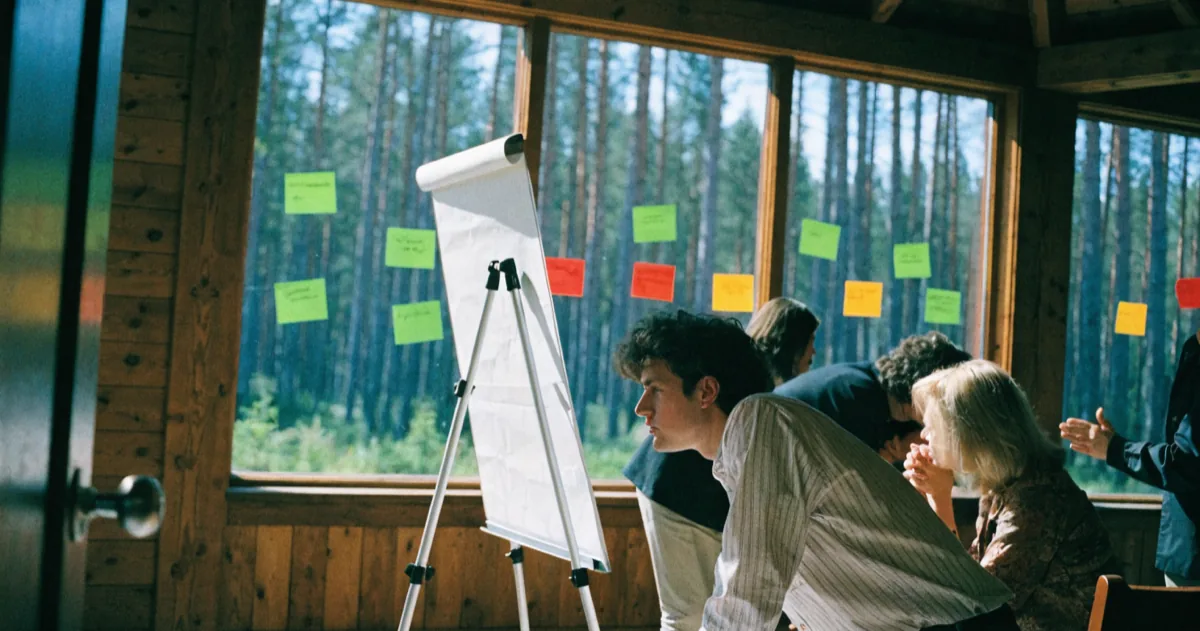
The venue is booked, the flights are booked, and somebody has sent you a spreadsheet with empty cells in it. That is usually the moment people go looking for team building activities for a company retreat, and what they find is a list of thirty-five ideas in no particular order: kayaking, escape rooms, a marshmallow tower, karaoke, a cooking class. All of it plausible. None of it sorted by anything.
A pool of ideas is not an agenda. Activities at a retreat do not mostly fail because they are bad activities — they fail because they were put in the wrong slot. A ninety-minute build challenge is excellent at 2pm on day one and impossible at 9:30pm on arrival night, when a third of the group is still in a taxi. The same escape room that fixes a Tuesday afternoon will not close a retreat.
So this list is sorted by the slot. Arrival evening, the big daytime block, the working session that is also team building, the evening, and the morning everyone is quiet. Twenty-four activities, each with the number of people it holds, the time it needs, one question to ask afterwards, and the specific way it goes wrong.
Key takeaways - Sort by slot, not by mood. The slot decides more than the activity does. - Plan four to six activities, not thirty-five. In real offsites, team building takes about a fifth of the time. - The debrief is the intervention. Teams that debrief outperform those that do not by roughly 20 to 25 percent, and almost nobody writing retreat lists mentions it. - Voluntary is a condition, not a courtesy. The measured benefit depends on people being able to opt out — discreetly. - Most attendees are paying for part of your retreat out of their own pocket. That should change which evening you plan.
What the retreat is actually repairing
Naming the deficit tells you what to put in the agenda, and for most companies running a retreat in 2026 the deficit is not a lack of strategy alignment. It is that people no longer know each other.
Microsoft's Work Trend Index, a survey of 31,102 full-time workers across 31 countries, found that 59% of hybrid employees and 56% of remote employees have fewer work friendships than before, and that 55% of hybrid and 50% of remote employees feel lonelier at work. The same research found 66% of respondents say doing informal coffee chats virtually feels like "more of a chore" than meeting in person (Microsoft Work Trend Index, Great Expectations).
Read that carefully, because it points somewhere counterintuitive. The thing that has gone missing is informal contact — the accidental conversation, the walk to lunch, the ten minutes before a meeting starts. A retreat agenda packed wall to wall with facilitated exercises replaces informal contact with more scheduled contact, which is the one thing people already have plenty of. The activities below are there to create the conditions for unstructured time, not to consume all of it.
How much room your agenda actually has
Team building gets about a fifth of a real offsite. Plan four to six activities, and treat any list of thirty-five as a catalogue rather than a schedule.
A survey of 2,000 US full-time employees who had attended a corporate offsite in the previous twelve months, fielded by Talker Research in November 2024, found the time split as follows: 36% work-related activities, 25% socialising, 21% team building, and 18% leisure or relaxation. The same study found companies averaged 2.6 offsite events in 2024, that 54% hold one or two a year, and that 59% report budget increases since 2019 (Emburse, The State of Corporate Offsites).
Put those percentages against a two-day retreat with roughly sixteen waking programme hours and you get a rough shape:
| Slice | Share | Two-day retreat |
|---|---|---|
| Work sessions | 36% | About 6 hours |
| Socialising | 25% | About 4 hours |
| Team building | 21% | About 3.5 hours |
| Leisure and rest | 18% | About 3 hours |
Three and a half hours of team building is two activities and a closing circle. Maybe three if one is short. That is the honest budget, and almost every retreat agenda that collapses does so because somebody planned against a number four times larger.
The other line worth defending is the 18%. Unstructured time is a line item in that data, not slack that appeared because you failed to fill it. It is where the deficit from the previous section actually gets repaired, and it is the first thing to disappear when a senior person looks at the grid and says there is a gap at 4pm.
The two conditions that decide whether any of it works
Before the list: two findings that change how you run whatever you pick, and that the retreat-ideas genre almost entirely omits.
The debrief is the intervention
A meta-analysis of 46 samples covering 2,136 people found that debriefs improve effectiveness over a control group by approximately 25% (d = .67), and concluded that organisations "can improve individual and team performance by approximately 20% to 25% by using properly conducted debriefs." The authors describe debriefs as "a relatively inexpensive and quick intervention," and found that alignment, facilitation and structure all matter to the result (Tannenbaum and Cerasoli, Human Factors, 2013).
That is the largest measured effect available to you at a retreat, and it costs ten minutes. The activity is the delivery mechanism; the conversation afterwards is the thing with the number attached. A cooking competition with no debrief is a nice dinner. The same competition followed by ten minutes of "who ended up deciding things, and did anyone notice it happening?" is a team learning something about itself.
Keep the structure simple and use it every time:
- What happened? Facts only, ninety seconds, no interpretation.
- What did we do that we also do at work? This is the whole point. The bridge is the activity; the traffic is the workplace parallel.
- What is one thing we would do differently on Monday? One. Written down where people will see it again.
Every activity below ships with a suggested question for step two, because that is the step people skip.
Voluntary is load-bearing
University of Sydney researchers Petr Matous and Julien Pollack, publishing in Social Networks, found that team building "is well-tested and has been shown to increase interpersonal closeness, however, to be successful it must be voluntary." Their recommendation is that people be able to opt out discreetly, and their interviews found participants who felt management was being "too nosy or trying to control their life too much" (University of Sydney).
Note what that does to the design problem. The question is not how to get everyone to join in. It is how to build an exit that nobody has to be seen using — because an opt-out that requires announcing yourself in front of forty colleagues is not an opt-out.
The mechanism that works is a named parallel option in every slot. Not "you can sit this one out", which makes leaving visible, but a second real thing happening at the same time: a quiet room that is on the agenda, a walk with a stated route and meeting time, a table where people are playing cards. Leaving then means choosing between two activities rather than refusing one, and nobody has to explain anything.
Arrival evening: five for a room that is not assembled yet
Arrivals are staggered, people have travelled, and nothing you plan will have everybody in it. Design for that instead of fighting it: low commitment, easy to join late, easy to leave.
1. Two slides each, neither about the job
Everyone brings two slides. Ninety seconds. The only rule is that neither slide may be about their role, their team or their work. What you get is the fastest route from forty names to forty people, and it gives the rest of the retreat a supply of things to ask about.
Fits 10 to 50 people, 45 to 75 minutes. Debrief question: whose slide surprised you most, and what did you assume before it? Fails when nobody polices the ninety seconds, at which point the fourth speaker sets a five-minute precedent and you lose the evening.
2. The map on the wall
A large printed map by the entrance, a box of pins, two colours: where you live now, where you are from. It costs nothing, it works while people trickle in, and it produces the same conversation over and over without anyone facilitating it.
Any size, runs itself all evening. Debrief question: none needed — this one is scaffolding, not an exercise. Fails when the map is only of one country and half a distributed team cannot pin themselves.
3. Question cards on the dinner tables
Six cards per table, face down, each with one question worth answering out loud. Not icebreakers — questions with actual content. What did you believe about this company before you joined that turned out to be wrong? What part of your job would you keep if we cut everything else?
Any size, absorbs a whole dinner. Debrief question: which answer did more than one person give? Fails when the questions are written to be safe, which produces safe answers and a table that goes quiet after the second card.
4. A side quest that runs all retreat
One list, published on arrival night, of small things to find or do over the next two days: a photo of someone doing something they have never done, the oldest object in the building, two colleagues who share a birthday month. No teams, no prizes worth winning, nothing scheduled.
Any size, runs 48 hours in the background. Debrief question: save it for the close. Fails when it is presented as a competition with a real prize, which turns background fun into another obligation.
5. The staffed nothing
An area, a host, a stated place on the agenda, and no programme: drinks, a couple of card games, chairs arranged for conversation. This is the named parallel option for arrival night, and it is the item most likely to be cut by whoever thinks a gap is a planning failure.
Any size, all evening. Debrief question: none. Fails when it is not on the printed agenda, because then choosing it looks like opting out rather than picking the other thing.
The big daytime block: seven worth 90 to 180 minutes
This is the only slot long enough for anything with a build in it, and most retreats have exactly one per day. Spend it on something that could not have been a video call.
6. Build a thing under one hard constraint
Cardboard boats that have to float with a person in them, a bridge between two tables that holds a full kettle, a catapult with a target thirty feet away. The constraint has to be physical and public, so that success and failure are obvious to everyone at the same moment.
Fits 8 to 60 in teams of 4 to 6, 90 to 120 minutes. Debrief question: how did your team decide to stop designing and start building, and who made that call? Fails when the constraint is vague. "Make something creative" produces four teams quietly waiting for someone else to define the task.
7. Cook the dinner you are going to eat
Teams take a course each and the whole group eats the result at 7pm. The deadline is not invented — the deadline is dinner, and everyone can see the clock. It handles a wide range of confidence, because there is a job at every skill level.
Fits 8 to 40, 2 to 3 hours including eating. Debrief question: which team ran out of time, and what did the others do about it once they noticed? Fails when dietary requirements are collected after the menu is set. See the food section below.
8. A brief, not a scavenger list
Send teams into the nearest town with a brief rather than a checklist: find the best meal under fifteen euros and be prepared to defend it, or bring back the object that best represents this town for under ten. Judged on the argument, not the object.
Fits 9 to 40 in teams of 3 to 5, 2 to 3 hours. Debrief question: how did your team resolve it when two people wanted different answers? Fails when it becomes a list of twenty photo tasks, which turns a judgement exercise into a race and rewards whoever walks fastest.
9. Escape rooms, deliberately split
Book two or three rooms and split the group. The value is not the puzzle; it is the sixty minutes afterwards when three groups compare how they organised themselves and discover they did it three different ways.
Fits 12 to 30 across multiple rooms, 60 minutes plus travel. Debrief question: who ended up leading, and was it the person who leads at work? Fails when everyone is in one room and eight people stand behind three people who are doing everything.
10. Skills swap
Six colleagues each teach a thirty-minute lesson in something they know and their job does not use: knife skills, film photography, how a mortgage works, basic Portuguese. Two rounds, people pick. It is the cheapest activity on this list and reliably the best reviewed.
Fits 15 to 80, 60 to 90 minutes for two rounds. Debrief question: what did you learn about a colleague from watching them teach? Fails when the lessons are work topics, which turns a retreat into a conference.
11. Local volunteering, booked properly
A morning at a food bank, a trail clear, a build day with a local organisation. Done well it is the activity people remember for years. Done badly it is a group of consultants standing around a garden being politely tolerated.
Fits 10 to 60, half a day. Debrief question: what did the people who do this every day make look easy? Fails when it is booked for the photo opportunity. Ask the organisation what they actually need, accept that the answer may be a boring task, and if they do not need help that week, do something else.
12. The outdoor adventure day
Rafting, high ropes, mountain biking. It is the most-sold retreat activity and the one that needs the most honesty from you, because a single physical activity for the whole group excludes people on fitness, on injury, on confidence, on body size, and sometimes on faith or dress — and every one of those people has to opt out in public.
Fits 10 to 40, a full day. Debrief question: what did you do when a teammate was struggling? Fails when there is no equally good parallel option. If you run this, the alternative has to be a real activity with its own host and its own place on the agenda, not "you can stay at the hotel."
Four working sessions that are also team building
These are the activities that survive a budget review, because they produce something. They are also where the 36% work slice and the 21% team-building slice overlap, which means they earn their slot twice.
13. An unconference half-day
Empty grid, four rooms, four time slots. Anyone can propose a session by writing it on a card and sticking it up; people vote with their feet. The self-organising part is the exercise, and the sessions are usually better than the ones you would have scheduled.
Fits 20 to 100, 3 to 4 hours. Debrief question: which session filled up that nobody would have put on the official agenda? Fails when leadership proposes half the sessions. Ask them to propose none in the first round.
14. A pre-mortem on next quarter
The plan has failed. It is December and it went badly. In silence, everyone writes down why. Then read them out and cluster them. It surfaces the objections that never get raised in a planning meeting, because it is safe to describe a failure that has not happened.
Fits 6 to 40, 60 to 90 minutes. Debrief question: which risk did more than half of us write down independently, and why has nobody said it out loud before now? Fails when the person who owns the plan facilitates it.
15. A roadmap teardown by the people who did not write it
Support presents what engineering should build. Engineering presents what sales should sell. Each group gets forty minutes to prepare and ten to present. It is genuinely useful and it is also the most reliable way to make two functions understand each other's constraints.
Fits 12 to 50, 2 hours. Debrief question: what did the other group get right that we would not have said ourselves? Fails when it turns into a grievance list. State the rule up front: every criticism arrives with a proposal.
16. Watch one customer call together
A recorded sales call or support session, played to the whole room, stopped whenever anyone wants to say something. For people who never touch a customer, one hour of this is worth more than a quarter of internal updates.
Any size, 60 minutes. Debrief question: what did we hear the customer say that contradicts something we believe internally? Fails when you pick the call that flatters you. Choose one that went badly, and get the customer-facing person's consent before you play it.
Evenings: four that do not depend on a bar tab
Two things to know before you plan an evening. First, the retreat has a bill you may not be seeing: 65% of offsite attendees report a personal financial impact from attending, rising to 77% of Gen Z and 70% of Millennials (Emburse). An "optional" dinner out at forty euros a head is not an optional bit of fun for a chunk of your team; it is a cost they did not choose. Second, an evening built entirely around a bar quietly sorts your team into people who drink and people who spend three hours watching people who drink.
None of that means no bar. It means the evening needs a spine that is not the bar.
17. The talent show nobody has to be in
Sign-up sheet on day one, ten acts maximum, hard stop after an hour. The trick is a large and obviously honourable audience role — someone runs the music, someone introduces the acts, someone judges — so not performing is a job rather than an absence.
Fits 20 to 100, 60 to 90 minutes. Debrief question: none. Do not debrief the talent show. Fails when managers are asked to "kick things off", which converts it from voluntary to expected in about four seconds.
18. A bracket on the wall
One big sheet of paper, a knockout tournament in something small: table football, darts, a card game, chess, arm wrestling. It runs all evening in the background, people drop in and out, and it gives anyone who does not want to talk a legitimate reason to be standing in the room.
Fits 8 to 64, runs 2 to 3 hours in parallel with everything else. Debrief question: none needed. Fails when it needs everyone present for the final. Announce the final time in advance and let it be one moment, not a summons.
19. Two rooms, one dinner
A film in one room, a long table in the other, food in both, and nobody tracking who is where. This is the named parallel option in its simplest form, and it is particularly good on the second night, when a proportion of the group is genuinely tired and would otherwise stay up out of politeness.
Any size, whole evening. Debrief question: none. Fails when the "real" event is obviously one of the two rooms.
20. The long table, reseated once
One table, everyone at it, and one rule: halfway through the meal, everyone on one side moves three seats. It sounds trivial. It is the difference between talking to two people for three hours and talking to six, and it is the single cheapest fix for the fact that people sit with whoever they already know.
Fits 12 to 60, whole dinner. Debrief question: who did you talk to tonight that you have never had a call with? Fails when you announce it as a networking exercise. Announce it as a rule of the dinner, or not at all.
The morning after and the close: four for a low-energy room
The last thirty minutes is the part people quote back for a year, and it is usually the part planned last, in a hurry, by someone checking a flight time.
21. Walk and talk, in assigned pairs
Pairs drawn from a hat, one hour, a route with a turning point so nobody gets lost, back for coffee. Give each pair two questions to discuss so it does not default to small talk. Walking side by side is easier than sitting opposite for exactly the people who find the rest of a retreat hardest.
Any even number, 45 to 60 minutes. Debrief question: what did your pair agree on that surprised you both? Fails when the route is optional and vague, and four pairs come back forty minutes late.
22. The wall of what changed
Three sheets on a wall: what we should keep, what we should stop, what I now understand that I did not on Wednesday. Everyone writes in silence for ten minutes. Silent writing gets you the opinions of the people who never speak in a circle, which is most of them.
Any size, 20 to 30 minutes. Debrief question: read the third sheet aloud, unedited. Fails when somebody types it up and it is never seen again. Photograph the wall and put it in the next all-hands.
23. One line each, out loud
Every person says one sentence: the thing they will do differently on Monday. One sentence, no explanation, no discussion, go around the room. This is step three of the debrief structure applied to the whole retreat, and it is the closest thing to a mechanism for making a retreat survive contact with the inbox.
Fits up to about 50, 15 to 30 minutes. Debrief question: this is the debrief. Fails when people are allowed to explain. The one-sentence limit is what makes it bearable and what makes it honest.
24. The closing circle with a hard stop
Everyone in one circle, standing, twenty minutes on a visible timer. Thanks are given by name and specifically — not "great work everyone" but "Priya, the thing you said in the pre-mortem changed my plan". End on time even if it is going well, especially if it is going well.
Fits up to about 60, 20 minutes. Debrief question: none. This is the end. Fails when it starts with the CEO speaking, which sets the register for everything after it. Have the most junior volunteer go first.
Food is a constraint on the list, not a separate workstream
At least 10.8% of US adults — more than 26 million people — have a food allergy (Gupta et al., JAMA Network Open, 2019). On a retreat of forty, that is four people before you count intolerances, religious requirements and people who do not eat meat.
This matters here because three of the activities above are built on food. A cooking competition where one team's dish cannot be eaten by two colleagues is not a team-building activity for those two. Collect requirements when you collect travel details, give them to the venue and to whoever writes the activity brief, and design so that the person with the requirement eats the same meal as everyone else rather than receiving a separate plate at the end. The separate plate is the thing people remember, and not fondly.
Which of these produces a picture worth having
Companies average 2.6 offsites a year, and for a distributed team those days are close to the only time the company is physically in one frame. Whatever gets photographed there is the year's visual record — the newsletter, the wall by the kitchen, the deck a new hire sees in week one. By default it does not survive the journey home: the pictures sit on forty phones and three of them make it to a Slack channel.
You can fix that with one decision on day one, before the first activity. Set up one shared album everyone can add to, put the link on the printed agenda and on a card at reception, and say once at the opening session that everything goes there. It matters more than usual at a retreat because the best artefact is often not a photo at all — someone explaining their two slides, thirty seconds of the boat sinking, a colleague's voice saying the thing they said in the closing circle — and those need somewhere to go that is not a camera roll. Of the activities above, the ones that reliably produce something worth keeping are the builds (6), the cook-off (7), the talent show (17) and the closing circle (24). The unconference produces the best whiteboards and the worst photographs.
A two-day agenda you can copy
Numbers refer to the activities above. This uses six of them, which is at the top of what the time budget supports.
| When | Block | What |
|---|---|---|
| Day 0, 18:00 | Arrivals | Map on the wall (2), staffed nothing (5), side quest published (4) |
| Day 0, 20:00 | Dinner | Question cards (3) |
| Day 1, 09:00 | Work | Opening, then pre-mortem (14) |
| Day 1, 11:30 | Work | Unconference, first two slots (13) |
| Day 1, 14:00 | Big block | Build under constraint (6), 2 hours, with the debrief |
| Day 1, 16:30 | Free | Nothing scheduled. Defend this. |
| Day 1, 19:00 | Evening | Long table, reseated (20), bracket running in parallel (18) |
| Day 2, 09:00 | Low energy | Walk and talk in pairs (21) |
| Day 2, 10:30 | Work | Roadmap teardown (15) |
| Day 2, 12:30 | Close | Wall of what changed (22), one line each (23), hard stop |
Two notes. Plan one more activity than you need and decide in advance which one you would cut, so that cutting it is a decision rather than a panic at 15:40. And put the two-hour block on day one, not day two — day two afternoon is when people start checking flights, and a build challenge against a room that has mentally left is a bad use of your best slot.
Five ways this goes wrong
The agenda has no white space.
Every gap gets filled because a gap looks like a planning failure. But unstructured time is 18% of a real offsite and it is where the informal contact that the retreat exists to restore actually happens.
The activity was chosen for the organiser.
If you love climbing, you will find good reasons for the climbing day. Test it by asking who on the team would be having the worst afternoon, and whether you know that person well enough to be sure.
One physical activity, no alternative.
Covered above, and worth repeating because it is the most common exclusion at a retreat, and the people it excludes are the least likely to complain about it.
No debrief, so nothing transfers.
The measured effect lives in the ten minutes afterwards. Skipping it does not make the activity worthless — it makes it a nice afternoon, at the price of a retreat.
Costs land on attendees by default.
Nobody decides to make people pay; it happens through a series of optional extras, an unbudgeted dinner, a taxi, a bag fee. Decide explicitly what the company covers, write it in the invitation, and remember that two thirds of attendees are reporting a financial impact from these events.
Sources
- Tannenbaum SI, Cerasoli CP, Do team and individual debriefs enhance performance? A meta-analysis, Human Factors 2013;55(1):231–245 — <https://pubmed.ncbi.nlm.nih.gov/23516804/>
- University of Sydney, Benefits of team building exercises jeopardised if not truly voluntary (Matous & Pollack, Social Networks) — <https://www.sydney.edu.au/news-opinion/news/2021/02/25/benefits-of-team-building-exercises-jeopardised-if-not-truly-vol.html>
- Emburse, The State of Corporate Offsites (Talker Research, 2,000 US full-time employees, November 2024) — <https://www.emburse.com/resources/the-state-of-corporate-offsites-2025>
- Microsoft, Great Expectations: Making Hybrid Work Work, Work Trend Index (31,102 workers, 31 countries, 2022) — <https://www.microsoft.com/en-us/worklab/work-trend-index/great-expectations-making-hybrid-work-work>
- Gupta RS et al., Prevalence and Severity of Food Allergies Among US Adults, JAMA Network Open 2019;2(1):e185630 — <https://jamanetwork.com/journals/jamanetworkopen/fullarticle/2720064>
Frequently asked
The ones that fit the slot you are filling. For the one long daytime block, a build challenge under a hard physical constraint or a cook-off where the deadline is dinner. For arrival night, two-slide introductions. For the close, silent writing followed by one sentence each. Whichever you pick, spend ten minutes afterwards asking what happened and what it resembles at work — debriefing is the part of this with a measured effect on performance behind it.
Two nights and one and a half full days covers most purposes: an arrival evening for people to assemble, one full day with a proper block in it, and a half day to close before travel. One night is not enough for anyone flying in, and three or more raises the cost to attendees sharply — including the costs they absorb personally, which most planners never see.
Real offsites split roughly 36% work, 25% socialising, 21% team building and 18% leisure. Team building is therefore about three and a half hours of a two-day retreat, which is two activities and a closing session. If your draft agenda has six team-building activities in it, you are planning against a day that does not exist.
Give the evening a spine that is not the bar: a tournament bracket running in the background, a talent show with an honourable non-performing role, or two rooms with different things in them and no expectation about which one you are in. Watch the cost of anything described as optional — most attendees report a personal financial hit from these events, and Gen Z employees report it most.
Make opting out invisible. The research finding is that team building must be genuinely voluntary to deliver its benefit, and that the opt-out should be discreet — so instead of saying people may sit it out, put a second real activity in the same slot with its own host and its own line on the agenda. Then leaving is choosing, and nobody has to announce anything.
 Guide
GuideCorporate Christmas party ideas: the three questions that pick one for you
Most Christmas party ideas for work are written for a ballroom. Here is how to choose one for the room you actually have, without making anyone buy a costume.
 Guide
GuideChristmas team building activities that work when half the team is on a call
Fourteen Christmas team building activities sorted by whether everyone has to be there at once — with cost, length and video notes on each.
 Guide
GuideCompany Christmas party games: the 14 that survive a real work party
Fourteen company Christmas party games with the numbers the lists leave out: how long each one takes, how many people it holds, and who quietly sits it out.