The wedding rehearsal checklist: what to run through, in what order

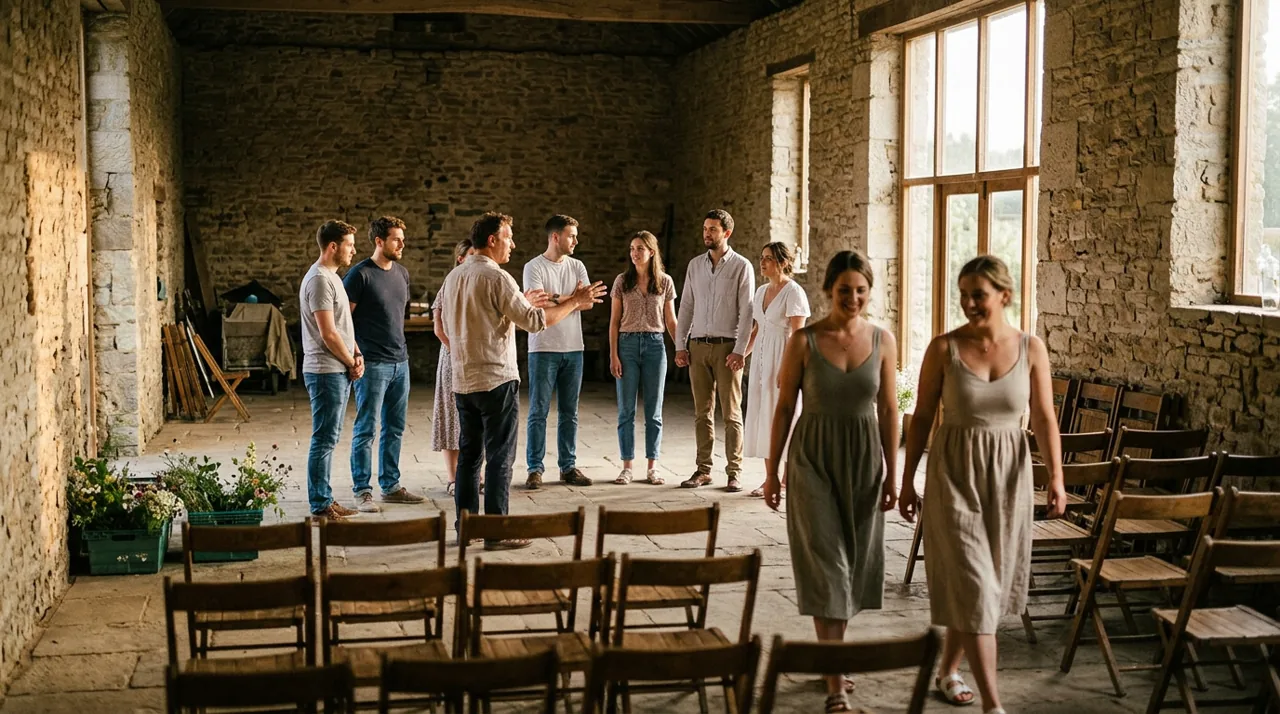
A wedding rehearsal is about 20 to 30 minutes of actual walking, and you should block a full hour for it. Everyone stands where they will stand, you walk the exit, then the entrance, then you do it once more. Vows, readings and the ring exchange are not rehearsed. That is the whole thing.
The gap between "30 minutes" and "block an hour" is where most rehearsals go wrong. The practice is short. The people are late, the ceremony chairs are stacked in a corner, someone brought four boxes of signage out of the boot, and the officiant is fielding questions about the seating for a divorced parent. None of that is the rehearsal. All of it happens during the rehearsal.
This is the running order, who genuinely needs to attend, and the handful of things worth deciding before anyone walks anywhere.
How long does a wedding rehearsal take?
Two practitioner sources put it differently. Ceremony Officiants says a rehearsal "should not last more than 20-30 minutes at most". DPNAK Weddings says "a good rule of thumb is to leave yourself one hour to practice your ceremony". Both are right, because they are not measuring the same thing.
| Source | Says | Measuring |
|---|---|---|
| Ceremony Officiants, retrieved 2026-08-11 | 20 to 30 minutes | The walking practice |
| DPNAK Weddings, retrieved 2026-08-11 | One hour | The calendar block |
Take both. Thirty minutes is what the run-through costs once everyone is standing in the right place. An hour is what you reserve, because the same source asks the wedding party to arrive 15 to 20 minutes early and adds 10 to 15 minutes if you are unloading ceremony items.
Do not put the rehearsal dinner invitation at the time the rehearsal ends. DPNAK suggests leaving 20 to 30 minutes plus travel time between the two. If the rehearsal runs to 6pm, the dinner invite says 7pm, not 6.15pm.
Who actually needs to be there
Anyone who walks, stands, speaks or hands something over. That is a shorter list than the one that usually turns up. Ceremony Officiants names the same group: the officiant, the couple, the wedding party, parents, grandparents, the flower girl and the ring bearer.
- The couple, and the officiant who is running it.
- Everyone in the processional: wedding party, parents, grandparents being escorted, flower girl and ring bearer.
- Readers and anyone doing a ritual, so they know where to stand up from and where to go back to.
- Whoever is handling the rings, and whoever is cueing the music.
- The venue coordinator, if the venue provides one. They settle the questions nobody else can answer.
The photographer does not usually attend the rehearsal, and does not need to. Guests certainly do not. A rehearsal with an audience takes twice as long and teaches nobody anything.
What you rehearse, and what you leave alone
Ceremony Officiants is direct about the scope: "you are only practicing walking in and walking out, and making sure everyone knows where to stand." Ceremony content stays for the day itself.
| Rehearse it | Leave it |
|---|---|
| Where each person stands, and which way they face | The vows |
| The recessional, then the processional | The readings, in full |
| The hand-off when the couple meet at the front | The ring exchange itself |
| Spacing down the aisle | The first kiss |
| Who cues the music, and on what | The officiant's address |
There is a superstition about not saying the vows aloud beforehand. Ignore the superstition and keep the rule anyway, for a duller reason: the first time you say them to each other should not be to an empty room with a florist working behind you.
Why you walk the exit first
This is the order Ceremony Officiants sets out: place everyone first, read through the ceremony headings, practise the recessional, and only then the processional. It reads backwards, and it is the single thing that makes a rehearsal short. Put everyone at the front in their final positions, then walk them out. The recessional order is now demonstrated rather than explained, and it is also the reverse of the processional, so half the entrance has already been taught by the time you turn around.
Explaining an entrance to fourteen people standing at the back of a room does not work. Showing them where they end up, and walking them out from it, does.
Spacing, the detail everyone gets wrong
Ceremony Officiants gives numbers for this, which is rare and worth having: roughly 20 to 30 feet between people in the processional, and on the way out, start walking when the couple ahead of you is about halfway back up the aisle, leaving at least 20 feet between couples.
Too close and the aisle looks like a queue, and your photographer gets one usable frame instead of eight. Too far and the music runs out. Pace it once at the rehearsal and nobody has to think about it again.
The rehearsal dinner is the event nobody photographs
Worth noticing, because it is the only evening where everyone who matters most is in one room and nobody is working. The photographer is not booked. The wedding party is not yet exhausted. Grandparents are still fresh, and people who have flown in are meeting each other for the first time.
Almost none of it gets kept. The photos live on twenty phones and stay there, and the toast that made everyone cry exists only in the memory of the people who heard it.
Gathmo is my own product, so read the next paragraph with that in mind. The plan limits below come from our published configuration, not from a sales page.
If you are already setting up a QR code guest album for the wedding, the rehearsal is the right evening to test it: print the sign, put it on the dinner table, and watch whether people actually scan it. You learn whether the venue has signal, whether the wording works, and whether the code is readable at the size you printed it. Then it runs for the dinner as a bonus.
One caveat so it is not a surprise: the free tier caps an album at 20 items, which a rehearsal dinner will pass. Essential removes the item cap at EUR 29 and keeps the album for 90 days. If you only want the test and not the dinner album, free is enough for that.
A rehearsal timeline you can copy
Adapted from the sample schedule DPNAK publishes, with the practice broken out. Shift the clock to fit your dinner booking.
| Time | What happens |
|---|---|
| 4:40pm | Arrivals; items unloaded |
| 5:00pm | Positions set at the front |
| 5:10pm | Recessional walked |
| 5:20pm | Processional walked, with music |
| 5:35pm | Both run again, at pace |
| 5:45pm | Rings and paperwork handed over |
| 6:00pm | Rehearsal ends |
| 6:10pm | Travel to dinner |
| 7:00pm | Dinner invitation time |
What you will need
- A confirmed processional order, decided before the rehearsal rather than during it
- The ceremony script, or at least its section headings, in the officiant's hands
- Music cues agreed with whoever is playing them
- Access to the ceremony space at the time you booked it, with someone from the venue present
Gather everyone and hand out positions
Walk the wedding party to the front of the ceremony space and put each person exactly where they will stand tomorrow, facing the way they will face. Do this before you explain anything. People remember a place they have stood in; they do not remember a diagram. Settle the awkward questions here too, while everyone is together and nothing has started: which parent sits where, who escorts a grandparent, whether anyone needs a chair.
Read the ceremony headings aloud
The officiant reads out the structure, not the script: welcome, readings, vows, rings, pronouncement, kiss, recessional. Two minutes of this stops every "wait, when do I go?" question that would otherwise interrupt the walking. Anyone with a job in the ceremony can hear where their part falls and ask now.
Walk the recessional first
From the positions everyone is already standing in, walk them out. Couples pair up and leave in reverse order, with about 20 feet between couples, starting when the pair ahead is roughly halfway back up the aisle. Because it is the reverse of the entrance, you have now taught most of the processional without anyone standing at the back of a room being talked at.
Walk the processional, with the music
Now bring everyone in, in order, roughly 20 to 30 feet apart. Play the actual music if you can, because the gap between "walk slowly" and the real tempo is bigger than people expect. Whoever is cueing tracks should practise the change-over into the entrance music. This is the one step where a run without music costs you on the day.
Practise the hand-off at the front
The moment the aisle walk ends and the couple meet: who steps where, who takes the bouquet, who hands it back before the rings. It takes four seconds on the day and it is the part people freeze on, because it is the only bit that is not walking in a straight line.
Run it once more, then stop
One clean repeat of processional and recessional, at the pace you actually want. Then finish. A third and fourth run does not improve anything and it is how a 30-minute rehearsal becomes a 90-minute one with a cold dinner at the end of it. Use the remaining minutes to hand over rings, marriage licence and any paperwork, and to say out loud what time each person arrives tomorrow.
Quick recap
- Processional order decided in advance, on paper
- Everyone who walks, stands, speaks or hands something over is present
- Ceremony items unloaded before the practice starts, not during it
- Positions set at the front before anything is explained
- Recessional walked first, then the processional
- Spacing paced out with the real music
- Rings, marriage licence and paperwork handed to the person responsible
- Arrival times confirmed individually with each person
- Dinner invitation time set at least 20 to 30 minutes after the rehearsal ends, plus travel
Frequently asked
Twenty to thirty minutes of practice, inside a one-hour block. Ceremony Officiants puts the run-through at "not more than 20-30 minutes at most"; DPNAK Weddings recommends reserving a full hour, because arrivals, unloading and questions all land inside the same window.
Everyone is placed in their ceremony positions, the officiant reads out the ceremony structure, and the group walks the recessional and then the processional, usually twice. Vows, readings and the ring exchange are not performed.
The couple, the officiant, everyone in the processional including parents and grandparents being escorted, readers, whoever holds the rings, whoever cues the music, and the venue coordinator if there is one. Guests and the photographer do not attend.
No. The rehearsal covers movement and positions only. Reading the vows aloud in an empty venue the night before takes the moment away from the ceremony and gains you nothing.
At least 20 to 30 minutes after the rehearsal ends, plus travel time between the two venues. A dinner invitation set for the minute the rehearsal finishes produces a room of guests waiting for a wedding party stuck in a car park.
It is the one evening where everyone who matters is together and nobody is working, and it is almost never covered by a photographer. A shared album that guests can upload to costs nothing to set up and doubles as a live test of your ceremony QR sign.
 Guide
GuideWhat to do with your wedding photos: the order that actually matters
Four things, in this order: get the files off the gallery, back them up properly, collect the guest photos you never received, and print far fewer than you think.
 Guide
GuideWedding Photo Scavenger Hunt: 40 Prompts
Forty wedding photo scavenger hunt prompts in five timeline-ready rounds, with consent rules, a QR setup order, and low-light photo tips.
 Comparison
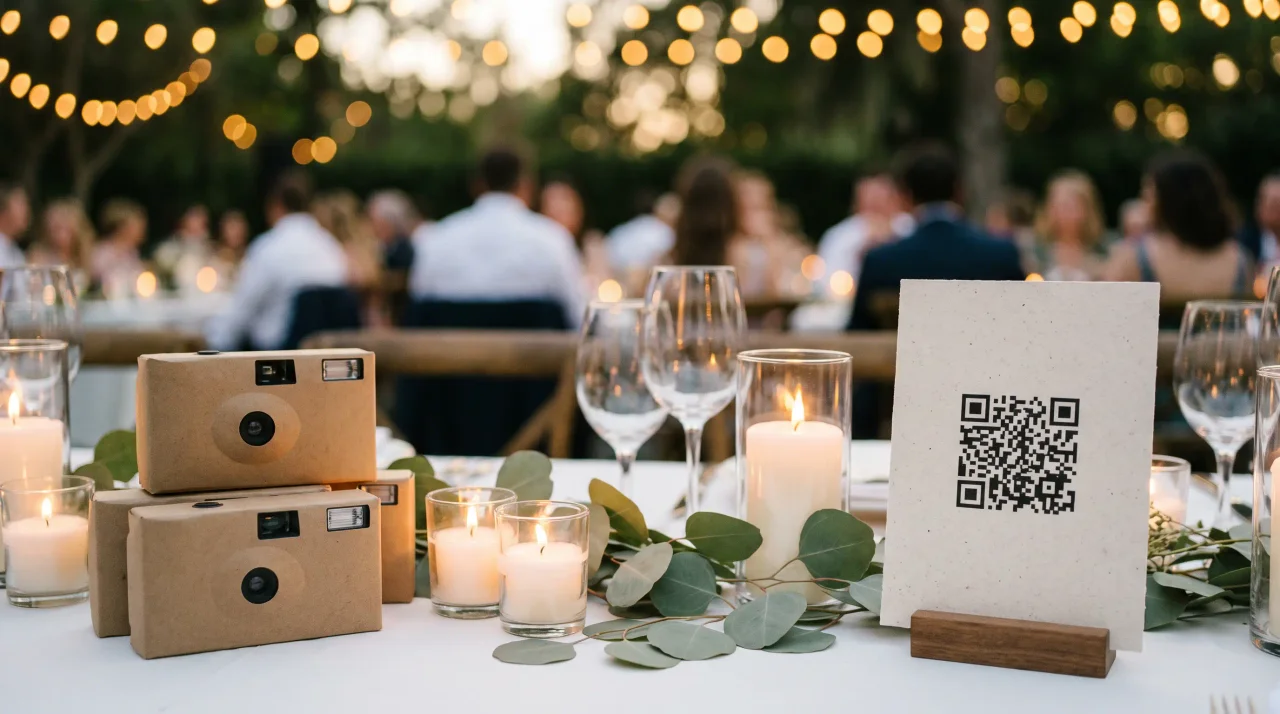
Disposable cameras or a QR code at your wedding? The 2026 cost math
What it actually costs to finish a wedding disposable camera in 2026, using a published lab price list -- and where a QR code changes the maths.