Company Christmas party games: the 14 that survive a real work party

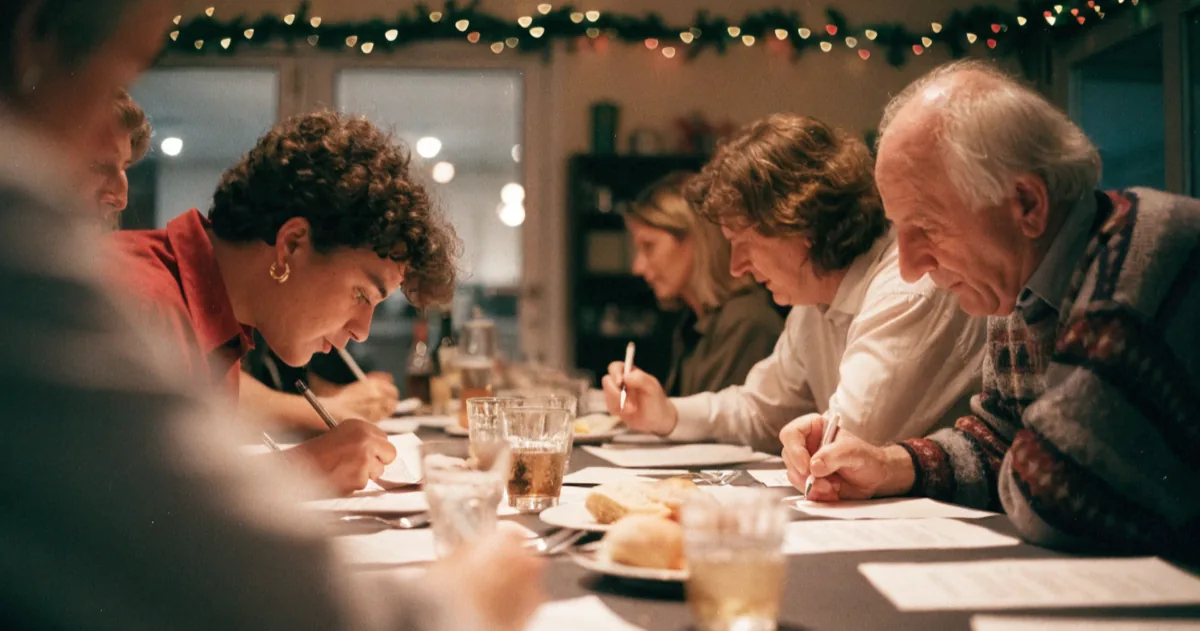
Three things decide which company Christmas party games work, and none of them is how funny the game is. How many minutes you actually have. How many people are in the room. Whether the room has any floor space left once the tables are in it.
Every list you will find answers none of those. They give you a number in the title — 10 games, 25 games, 30 games — and two sentences of rules each. If you have been handed the party and you are trying to fill a slot on a run sheet this week, a list of thirty is not help. It is thirty more decisions.
So here are fourteen, each with its numbers attached, and the filter that cuts most of them before you get there.
- Most work parties have one 30–45 minute window that belongs to you. That is two games, not eight.
- The break points are roughly 15 people and 40 people. Games do not scale smoothly across them.
- If the tables cannot move, half of every list is already out — relays, limbo and musical chairs need floor you do not have.
- The best game for a work party is the one with the lowest performance cost, not the highest laugh count.
The four questions that cut the list down
A game that does not fit the slot, the headcount, the floor plan and the room's willingness to perform is not a game. It is a gap in the evening with your name on it.
Run every candidate through these four before you read another list.
How many minutes do you have?
Not how long the party is — how long the window is before people re-sort themselves into the groups they came with. At most parties that is one block of 30 to 45 minutes, usually after the food. Two games fit in it comfortably. Three is tight. Anyone planning six has not run a party.
How many people?
The two break points are around 15 and around 40. Under 15, the big-group formats have nothing to divide into and a quiz becomes an exam. Over 40, anything that needs one host, one voice and everyone's attention at the same time stops carrying to the back of the room.
Does the room have floor space?
Look at the actual room with the tables in it. A function room above a pub, a hired room with the chairs already set, an office with the desks pushed back — none of these have a clear floor. That single fact eliminates relays, limbo, musical chairs and every game where people move fast in a group, before you have even considered whether they are fun.
What does the game cost the least confident person there?
This is the question that separates a party game from a work party game. Somewhere in your room is a person who joined in September, does not know anyone outside their own team, and is about to be asked to sing. The enjoyment of a performance game is concentrated in about four people, and the cost is spread across everyone else.
It is worth knowing how ordinary the third of those constraints is. In Challenger, Gray & Christmas's holiday party survey of 202 US companies, 58% of parties were being held during the workday and 32% on company premises (Challenger, Gray & Christmas, December 2023). The default company Christmas party is not a ballroom in the evening. It is your own office, in the afternoon, with the furniture where it always is — which is exactly the room the game lists do not write for.
Who reports to whom? The same game is a completely different game when the person losing it writes the performance review of the person winning it. A game where a senior leader is a contestant against their own team is not the same game it was at your friend's house.
Company Christmas party games that work at a table
If the tables cannot move, you still have six good options, and every one of them is better than the relay race you were going to try to squeeze in anyway.
| Game | Minutes | Works with | Needs floor space | Anyone has to perform |
|---|---|---|---|---|
| Christmas song emoji quiz | 10 | 6–200 | No | No |
| Table trivia, three rounds | 25 | 8–150 | No | No |
| Guess the colleague's childhood photo | 15 | 8–60 | No | No |
| Gingerbread build-off | 35 | 8–40 | No | No |
| One-handed gift wrap race | 8 | 4–30 | No | Slightly |
| Worst cracker joke competition | 10 | 6–40 | No | Slightly |
Minutes are planning figures from run sheets, not measurements — they are the numbers I would block out, and they run long more often than short.
Christmas song emoji quiz.
Twenty carols and pop songs written as emoji, printed one sheet per table. It is the best opener in existence for a work party because it needs no explanation, starts the second the sheet lands, and gives a table of people who have never spoken a reason to lean in over the same piece of paper. Read the answers out at the end rather than collecting sheets; collecting turns it into homework.
Table trivia, three rounds.
Rounds of ten. One round on Christmas films, one on the year that is ending, one written about the company — who joined this year, which office has the most people, what the first product was called. The company round is the one people remember, and it is the reason to write your own quiz rather than print one. Keep tables as teams so nobody has to move.
Guess the colleague's childhood holiday photo.
Ask everyone, a week ahead, for one photo of themselves as a child at Christmas. Number them, put them on a screen or pass them around printed, and let people guess. It is the single warmest thing on this list and the least demanding — nobody performs, nobody competes, and it flattens seniority faster than any icebreaker, because everybody was seven once. It needs the collection step, which is the only reason it is not on more lists.
Gingerbread build-off.
Kits, four to six people per team, one table each, thirty minutes on a visible clock. It is the best long game for a table-bound room because it is genuinely absorbing and it gives people something to do with their hands while they talk, which is the actual job. Judge it on a silly category — most structurally unsound, worst adherence to building codes — rather than "best", so the team with the architect does not simply win.
One-handed gift wrap race.
Pairs, one hand each, one awkwardly shaped object, five minutes. Cheap, fast, funny, and it fits in the gap while you are setting up the next thing.
Worst cracker joke competition.
Everyone reads out the joke from their cracker; the room votes on the worst. It costs nothing, uses something already on the table, and takes ten minutes including the arguing.
Games for large groups, where "divide into teams" stops working
Past roughly 40 people, the constraint stops being "is this fun" and becomes "does this run without a host". Games that need one voice and one room's attention fail here. Games that run in parallel do not.
The test is simple: if the game requires you to be heard by everyone at once, and the room has no PA, it does not work at that headcount. No amount of enthusiasm fixes a room where the back four tables cannot hear the question.
Three formats survive.
Festive people-bingo.
A grid of squares — has worked here more than five years, has been to more than three of our offices, can name every one of Santa's reindeer, hates mince pies — and you fill each one with the name of a different person. It is the only game on this list whose actual mechanism is mixing departments, because you physically cannot complete the card from your own table. Runs 20 to 30 minutes in the background while the food is out, scales to 300, and needs no facilitation after you explain it once.
A passive station.
Sweets in a jar to be counted, a "guess the baby photo" board, a table of Christmas objects to memorise. Set it up before anyone arrives, put a pen and a slip box next to it, announce the winner at the end. It costs one person twenty minutes of setup, runs all evening, needs zero attention from you, and gives everyone who arrives early something to do that is not standing near the door.
A photo mission list.
Ten or fifteen small things to photograph over the course of the evening: someone from a team you have never worked with, the worst jumper in the room, a genuinely candid laugh, whoever is first on the dance floor. It runs the whole night, scales to any headcount, needs no host at all, and — unlike everything else on this list — it produces something you still have in January. More on that below.
The emoji quiz and table trivia also survive at this size, for one specific reason: the question is read once, then every table plays simultaneously at its own pace. That is the pattern. At 40-plus, look for games that get explained centrally and then played in parallel.
Games for a small team
Under about 15 people, the problem inverts. Small rooms are not easier — nobody can hide in them, so the performance cost of every game goes up, not down. A quiz with teams of two is not a quiz, it is an exam. Charades in front of eleven people you work with is more exposing than charades in front of eighty.
White elephant, with a cap and one steal per gift.
The cap has to be a number, stated on the invitation, and the steal limit has to exist or the last person to go simply takes the best thing and the game ends on a sour note. Twenty-five minutes for a group of ten to twenty. Without the cap it is not a game at all — it is a spending contest with a scoreboard nobody admits to keeping.
Two truths and a festive lie.
The ordinary version at work drifts into oversharing within four turns. Constraining every statement to something holiday-related fixes that completely: I have never seen Home Alone, I once cooked the turkey upside down, my family opens presents on Christmas Eve. Fifteen minutes, five to fifteen people, and it is safe in a way the unconstrained version is not.
A blind taste test.
Six mince pies from six supermarkets, or six hot chocolates, numbered and scored. Fifteen minutes, works sitting down, no performance whatsoever, and it produces an argument that runs for the rest of the evening. Keep it non-alcoholic so it includes the whole room.
The childhood-photo game from the table section is also at its best under 15, where everyone knows everyone well enough for the guessing to be genuinely hard.
When part of the team is dialling in
The game lists almost never address hybrid, which is strange, because it is the normal condition of a great many companies. Gallup's hybrid work indicator puts 52% of remote-capable US employees on a hybrid schedule and 26% working exclusively remotely, with around five in 10 full-time US employees holding a remote-capable job at all (Gallup, retrieved August 2026).
For a team like that, the Christmas party is often the only moment in the year the whole company is in anything resembling one room. It is worth getting right for a reason beyond the party: in Gallup's global study of workplace loneliness, fully remote employees reported loneliness at 25%, against 16% among those working exclusively on-site, with hybrid workers in between at 21% (Gallup, June 2024). One good evening does not fix that. But running the evening as an in-person party with a remote audience wastes one of the few occasions in the year that pushes the other way.
The rule is binary. A hybrid game either works identically on both sides of the screen, or it is an in-person game with an audience. There is no middle version, and the middle version is what most companies accidentally run.
Two games are genuinely hybrid-native:
Screen-share Pictionary.
One shared whiteboard, drawer takes control, everyone guesses in the same chat. It works because the drawing surface is the same object for the person in the room and the person at home. Fifteen minutes, any headcount, mild performance cost.
"Show us your corner."
Everyone, in the room and at home, holds up one festive thing within arm's reach and says one sentence about it. Eight minutes. It sounds slight and it is the best hybrid opener there is, because it is the only round where being at home is an advantage rather than a handicap.
The emoji quiz, the childhood-photo round and photo missions all carry over cleanly too. What does not carry: anything with physical props, anything timed against a physical action, anything where the remote half can only watch.
Then two mechanics that matter more than the game choice:
- Put a remote person on every team. Not all of them on one team. One remote person per in-room team forces the room to include them; a remote-only team is a separate party happening in a window.
- Fix the audio before you fix the game. One laptop on a tripod in a room of forty gives the people at home a wall of noise with no words in it. If they cannot hear the question, they are not playing, and no game design fixes that.
Ask one remote colleague afterwards whether they would rather have joined or skipped it. If the answer is "I mostly watched", the game was in-person with an audience, whatever it said on the invitation.
The games to cut, and why
Most of what appears on these lists is fine at a party with friends and wrong at a party with colleagues. The difference is not fun. It is that attendance at a work party is not really voluntary, and everybody goes back to work on Monday.
None of these are forbidden and plenty of teams enjoy them. Each one just carries a cost, and it is worth knowing who pays it before the invitation goes out rather than after.
- Karaoke, lip sync battles and talent shows. This is the performance question at its sharpest. As an optional thing at the end, once people are free to leave, fine. As the scheduled activity, it is a reason to go home early.
- Anything where drinking is the mechanism. Beer pong, drinking-forfeit games, a wine tasting as the entertainment. Gallup's July 2025 reading put the share of US adults who drink alcohol at 54%, with 44% describing themselves as total abstainers (Gallup, data from July 2025). Whatever the exact split in your office, the people not drinking are not a rounding error, and a drinking game makes spectators of them for the duration.
- Forfeits of any kind. A forfeit is a punishment applied by colleagues to a colleague. That is the whole sentence.
- Relays, limbo and musical chairs. Floor space you do not have, plus a physical demand nobody agreed to when they accepted the invitation. Anyone with a bad knee gets to choose between pain and visibly opting out.
- Secret Santa with no spending cap. Without a stated number the spread between the most and least expensive gift does its own quiet damage, at both ends of it.
- Anything where a senior leader competes against their own reports. Have them judge, present, or sit it out. Not compete.
- Bought-costume competitions. Here is the test: can someone take part using clothes they already own? "The worst jumper you already have" passes. "Come dressed as an elf" is a bill you have quietly sent to your team, and it lands hardest on the people who can least absorb it.
What happens to the photos
The predictable ending: everyone photographs the gingerbread houses, the pictures stay on thirty separate phones, and by mid-January the company has nothing. No shot for the intranet, nothing for the careers page, nothing to open next year's invitation with. The one evening all year when the whole team is in the same room produces no record of itself.
Two of the games above actively produce a photo set — the childhood-photo round and the photo missions. That is a real argument for choosing them over a game that produces only a winner.
Whatever you use to collect them — a folder somebody sets up on the day, a shared drive, or a shared photo album — decide three things before the night rather than after: who can see the album, whether uploads are reviewed before they appear, and how somebody asks for a photo of themselves to be taken down. A work party is not a wedding. Attendance is close to obligatory, everyone in the frame is in a professional relationship with everyone else, and someone will end up in a picture they would not have chosen. Answering those three questions in advance is the difference between a company that has a record of the evening and one that has an awkward conversation in January.
Gathmo is my own product, so read the next paragraph accordingly. The three questions above apply whatever you use, and none of them is a reason to pick one tool over another.
The mechanical part is simple enough: a printed code on each table, people scan it with the camera they already have out, and photos, short clips and voice notes all land in one album — no app to install and no account to make. If you are collecting from a whole room at once, that shared-album approach is what group photo sharing is built for. It is also the only version of this that reaches the colleague who took the best photo of the night and would never have thought to send it to anyone.
If you are still choosing the shape of the evening rather than filling it, the earlier decision is covered in our guide to corporate Christmas party themes.
A 40-minute run sheet you can copy
Assembled, because the real question behind "what games to play at a company Christmas party" is what order to put them in. This is the shape I would use for a room of 30 to 60 with tables and no floor space.
- From the doors opening — the passive station is live. Jar on a side table, slips, pen. Nobody announces it; people find it.
- From the doors opening — photo missions on a card at every place setting. No announcement needed either.
- 0:00 — emoji quiz sheets go down on the tables while people are still finishing food. Ten minutes, answers read out, no marking.
- 0:12 — the long game. Gingerbread build-off, or the childhood-photo round if you collected the photos. Thirty minutes on a visible clock.
- 0:35 — winners of the long game and the jar, in that order, in under three minutes.
- 0:38 — stop.
That last line is the one to keep. The most common mistake at a work party is a fourth game: the room's energy peaks somewhere in the long game and everything after it is a slow decline that the organiser is the last person to notice. Stop while people still want more, and let the rest of the evening be people talking to each other, which is what they came for.
The short version, again
Two games, not eight. Pick for the room you actually have rather than for the list you are reading. Ask what the least confident person in the room is being asked to do, and cut anything where the answer is "perform". And decide before the night where the photos go, because the party you spent three weeks planning is otherwise going to survive only as fourteen separate camera rolls that nobody ever opens.
Frequently asked
Over about 40 people, choose games that get explained once and then played in parallel: a Christmas song emoji quiz on every table, table trivia in rounds, festive people-bingo, and a passive station like a guess-the-jar. Avoid anything needing one host to be heard by the whole room at once, which is where most large-group parties fall apart.
Plan for one window of 30 to 45 minutes, which holds two games — a short 8-to-10-minute opener and one longer 25-to-35-minute main game. Three is tight and more than three overruns the point at which the room's energy peaks.
Anything played sitting down: emoji quizzes, table trivia, gingerbread building, a blind taste test, a one-handed gift wrap race, guessing colleagues' childhood photos. Cut relays, limbo and musical chairs — they need clear floor that a room with tables in it does not have.
Pick games that are identical on both sides of the screen — screen-share Pictionary, a quiz everyone answers at the same time, a round where people show one festive thing near them. Put one remote person on each in-room team rather than making a single remote-only team, and fix the room audio first, because people who cannot hear the question are not playing.
Games built on drinking, anything with forfeits, karaoke or talent shows as the scheduled activity, competitions needing a bought costume, Secret Santa without a spending cap, and anything where a senior leader competes against their own reports. Each one is fine among friends and carries an uneven cost among colleagues.
No, and small ones work better than good ones. A large prize turns a party game into a competition and changes how people behave in it. A boxed chocolate orange and the naming rights to a silly category do the job; a bottle of something expensive makes the winning team try, which is the opposite of what you wanted.
 Guide
GuideTeam building activities for a company retreat: 24 that fit a real agenda
Twenty-four retreat team building activities sorted by the slot they fill, each with a debrief question and the way it fails.
 Guide
GuideCorporate Christmas party ideas: the three questions that pick one for you
Most Christmas party ideas for work are written for a ballroom. Here is how to choose one for the room you actually have, without making anyone buy a costume.
 Guide
GuideChristmas team building activities that work when half the team is on a call
Fourteen Christmas team building activities sorted by whether everyone has to be there at once — with cost, length and video notes on each.