Different wedding reception ideas: 40 ways to break the template

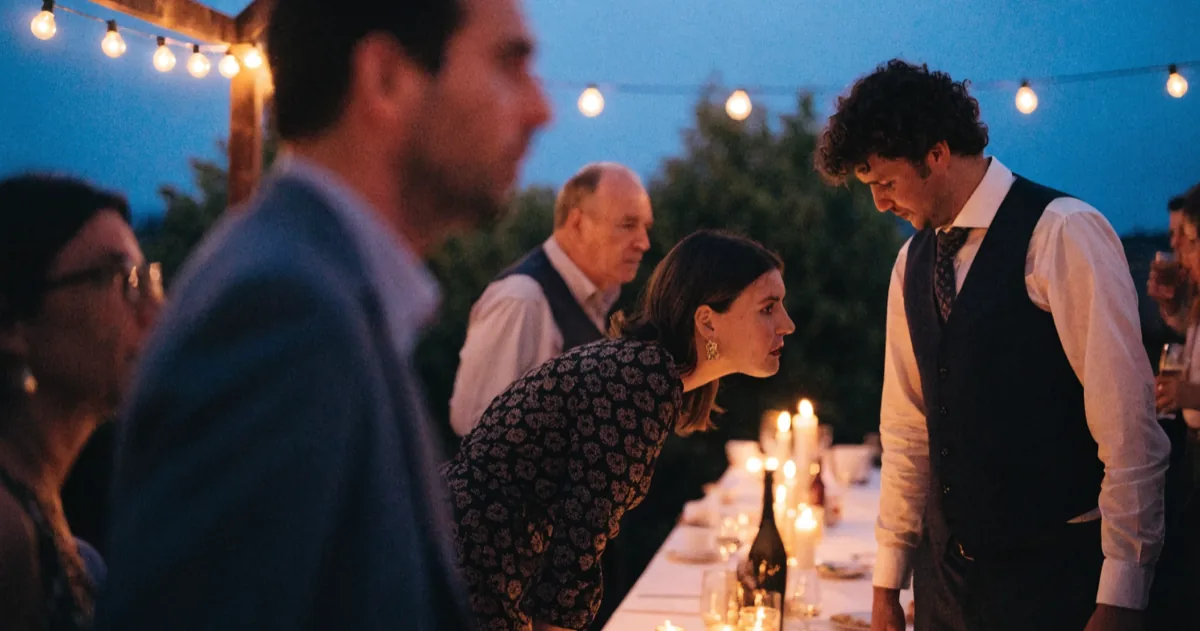
You already know the reception you are trying not to have. Drinks at five. Everyone finds their name on a chart. Three courses, four speeches, a first dance at nine, and by ten the same forty people are on the floor and the same seventy are outside talking. You could set your watch by it, because you have been to eleven of them.
So you search for something different, and the internet hands you eighty ideas about glassware.
Amber glassware does not change an evening. Neither does a neon sign or a monogrammed dance floor. What changes an evening is a decision about its shape — and there are only five places to make one. This article sorts forty ideas into those five layers, tells you which ones survive contact with a hundred guests, and ends with the part every other list leaves out: what an unusual reception does to the record you keep of it.
- Receptions feel different when you change the format, the running order, the food, the traditions or the record — not the decor.
- You have more permission than you think. Guest experience is now the top priority for 69% of couples, and 60% choose a semi-formal celebration built around comfort and mingling rather than a rigid running order.
- Break one layer and keep the other four recognisable. A reception that breaks all five stops reading as a wedding to the people standing in it.
- Changing the format is the only move that is free. Changing the food is the one most couples make first — 53% added a dessert bar.
- Every idea here has the same side effect: the further you move from the standard template, the less of the evening your booked coverage actually captures.
What actually makes a reception feel different?
A reception feels different when you change its shape, not its surface — and the industry has already moved further in that direction than most planning advice admits.
Guest experience is the number one priority for 69% of couples, according to The Knot's 2026 Real Weddings Study, and 60% now describe their celebration as semi-formal, a choice the study reads as favouring comfort and mingling over rigid tradition (WeddingPro). Among couples spending over $41,000, that guest-experience figure climbs to 77%. Which is worth pausing on: this is not a way of dressing up a small budget. The pattern gets stronger as budgets rise.
So the permission you are looking for exists. The problem is that most advice spends it on the wrong layer.
There are five layers to a reception, and they are not equally powerful:
- Format — the basic shape of the event. Meal or no meal, seated or standing, one place or several.
- Running order — what happens when.
- Food — what people eat and how it reaches them.
- Traditions — which rituals you keep, swap or skip.
- The record — what survives the night.
Decor is not on the list. Decor is what a layer looks like once you have chosen it.
The rule that makes this work: break one layer and keep the other four recognisable. A reception that changes everything at once does not read as unconventional to the people inside it — it reads as confusing. Guests navigate a wedding by pattern-matching against every wedding they have attended. Give them one surprise and they will enjoy it. Give them five and they will spend the evening asking each other what happens next.
Change the format (8 ideas)
The format is the only layer that changes every hour of the day at once, and it is the layer almost nobody touches.
For scale as you read these: the average US wedding in 2025 cost $34,000 with 117 guests, which works out to $292 per guest, up $8 from the year before (The Knot Worldwide 2026 Real Weddings Study, based on more than 10,000 US couples). At 117 guests, every format decision is being multiplied by 117.
- A brunch or lunch reception. Eleven to three. Egg dishes, a pastry table, one cocktail on repeat. It is usually the cheapest reception per head available to you, for three compounding reasons — a shorter service window, far less alcohol, and a venue slot nobody else wants. It also ends while everyone is still in a good mood.
- Cocktail-style, no seating plan. No plated service, no top table, no chart by the door. Standing height tables, enough seats for perhaps half the room, food circulating all evening. The trade you are making is intimacy for circulation: your guests will speak to three times as many people and sit down with none of them.
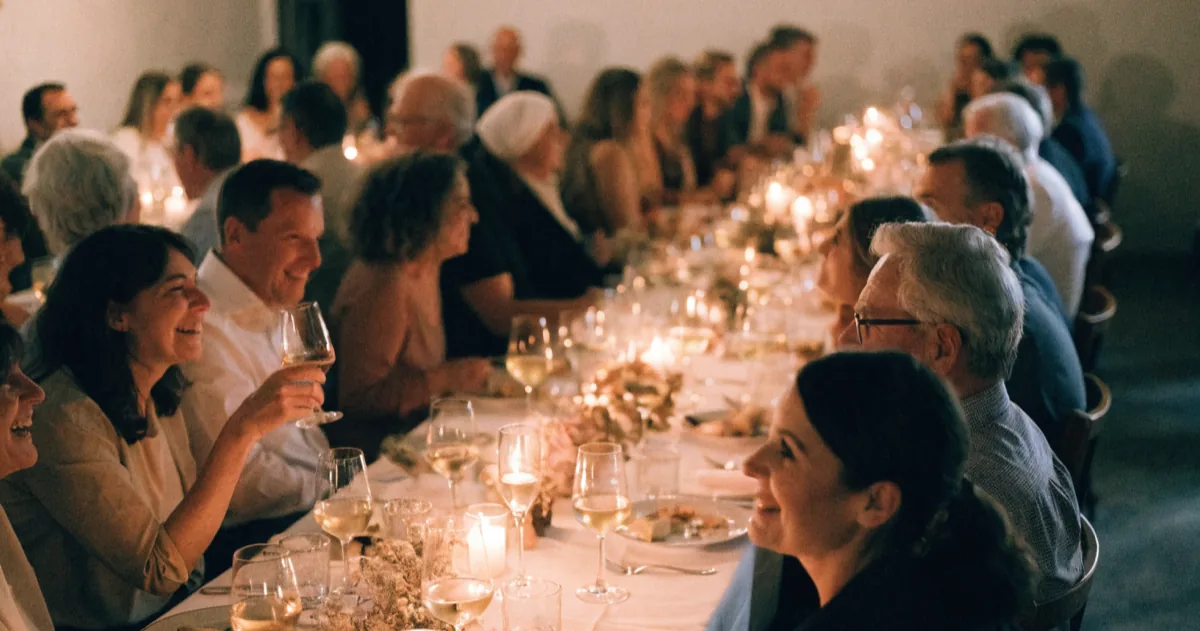
- A long-table supper club. One table, everyone at it, the meal as the event rather than the prelude to it. Works up to about 40 people. Past that the table becomes a corridor and the people at each end have separate weddings.
- A two-part reception. Dinner for the twenty who were there when it mattered, then a party for the hundred at nine. This is the format that most reliably solves an impossible guest list, and it is the one most likely to hurt feelings, so the invitation wording is doing real work.
- A progressive reception. Ceremony in one place, drinks in a second, dinner in a third — usually within walking distance. Guests see three rooms instead of one and the evening never stalls, because moving is itself a change of pace.
- A backyard or rented-house weekend. Everyone stays. The reception is not an event with a start time, it is what happens in the garden between Friday and Sunday. Cheapest per hour, most expensive in your own labour, and the format most likely to produce the photographs you actually frame.
- A restaurant buyout. Book a restaurant you love, take the whole room, let the kitchen do what it already does well. No catering quote, no rentals, no drapes. Excellent under 60 guests, structurally impossible above about 90.
- A reception with no dance floor at all. This is a real option and it is worth saying out loud, because a lot of couples assume a wedding without dancing is a wedding that failed. It isn't — but the dance floor is load-bearing. It is the thing that occupies the second half of the evening, so if you remove it, something else has to hold that ground: a long meal deliberately paced to run late, a fire pit, a live act, games. Remove the dance floor and put nothing in its place and you get a quiet hour at half past nine that everyone remembers for the wrong reason.
Change the running order (6 ideas)
The standard timeline is a catering convention, not a rule. It exists because kitchens like knowing when to plate.
- Dance first, eat second. Open the floor while everyone is at peak energy, then feed them. The energy curve of a normal reception peaks around ten and dies; this inverts it and the room never has a flat hour.
- First dance straight after your entrance. Get it done while everyone is already looking at you, instead of building a two-hour cloud of dread over it.
- A golden-hour break. Twenty minutes with your photographer in the good light. Non-negotiable if you care about the portraits — but it removes the two people the room is organised around, so schedule something for guests in that window. A toast, a course, a game. Not nothing.
- Toasts spread across the courses. One between each. Nobody has to sit through forty minutes of speeches and every speaker gets a room that is still listening.
- No receiving line — do a table round instead. A receiving line is 117 people in a queue. A table round during dinner is the same conversations, seated, with a drink, and you control the pace.
- Leave early and let the party continue. Your exit does not have to be the end. Say goodbye at eleven and let whoever is still standing carry on without you.
Whichever you pick, one thing holds: most guests will forgive an unusual order, but nobody forgives twenty unexplained minutes of nothing. Every swap needs somebody — a coordinator, a bandleader, a loud friend with a plan — whose job is to say out loud what is happening next. The failure mode of a rearranged timeline is never the arrangement. It is the silence in the seam.
Change the entertainment (8 ideas)
Most entertainment budgets buy background. The memorable version buys a thing people watch together or do together.
- A ceilidh, contra or line-dance caller. The single highest-yield swap at a mixed-age reception, because a caller removes the "I don't dance" opt-out. Nobody has to know the steps; somebody is telling them the steps. Grandparents and eight-year-olds end up in the same set.
- A live painter. Someone painting the room as it fills. Guests drift over all evening to see how far along it is, and you leave with the painting.
- A close-up magician working the tables. Solves the dead half-hour between courses better than anything else on this list.
- A silent disco. Two or three channels, headphones. The neighbours stay friendly, the people who want to talk can talk, and the floor stays full until two.
- Karaoke, but late and short. An hour, capped, after the band. Any longer and it becomes a hostage situation.
- Duelling pianos. Request-driven, so the room programmes itself.
- Lawn games with a scoreboard. The scoreboard is the whole trick. Cornhole with a bracket taped to a post is an activity; cornhole without one is two people idly throwing beanbags.
- A band that is genuinely good, over a playlist that is merely correct. A playlist cannot read a room. A band that can is worth more than any decor line item you will cut to afford it.
If your instinct here is a photo booth, it is worth reading through the alternatives to a photo booth first — the booth is the default answer, which is exactly why it is rarely the different one.
Change how people eat (7 ideas)
Food is the layer couples change most readily, which makes it the safest place to start. More than half of couples — 53% — added a dessert bar (The Knot 2026 Real Weddings Study, via WeddingPro).
- Food trucks. Two or three, parked. Guests choose, queue briefly, eat standing, go back for something else later.
- Themed stations. A taco station, a pasta station, a raw bar. People move, which means people mix.
- Family style at long tables. Platters down the middle. Strangers have to pass each other things, which does more for a table than any icebreaker.
- One dish that means something. Your grandmother's recipe, scaled by the caterer, with a line on the menu card explaining it. Costs nothing extra and is the thing people mention in the thank-you notes.
- A late-night snack. Chips at midnight. Disproportionately beloved.
- A dessert bar instead of a cake. Or a cake so small it is purely ceremonial, with the actual dessert elsewhere.
- A grazing table in place of a first course. Guests serve themselves while the room fills, which absorbs the awkward opening half-hour.
One warning, because it is the most common way this layer fails: stations need floor space per head that a room laid for 117 covers does not have. A room seats more people than it can circulate. Walk the floor plan with your caterer and count the metres between the station and the nearest table. The failure mode is a queue, not a menu.
Change the traditions you never wanted (6 ideas)
Traditions are genuinely optional, and the data shows there is no default any more.
Zola's 2026 First Look Report, drawn from more than 11,500 engaged couples, found Gen Z keeping the bouquet toss at 40% against 28.9% of Millennials, and including bridal parties at 92.2% against 78.8% (PR Newswire). The younger cohort is reviving rituals the older one dropped. Which means there is no consensus to defy and none to defer to. The tradition is only obligatory if you want it.
- Skip the bouquet and garter. No replacement needed. Nobody has ever asked where they went.
- An anniversary dance instead. Every married couple on the floor, then out by years until the longest-married pair is left alone. It takes four minutes and it is the moment the older half of the room came for.
- A first dance you actually chose — or none. If the song is somebody else's idea of romantic, it will look like it.
- Cut something other than a cake. A wheel of cheese, a pie, a stack of doughnuts.
- Write your own vows. 61% of couples already do (The Knot Worldwide 2026 Real Weddings Study), so this is no longer the unconventional choice — but it is still the one that changes what the day sounds like.
- Move a ceremony moment into the reception. A friend's blessing between courses, when everyone has a drink and nobody is nervous.
If the guest book is the tradition you want to drop, there are guest book alternatives that do the same job better, and recorded voice messages in particular tend to produce something people replay years later — which a signed page rarely does.
Make guests part of the evening (5 ideas)
The ideas guests remember are the ones they did, not the ones they watched.
- A photo scavenger hunt. A prompt list per table, an hour to fill it. It gives shy guests a reason to approach people they don't know, which is the actual problem it solves. There is a ready-made set of 40 prompts here.
- A question on each place card. Not "how do you know the couple" — something with an answer worth hearing.
- A song request slip with the place card. Collected before dinner, handed to the DJ. Your floor fills with songs your guests chose.
- Something the room builds together. A message tree, a thumbprint piece, a jigsaw where every guest signs a piece.
- Guests pick the last three songs. By vote, at eleven. The evening ends on the room's choice.
One rule: one participation idea per reception. Two of them compete for the same attention and both end up half-finished.
The record an unusual reception loses
Here is the thing every list of unconventional reception ideas leaves out, including the good ones: the further your reception moves from the standard template, the less of it your booked coverage actually captures.
88% of couples hire a photographer, out of an average of 13 vendors (The Knot Worldwide 2026 Real Weddings Study). A photography contract is written against assumptions: a set number of hours, one venue, a running order the photographer can anticipate. Every idea above quietly violates one of them.
- A progressive reception moves rooms. Someone is packing a bag during the moment you moved venues for.
- A two-part reception peaks at ten, which is often after the contracted hours end.
- A golden-hour break takes the photographer out of the room by design, so nothing that happens in that twenty minutes is covered.
- A cocktail-style evening has no formal moments to shoot. There is no cake cut, no toast sequence, no first dance to build a gallery around — so what survives of it is largely whatever guests happened to catch.
Notice that the last one is not a scheduling problem. Removing the formal moments removes the skeleton the whole photographic record hangs on. The evening was better and the record is thinner, and you find that out eight weeks later.
Three things fix it, and all three are decisions you make before the day:
Brief the photographer on the shape, not the schedule.
A timeline says "19:30 dinner". A shape says "there is no first dance, the room peaks at ten, and the thing I will want to see again is the anniversary dance." A good photographer will restructure their whole night around that sentence. They cannot restructure around a spreadsheet.
Name the one part you are buying.
With a non-standard format you cannot cover everything, so decide in advance which hour is the one, and put the contracted time around it rather than around the meal.
Give guests one place to put what they shot.
This is the part that scales, because it is the only coverage that is already everywhere your photographer isn't — in the second room, at the late party, at the table during the golden-hour break. The failure is never that guests didn't take photos; it is that afterwards those photos are scattered across sixty camera rolls and three group chats and nobody ever assembles them. One shared album everyone can add to solves the assembly rather than the capture: guests scan a code, add photos, video and voice notes to the same place with no app to install and no cap on how much they upload, and you end up with the parts of your own reception you were not in the room for.
Once the night is over, the work shifts to collecting the photos your guests took and then deciding what to do with the photos afterwards — both of which are much easier if the collecting was set up before the first guest arrived.
How to choose which one is yours
Pick by constraint, not by taste. You have four or five constraints already and they eliminate most of the forty for you.
| Your constraint | Break this layer | Start with |
|---|---|---|
| Under 40 guests | Format | Restaurant buyout (7), long-table supper club (3), two-part (4) |
| 100–150 guests | Food and entertainment | Stations (24), caller-led dancing (15) — format changes get expensive at this scale |
| Tight budget | Format and running order | Brunch (1), backyard weekend (6), dance-first (9). Both layers are free to change. Avoid stations, which need staff |
| Traditional families | Traditions, one swap only | Anniversary dance (31). Announce it warmly and it reads as a gift, not a rejection |
| A venue with rules | Running order | Toasts across courses (12), early exit (14) — the layer nobody's contract restricts |
| A non-standard venue | The record, first | Brief the shape, then the album. Coverage is what breaks at unusual venues, before the catering does |
The reason to work by subtraction is that addition is already the problem. Zola found budget-versus-inspiration to be the number one pain point for 60% of couples, up 12% on the previous year. Everyone has seen more ideas than they can afford; nobody has a method for cutting them.
It is also worth knowing that in the same survey, 85% said their wedding will be worth every penny. Nobody says that about the centrepieces.
One footnote on the numbers in this article, since they come from two different surveys. The Knot puts the average at $34,000, from more than 10,000 US couples who had already married in 2025. Zola puts it at $36,000, from more than 11,500 couples who were still planning. Different samples, different vantage points, same order of magnitude — treat either as a reference point rather than as your budget.
The short version
There are five layers to a reception: the format, the running order, the food, the traditions and the record. Decor is not one of them, which is why changing it never produces the evening you were imagining.
Break one layer. Keep the other four recognisable, so guests always know where they are. Choose which layer by constraint — guest count, budget, venue rules, how much your families expect — rather than by which idea is prettiest, because subtraction is the skill this decision actually requires.
Then tell every vendor the shape of the evening, not just its schedule. A photographer, a band and a caterer can all adapt to "there is no first dance and the room peaks at ten." None of them can adapt to a timeline that quietly lies about what kind of night it is.
Sources
- The Knot Worldwide, 2026 Real Weddings Study (more than 10,000 US couples married in 2025) — theknotww.com
- WeddingPro, Navigating a New Era: Vendor Insights from The Knot's 2026 Real Weddings Study — pros.weddingpro.com
- Zola, 2026 First Look Report (more than 11,500 engaged couples), via PR Newswire — prnewswire.com
All figures retrieved 2026-08-12.
Frequently asked
Change the format rather than the decorations. The eight realistic alternatives are a brunch or lunch reception, a cocktail-style evening with no seating plan, a long-table supper club, a two-part reception (small dinner then a larger party), a progressive reception across two or three venues, a backyard or rented-house weekend, a restaurant buyout, and a reception with no dance floor at all. Each one changes every hour of the day rather than one moment in it.
Change what guests do, not what they look at. The reliable moves are a dance caller — a ceilidh, contra or line-dance caller removes the "I don't dance" excuse because someone is telling everyone the steps — plus one participation idea such as a photo scavenger hunt or guest-chosen songs, and food that requires people to move around the room. Boredom at a reception is almost always a seating problem: guests stuck with the same six people for four hours.
A reception with no seating plan, no plated service and no fixed running order. Food circulates all evening, there are standing-height tables and seats for roughly half the room, and guests move freely. It suits big, sociable guest lists, and it typically costs less per head than a served dinner because the service window is shorter and there is no plated course. Its weak point is older guests: "seats for half the room" is fine at 25 and unkind at 75, so seat generously along the edges.
Usually, yes — and it helps to know why rather than trusting a headline figure. Three things drive it down: a much shorter service window, far less alcohol consumed before three in the afternoon, and a venue slot with lower demand than a Saturday evening. How much you save depends entirely on your caterer and region, so get two quotes for the same menu at different times of day rather than relying on a published average.
Yes, and it is more common than it looks — 60% of couples now choose a semi-formal celebration built around comfort and mingling rather than a rigid running order (The Knot 2026 Real Weddings Study, via WeddingPro). The one thing to plan for is that the dance floor normally occupies the second half of the evening. Put something deliberate in that space — a long, slowly paced meal, a fire pit, lawn games, a live act, a late dessert course — or you get a flat, quiet hour around half past nine.
 Guide
GuideSmall Wedding Reception Ideas: 21 That Work Under 50 Guests
Twenty-one small wedding reception ideas for 20 to 50 guests, plus the three things that break when you shrink a big reception, and a timeline that fits.
 Guide
GuideThe wedding rehearsal checklist: what to run through, in what order
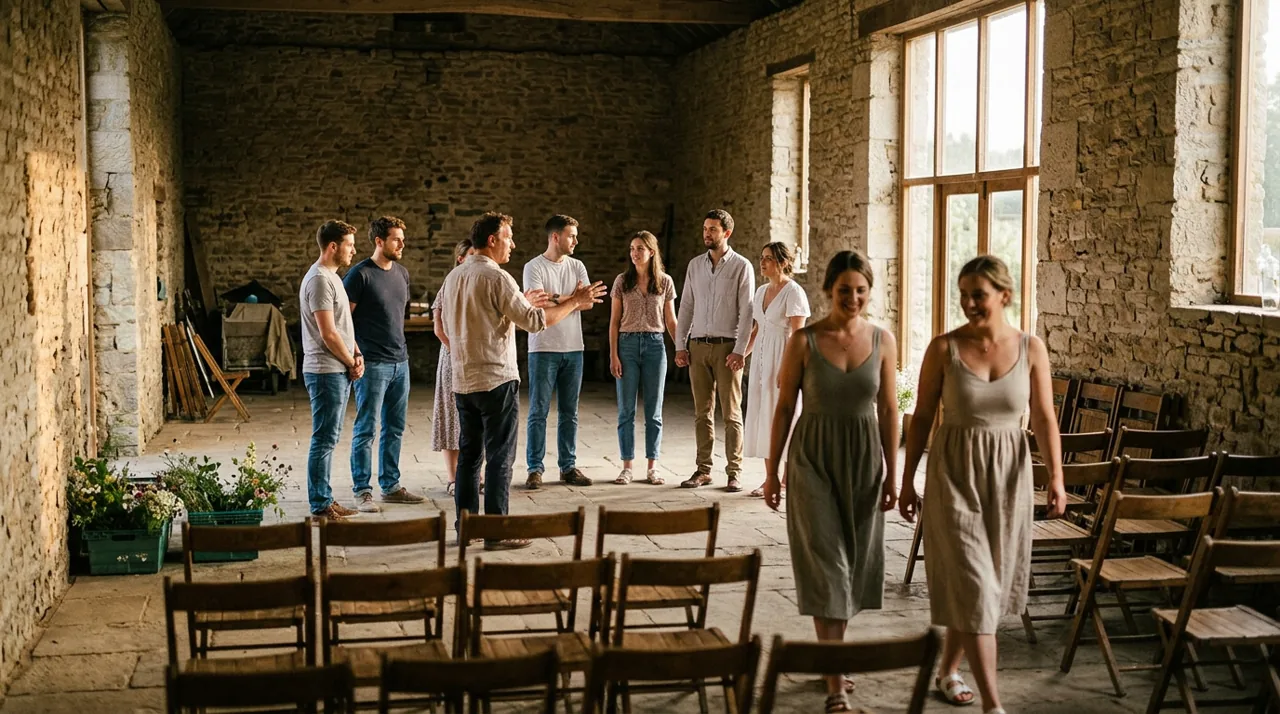
A wedding rehearsal is 20 to 30 minutes of walking, inside an hour of calendar. Here is the running order, who has to be there, and what not to rehearse.
 Guide
GuideWhat to do with your wedding photos: the order that actually matters
Four things, in this order: get the files off the gallery, back them up properly, collect the guest photos you never received, and print far fewer than you think.