Small Wedding Reception Ideas: 21 That Work Under 50 Guests

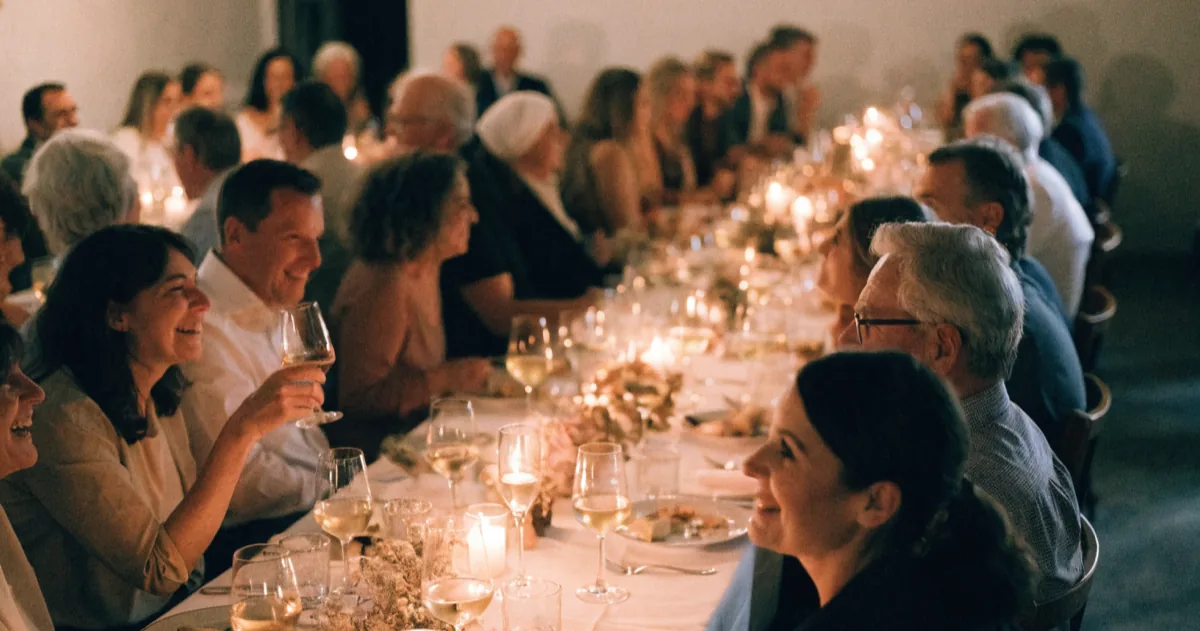
Most small wedding reception ideas you will find were written for a much bigger wedding and then trimmed. The average US wedding had 117 guests in 2025, according to The Knot Worldwide's 2026 Real Weddings Study of 10,474 couples. If you are planning for 40, you are planning a different shape of evening, not a smaller version of that one.
That distinction decides almost everything. Shrink the guest list and some parts of a reception improve on their own, while others quietly stop working — and the ones that stop working are usually the ones you assumed were mandatory. Below are 21 ideas grouped by what they actually solve, four traditions worth dropping, a four-hour timeline, and the arithmetic on what a small reception does and does not save.
- "Small" usually means 21–50 guests; under 20 is a micro wedding and 51–75 is where big-wedding logistics return.
- The rule that sorts every idea: formats that depend on a crowd get worse as the list shrinks, and formats that depend on attention get better.
- Cut the bouquet toss, the garter, the grand entrance and the receiving line. All four need a crowd you no longer have.
- Plan four hours, not six, and decide in advance how the night ends.
How many guests is a small wedding reception?
A small wedding reception is generally 21 to 50 guests. Below that you are into micro-wedding territory, and above 50 the logistics of a full-size wedding start coming back one at a time — a floor plan, an amplified sound system, staff you have to brief.
The industry uses these words loosely. A small intimate wedding reception can mean anything from ten guests to a hundred depending on who is writing, so here is the banding this article follows, measured against the real average:
| Size | Guests | What changes |
|---|---|---|
| Micro wedding | 2–20 | One table. No seating plan needed. A restaurant can host you with no buyout. |
| Small wedding | 21–50 | One long table is still possible. No dance floor, no queues, no amplified music. |
| Intimate wedding | 51–75 | Multiple tables, a floor plan, and usually a microphone for toasts. |
| US average | 117 | Everything the standard wedding-planning advice assumes. |
The 117-guest average comes from The Knot Worldwide's survey of 10,474 US couples married during 2025. Worth keeping in view, because it is the number that every venue package, every rental minimum and every seating template you encounter was built around. At 40 guests you are at roughly a third of that scale, and a third of a big reception is not a small reception. It is a big reception with gaps in it.
The three things that break when you shrink a big reception
This section makes no claim to data. It is mechanics, and you can check it against any small wedding you have been to.
The dance floor stops working first.
A dance floor needs enough people willing to be looked at that no individual is on display. At 120 guests, thirty dancers is a party. At 40 guests, six dancers is a performance and the other 34 are the audience. The floor then sits empty for the rest of the night, which reads as a failed reception even when everyone is having a good time at the table.
Anything with a queue stops working second.
A photo booth, a caricaturist, a churro cart, a cigar roller — the queue is what signals that the thing is worth doing. Forty people clear a queue almost immediately, and then it stands unused for the rest of the night in the corner of the room where you paid for it to stand.
The room's own noise floor disappears third.
A hundred and twenty people generate a wall of sound that music has to compete with. Forty people do not. Play music at big-wedding volume in a room of 40 and you have ended the conversation, which is very likely the thing you chose a small wedding for in the first place.
Those three failures share a cause, and it gives you the rule that sorts every idea below: crowd-dependent formats degrade as the guest list shrinks, and attention-dependent formats improve. A dance floor, a queue and a PA all need a crowd. A toast, a handwritten note and a shared table all need attention. Spend your budget on the second list.
Layout and seating
1. Put everyone at one long table
The single most effective small-reception decision. One table means one conversation that everybody can join, no B-table, and nobody watching the good table from across the room.
Check whether your room can take it before you commit. A standard 8-foot banquet table seats four guests on each long side, eight in total, or ten if you add a chair at each end. So 40 guests is five 8-foot tables in a row — a 40-foot line, plus room on both sides to pull chairs out and walk behind them. If your room cannot take that, use two parallel lines of 20 rather than breaking the group into five separate round tables.
2. Skip the head table
At 120 guests a head table makes the couple findable. At 40 it puts the two of you at the end of the room, facing everyone, unable to talk to anybody who is not directly beside you. Sit in the middle of the long side instead. You will get about six people you can actually hear.
3. Do not use a second room
Venues love to offer you a dining room plus a lounge. Split 40 people across two spaces and you get two half-empty rooms and a slow leak of guests between them. One room that feels slightly tight beats two that feel abandoned. If the venue insists on the second space, use it for coats and let it stay closed.
4. Still do a seating plan
The counter-intuitive one. Small groups do not self-mix — they clot into whichever two or three clusters arrived together, and stay there all night. A seating plan is the only lever you have on who talks to whom, and at this size the whole plan takes an evening. Put the people who do not know each other next to each other, not across the table, where conversation has to be projected.
Food and drink
5. Serve family style
Platters on the table that guests pass around. Below 50 guests this beats both alternatives: it is faster than a plated service with one kitchen, and unlike a buffet it does not require anyone to stand up and queue, which at this size means a third of your guests are out of their seats at any moment.
6. Book a restaurant instead of a venue
Structurally the biggest saving available at this size, and the reason it works is unglamorous: a restaurant already owns the tables, the linen, the glassware, the kitchen and the staff, so you are not renting any of it. Most will do a private room or a full buyout on a minimum-spend basis rather than a flat venue fee. Ask what the minimum is on your date and in your slot — a Friday lunch buyout is a different number from a Saturday dinner, and at 30 guests you may clear the minimum on food and drink alone, making the room effectively free.
7. One extravagant course instead of four modest ones
Per-guest pricing is what makes this possible. The course you would never order for 120 people is affordable for 30. Pick one thing to be genuinely excessive about, serve something simple on either side of it, and let that be the food people describe afterwards.
8. Run a two-drink bar with names on it
Not a full bar. Two cocktails, chosen by you and named on a card, plus wine, beer and something non-alcoholic. A full bar at 40 guests means a bartender standing idle, a longer drinks list than anyone reads, and most of the bottles going home unopened. Two drinks that mean something are also a better story than a bar that could make anything.
Entertainment for a small room
Below 50 guests — and especially at a micro wedding reception of 20 or fewer — the entertainment question is not what to book but what to leave out.
9. Make the toasts the programme
The strongest format that only exists at this size. At 140 guests you can allow three speeches before the room turns. At 40 you can let eight people speak, and the evening has a spine.
Do it properly: ask people weeks in advance, tell them two minutes each, and give each one a specific prompt rather than an open floor — "the first time you met her", "the thing he will not tell you about himself". Space them across the meal instead of stacking them all after dessert. Eight two-minute toasts spread over three courses is 16 minutes of content that carries an entire reception.
10. One speaker and a playlist you actually built
No DJ. A single good speaker at conversation volume, and a playlist you made yourselves and listened all the way through. The failure mode with a hired DJ at this size is not taste, it is volume: they are equipped for a room four times the size and calibrated to fill it.
11. Table games nobody has to host
Because a queue-based attraction fails at this size but a table-based one does not. Cards on the table, a question deck, a shared crossword, a jar of guesses about the couple. Guests opt in from their seats, it needs no host and no announcement, and it fills the flat stretch between the last course and whatever happens next.
12. Have a first dance without a dance floor
You can have the dance without committing to a dance floor all night. Clear a space between the tables, do the one dance with everyone standing around you, then let people sit back down. You get the photograph and the moment without an empty rectangle in the middle of your reception for the next three hours.
13. Hire one live musician, not a band
A single guitarist, a harpist, a cellist, a jazz duo at most. A four-piece band in a room of 40 is louder than the room can absorb and costs several times more. One acoustic musician playing quietly under conversation is the sound a small reception wants, and they can go unamplified.
Capturing a small reception
Here is the mechanical problem nobody mentions. A small wedding usually means one photographer and no second shooter, and a small budget often means fewer hours. Meanwhile the thing that makes your reception distinctive — one table, everyone in one conversation — is also the hardest thing for a single photographer to cover, because they can only be at one end of it at a time. There is no photo booth to catch the overflow either, since a booth needs a queue to work.
So at this size your guests' phones are not a nice extra. They are the only wide coverage the evening will get.
14. Collect everything into one album everyone can add to
The mechanism matters more than the intention. "Send me your photos" produces about a fifth of what was actually taken, arriving over three weeks in four different apps. What works is a single destination that needs no app and no account: one QR code that collects photos, video and voice messages in a single album, printed on a card on the table. Guests scan, upload, and everything from the whole room ends up in one place you can share back as a link.
One practical detail if you are printing the card yourself: leave a clear white border around the code. DENSO WAVE, which developed the format, specifies that a QR code "requires a four-module wide margin at all sides of a symbol" — a module being one of the little squares. Designers routinely crop that margin to make the card look tidier, and the code stops scanning under low light. Print one and test it on two different phones before you print forty.
15. Use voice messages instead of a paper guestbook
This works precisely because the room is quiet. At 140 guests a recorded message means shouting over a band; at 40 there is no band, so people talk normally and say something real. A paper guestbook at a small wedding tends to produce a page of signatures and not one sentence worth keeping. See voice messages at weddings for how to prompt them so you get more than "congratulations".
16. Ask specifically for the three shots your photographer will not get
Not "take photos" — three named gaps. The getting-ready overflow before they arrive, the end of the table you were not sitting at, and the last hour after they leave. Ask for those three and you will get them.
17. Use a handful of photo prompts, not forty
A long list is right for a big wedding, where prompts have to keep 120 people occupied. At 40 guests, four or five is plenty, and a card on every place setting is redundant when eight people can see the same card. Pick a few from a wedding photo scavenger hunt and put two cards on the table.
Personal touches that only work at this size
These four are the ones a big wedding cannot copy. Each works because of the guest count rather than in spite of it, which is the real argument for a small intimate wedding reception in the first place.
18. Write something at every place setting
Forty handwritten notes is one evening's work with a glass of wine. A hundred and forty is a second job, which is why almost nobody at a full-size wedding does it. This is the clearest example of the whole principle: the thing that makes it valuable is that it does not scale.
19. Budget the time to greet every guest yourself
Assume two minutes with each group and count your groups. Twenty groups is 40 minutes — and if that 40 minutes is not written into the timeline, it will eat your dinner instead. Small weddings run late for exactly this reason: the couple assumes they will "get round to everyone" and then never sits down.
20. Serve food that means something to the two of you
Your grandmother's recipe, the dish from the first date, the thing you eat every Sunday. Caterers say no to this at 120 covers and yes at 40, because at 40 it is a single tray and not a production line.
21. Give the whole group one thing to do together
The advantage of a small reception is that everybody can genuinely be included in one moment. A toast where every person in the room adds one sentence. A group photograph that is actually the whole guest list, taken in daylight, in which nobody is a blur at the back. Something the size makes possible.
A four-hour small reception timeline
Plan four hours, not six. A small reception has no crowd to thin out and no second wave of energy, so a long one sags in the middle and ends without ending. Four hours, decided in advance:
| Time | What happens | Why it is there at this size |
|---|---|---|
| 0:00–0:40 | Arrival drinks, standing | Long enough for you to greet every group properly — see idea 19 |
| 0:40–0:50 | Sit down, one welcome, 90 seconds | With 40 people you do not need an entrance or an MC |
| 0:50–1:30 | First course, two toasts | Toasts start early so nobody is waiting three hours to speak |
| 1:30–2:20 | Main course, three toasts | The spine of the evening — see idea 9 |
| 2:20–2:50 | Dessert, final toasts, cake cut at the table | Cutting at the table keeps everyone seated and in the shot |
| 2:50–3:00 | First dance, tables where they are | Clear a space, one song, sit back down |
| 3:00–3:50 | Coffee, music at conversation volume, table games | The dangerous stretch — this is where an unplanned reception dies |
| 3:50–4:00 | A decided ending | Last song, a group photograph, or walking everyone out |
Two failure points to watch. The first is the gap after dessert, which is why ideas 11 and 12 exist. The second is the ending: at 120 guests the party ends by attrition, but 40 people will all still be there at midnight waiting for a signal. Decide what the signal is. A rehearsal helps you find both gaps before the day — the wedding rehearsal checklist and a timeline planner are the place to test this against your own venue's hours.
Keep, shrink, or skip: traditions under 50 guests
| Tradition | Verdict | Reason |
|---|---|---|
| Grand entrance | Skip | Everyone can already see the door. There is nothing to reveal. |
| Receiving line | Skip | It formalises something you can do properly in 40 minutes of arrival drinks. |
| Bouquet toss | Skip | Needs a crowd of single people. With four, it is uncomfortable for all four. |
| Garter removal | Skip | Same problem, watched from three feet away. |
| Seating plan | Keep | More important small than large — see idea 4. |
| Toasts | Expand | The one tradition that gets better as the room gets smaller. |
| First dance | Keep, shrink | Keep the dance, drop the dedicated floor. |
| Parent dances | Keep | Two songs, done during the same cleared space. |
| Cake cutting | Keep, move | Cut it at the table rather than at a separate cake station. |
| Speeches by parents | Keep | You have room in the programme for them now. |
| Favours | Shrink | Forty of something good beats 140 of something forgettable. |
| Guestbook | Replace | Voice or video messages instead of signatures — see idea 15. |
What a small reception actually saves
The Knot Worldwide's 2026 study puts the average cost at $292 per guest, up $8 from 2024, against an average total of $34,000. That per-guest figure is the most useful number in wedding planning, because it turns a guest-list decision into a budget decision you can do in your head.
Multiplying the published figure out:
| Guests | At $292 per guest |
|---|---|
| 20 | $5,840 |
| 30 | $8,760 |
| 45 | $13,140 |
| 117 (US average) | $34,164 |
Those are arithmetic on The Knot's per-guest average, not survey findings for each band — but note that the 117-guest row lands within $200 of their published $34,000 average, which is a decent sign the per-head number is doing honest work.
Now the honest counterweight, because most articles stop at the flattering half. Your total falls, your cost per head usually rises. The photographer, the dress, the suit, the rings, the officiant, the flowers you will actually notice, the venue minimum — none of those shrink with the guest list. Cut 117 guests to 45 and you remove almost all of the catering, most of the rentals and a chunk of the bar, while the fixed costs stay exactly where they were and are now divided among 45 people. Anyone quoting you a per-guest saving is quoting the variable half.
Which is worth knowing before you compare your plan to what you see online. Zola's 2026 First Look Report, surveying over 11,500 couples, found the average budget "holding steady at a record high" of $36,000, and that 60% of couples name managing their real budget against online inspiration as their single biggest pain point — up 12% on the year before. A small reception is a good way out of that trap, but only if you spend the difference on the four or five things 40 people will actually be close enough to notice.
Sources
- The Knot Worldwide, 2026 Real Weddings Study — press release. Survey of 10,474 US couples married between 1 January and 31 December 2025. Cited for the 117-guest average, the $292 average cost per guest (up $8 from 2024), and the $34,000 average total.
- Zola, 2026 First Look Report — press release. Survey of over 11,500 couples marrying in 2026. Cited for the $36,000 average budget and the 60% budget-versus-inspiration figure.
- Hughes Event Rentals — table seating capacity guide. Cited for an 8-foot banquet table seating four guests per long side.
- DENSO WAVE — QR Code development. Cited for the four-module quiet-zone margin.
Frequently asked
Twenty-one to 50 guests is the usual definition of a small wedding. Under 20 is normally called a micro wedding, and 51 to 75 is often described as intimate. For context, the average US wedding had 117 guests in 2025.
Eat together, and let people speak. The formats that work below 50 guests are one shared table, family-style food, an extended run of toasts spread across the meal, quiet live or recorded music, and table-based activities nobody has to host. The formats that do not work are a dance floor, anything with a queue, and amplified music at full volume.
Give it structure and give it a shape. Awkwardness at a small reception comes from empty time and undefined moments — a gap after dessert, an evening with no clear ending, a dance floor nobody will step onto first. Fix it with a seating plan that mixes people, toasts scheduled across the meal rather than stacked at the end, something on the table for the flat stretch, and a decided way to finish the night.
The total is much lower; the cost per guest usually is not. Catering, rentals and bar scale with the guest list, so cutting from 117 to 45 removes most of that spend. But fixed costs — photography, attire, flowers, officiant, venue minimum — do not shrink, and they end up divided among fewer people.
About four hours. A small reception has no crowd to thin out gradually, so a six-hour evening tends to sag after dessert and then drift without ending. Four hours with a decided finish works better than six with an open one.
Guest count, and what that count forces you to organise. A micro wedding reception is roughly 2 to 20 people and needs almost no logistics — one table, no seating plan, no amplification, and a restaurant can usually host you without a buyout. An intimate wedding reception of 51 to 75 needs a floor plan, several tables and usually a microphone for toasts, which puts it much closer to a conventional wedding in planning terms.
 Guide
GuideThe wedding rehearsal checklist: what to run through, in what order
A wedding rehearsal is 20 to 30 minutes of walking, inside an hour of calendar. Here is the running order, who has to be there, and what not to rehearse.
 Guide
GuideWhat to do with your wedding photos: the order that actually matters
Four things, in this order: get the files off the gallery, back them up properly, collect the guest photos you never received, and print far fewer than you think.
 Guide
GuideWedding Photo Scavenger Hunt: 40 Prompts
Forty wedding photo scavenger hunt prompts in five timeline-ready rounds, with consent rules, a QR setup order, and low-light photo tips.