55 Photo Booth Poses for Solo Shots, Couples and Groups

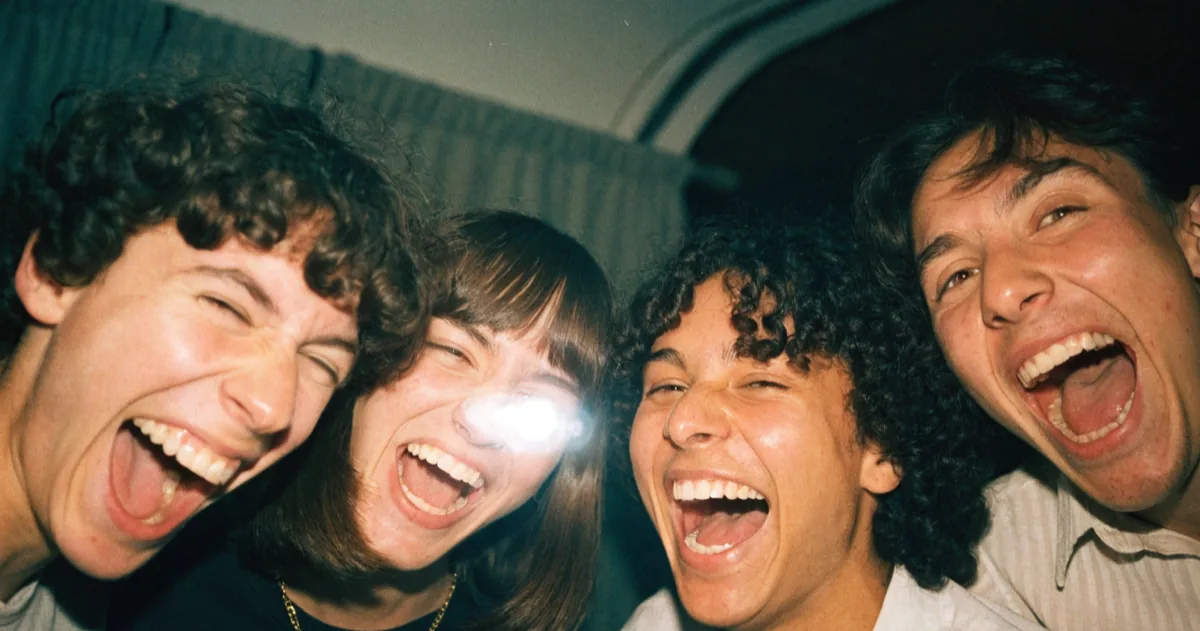
Most people walk into a photo booth with one pose in mind and walk out with four frames of the same face. That is not a failure of imagination. It is a timing problem: the booth starts counting before you have finished deciding, and by the time you think of something better, the strip is already printing.
The fix is to decide all four before you step in. Below are 55 photo booth poses, sorted by the only thing you actually know in the queue — how many people are going in with you. Each section ends with a four-frame sequence you can run straight through.
Key takeaways - A classic photo strip is four frames fired on one countdown, so you need four poses ready, not one. - Each frame is a 4:3 landscape rectangle. Spread out sideways; do not stack heads vertically. - The solo shot is the hardest one, because the frame is built for two heads and gives one person a lot of empty air to fill. - A 360 booth reverses the rules: the camera moves fast and you move slowly. - Whatever the booth prints goes home in one person's pocket. Everything else lands on everyone else's phone.
How many poses do you actually need?
Four. A classic photo strip is four frames on one countdown, and the countdown does not wait for you.
The format is worth understanding because it dictates everything else. The standard strip is 2 × 6 inches — 600 × 1800 pixels at 300 DPI, which is exactly half of a 4 × 6 photo print, and that is why the size won: two strips fit on one sheet of standard media with nothing wasted (LensBooth).
Now divide that strip into four. Each frame comes out at roughly 540 × 405 pixels once you allow for the margins, the gaps and the footer. That is a 4:3 landscape rectangle — wider than it is tall. LensBooth's layout guide puts it plainly: the frame is "wide enough for two heads side by side, which is why it is the default for anything involving couples or friends," and it "crops tightly on a solo portrait."
Two rules fall out of that, and they run against most of the posing advice you will find:
- Go sideways, not upright. A pyramid, a tall stack, someone standing on a chair — all of it gets cut. Shoulder-to-shoulder survives.
- Change something between every frame. Not your smile, your shape. Turn, drop, lean, lift something. Four frames of the same pose is one photo printed four times.
| People in the booth | The constraint | The sequence to run |
|---|---|---|
| 1 | The frame is built for two heads; you have to fill the width | Arms up → over the shoulder → chin on hand → mid-laugh |
| 2 (couple) | Stay level with each other or one of you gets cropped | Heart hands → the look → the kiss on the cheek → nose to nose |
| 2 (friends) | Contrast beats symmetry | Same face → the lift attempt → one committed, one not → cheek squish |
| 3–4 | Build a triangle, not a row | The stagger → everyone jump → look at the one in the middle → the pile-in |
| 5+ | The back row has to be lower, not behind | Kneel, sit, stand → everyone points at one person → the swap → the all-in hug |
| 360 booth | Hold the pose; the camera moves, you do not | Not four frames but one pass: the hold, or the freeze and release |
Not every layout uses four. Most strips hold "three or four vertically stacked images" depending on the template the operator picked, and most modern booth printers "produce two 2×6 strips on a 4×6 print and then cut them automatically" — which is why you usually walk away with two copies (Clear Choice Photo Booth). Check the screen before you go in; if it counts to three, cut the weakest pose from the sequences below.
Photo booth poses for one person
The solo shot is the hardest thing to do in a booth, and it is not your fault. You are filling a frame that was designed for two people. Everything below is a way to use the width you have been given.
- The lean. Put your weight on one hip and lean toward one side of the frame. The empty half stops looking empty.
- Over the shoulder. Turn your body a quarter-turn away, then look back at the lens. It adds depth to a flat frame.
- Hands framing the face. Both hands flat against your cheeks, elbows out wide. The elbows are what fills the frame.
- The prop as a second subject. Hold a hat, a sign or a glass out to one side at head height so the frame reads as two objects, not one person and a gap.
- Chin on hand. Elbow braced on an imaginary table, chin resting on your fist. Old-fashioned and it always works.
- Blowing a kiss sideways. Aim the kiss at the empty half of the frame rather than at the camera.
- Mid-laugh. Look down, then snap your head up on the flash. It produces a real expression instead of a held one.
- The sunglasses reveal. Sunglasses on, then pulled halfway down the nose so your eyes clear the rim.
- Arms up. Both arms straight overhead in a V. The cheapest way to fill a wide frame is to become wide.
The four-frame solo sequence
arms up → over the shoulder → chin on hand → mid-laugh. Big, then turned, then quiet, then real.
Photo booth poses for two — couples
Two heads side by side is the frame's native format, so almost everything works. The one thing that does not work is a height gap: if one of you is much taller, the shorter person gets a chin and the taller one gets a forehead. Bend your knees, sit on something, or lean your heads together until you are level.
- Heart hands. Each of you makes half a heart between you. The one everyone knows, and it earns its place because it fills the middle of the frame.
- Foreheads together. Eyes closed, looking down. The quiet frame that makes the other three look louder.
- The dip. One of you leans the other back. Keep the dip shallow — a deep one drops a head out of a short frame.
- The kiss on the cheek. One kisses, the other grins at the lens. Never both looking away.
- Back to back, arms folded. Chins turned to camera. Reads as a film poster in the best way.
- The ring shot. Hands stacked in front of both faces, ring toward the lens. For engagements it is the frame that gets shared.
- Nose to nose. Closer than feels comfortable. The frame is wide, so faces have to come in to fill it.
- The piggyback. Works only if the booth has headroom. Test the ceiling before the countdown starts.
- One whispering. Hand cupped to the other's ear, the listener reacting. Two different expressions in one frame beats two identical smiles.
- The toast. Glasses raised and clinked at eye level, between your faces rather than in front of them.
- The look. Both of you looking at each other, neither looking at the camera. Do this on frame three, when it will read as candid.
- Peeking round. One stands square to the lens, the other leans out from behind their shoulder.
The four-frame couple sequence
heart hands → the look → the kiss on the cheek → nose to nose. It reads as a story, and it is four visibly different shapes.
Photo booth poses for two — best friends
The friend version of a couple shot trades symmetry for contrast. The joke is usually that one of you commits completely and the other does not.
- Same face. Agree on one expression — shocked, unimpressed, delighted — and both hold it exactly.
- One committed, one not. One goes enormous, the other stares flatly at the camera. Decide who is who beforehand.
- Back-to-back finger guns. The Charlie's Angels arrangement, minus the third person.
- The prom pose. One standing behind, hands on the other's shoulders, both deadly serious.
- Cheek squish. Press your faces together hard enough to distort them both.
- Fake shock. Both hands to your own cheeks, mouths open, looking at each other rather than at the lens.
- The lift attempt. One tries to pick the other up. The photograph you want is the failure, not the success.
- Tongues out. Simple, universal, and it beats a smile you have already used three times.
- The high five. Caught mid-clap in the centre of the frame, faces turned to camera.
The four-frame friends sequence
same face → the lift attempt → one committed, one not → cheek squish.
Photo booth poses for three and four people
At three you stop lining up and start building a triangle. A straight row of three heads is a wide, boring frame and it wastes the height you do have.
- The stagger. One kneeling, one seated or crouched, one standing. Three heads at three heights.
- The sandwich. Two on the outside lean their heads onto the shoulders of the one in the middle.
- Charlie's Angels. One in front, two back to back behind, all finger guns.
- The group heart. Two outer people make the sides, the middle person makes the point at the bottom.
- The pile-in. Everyone leans hard toward the centre until your heads overlap.
- Look at the one in the middle. Two look at the third, the third looks at the camera.
- The conga. All three in profile, one behind the other, hands on the hips in front.
- Everyone jump. Ask for a longer countdown if the booth allows it, and jump on the flash rather than before it.
- The prop hand-off. Pass an object across the frame — a hat, a bouquet, a bottle — and let the blur happen.
- The wall. All four square to the camera, arms crossed, no smiling. Silly precisely because it is not.
The four-frame trio sequence
the stagger → everyone jump → look at the one in the middle → the pile-in.
Photo booth poses for a big group
Past four people, the problem is the back row. In a frame this short, a second row cannot stand behind the first — they have to be lower or they lose their heads to the crop.
- Kneel, sit, stand. Front row kneeling, middle row crouched, back row standing. Rebuild your usual group photo, but compressed vertically.
- The wedge. Two people at the front centre, everyone else fanning back and outward. Nobody is directly behind anybody.
- Lean in from the sides. Everyone at the edges tilts their head toward the middle. The frame fills corner to corner.
- The all-in hug. One person in the centre, everyone else collapsing inward on them.
- Confetti overhead. One person throws, everyone else looks up. Check with the venue first — some ban it outright.
- Everyone points at one person. Works for a birthday, a promotion, a proposal, or no reason at all.
- The chorus line. Everyone shoulder to shoulder with one leg kicked out. The kick is what makes it read.
- Cheers. All glasses raised to a single point in the middle of the frame, not scattered.
- The swap. Frame one: everyone poses properly. Frame two: everyone changes place. It is the only pose on this list that uses the countdown gap as the joke.
The four-frame group sequence
kneel, sit, stand → everyone points at one person → the swap → the all-in hug.
Poses for a 360 photo booth
A 360 booth inverts everything above. The camera arm moves fast and you move slowly, so the poses that work are held, not snapped. Anything you would do in a fifth of a second reads as a twitch on a rotating clip.
The platform sets the choreography: Clear Choice Photo Booth's guide to the format notes that a 360 platform "allows 2–4 guests to participate at once safely" (Clear Choice Photo Booth). Plan for a small group, not a crowd.
- The hold. Pick one strong shape and keep it for the whole rotation. It looks deliberate from every angle.
- The slow spin. Turn on the spot against the direction of the arm. You get more faces per second than you would standing still.
- The freeze and release. Statue-still for the first half of the pass, then move on the second. The clip has a beginning and an end.
- The fabric throw. A jacket, a veil, a scarf thrown upward and left to fall. Slow motion is the format's entire reason for existing, so give it something falling.
- The centre and the circle. One person still in the middle, the others walking slowly around them.
- Sit and lean. Sit on the edge of the platform and lean back on your hands. It fixes the problem of not knowing what to do with your legs.
Do not carry these back into a normal booth. A held pose across four still frames gives you four identical photographs.
What to do when there is no booth
A phone on a small tripod does most of what a booth does. Back it up further than feels right so the frame stays wide, set the self-timer, and let one person tap and run. The poses above all work — the sequences are actually easier, because you can shoot as many rounds as you like.
What the phone does not reproduce is the print, and that turns out to be the part that matters. A booth hands you a physical object. It goes home in one person's pocket, and everybody else at the party has nothing.
The same thing happens to the photos taken around the booth — the queue, the props being tried on, the strip being held up and admired. Those live on forty different phones and the host never sees a single one. If you want them, the fix is not asking people to text you afterwards. It is giving everyone one album everyone uploads to before the night starts, so the phone shots, the videos and the short voice notes all land in the same place as they happen. If you are still deciding on a format at all, our rundown of wedding photo booth alternatives compares the options side by side.
Five things that ruin a strip
Strips usually fail for mechanical reasons, not creative ones.
Blinking.
Spontaneous blinks happen roughly 15–20 times a minute and each one lasts about 150–300 milliseconds (Liu et al., Spontaneous Blinks Activate the Precuneus, PMC). Multiply that out and any one person's eyes are shut for something in the region of 6% of the time. Six people across four frames is twenty-four chances at that, so a closed pair of eyes somewhere on the strip is the normal outcome rather than bad luck. Fix: everyone looks down, then up on the flash, and one person calls it out loud.
Stacking upright.
The frame is wider than it is tall. Height gets cropped; width does not.
Prop clutter.
A prop held in front of a face is a photograph of a prop. Keep them at shoulder height or beside the head.
Standing too far back.
Booths are lit for close range. Four faces at the back wall become four small pale dots.
Repeating yourself.
The most common failure and the easiest to avoid: pick the sequence for your group size and run it.
How to get a shy guest to pose
"Just be spontaneous" is the instruction that makes people freeze. It asks someone to invent a performance in three seconds while a light counts down at them.
Give the hands a job instead. Almost all photo booth awkwardness is a hands problem — nobody knows where to put them, so they hang. Three fixes, in order of how well they work:
- Hold something. A glass, a prop, a sign, the edge of a jacket. Any object turns a decision into a grip.
- Do something. Toasting, whispering, pointing, laughing at someone off to the side. An action is easier to perform than an expression.
- Face someone. Looking at the person next to you is much easier than looking at a lens, and it photographs better anyway.
Two more things that help: nobody's first booth photo should be a solo one, so send them in with someone. And print the sequences above onto a card and leave it inside the booth. It removes the decision entirely, which is the actual barrier.
Before you queue
Four frames, one countdown, and a rectangle that is wider than it is tall. Everything else is detail.
Pick the section that matches how many people are going in with you, screenshot the four-frame sequence at the end of it, and spread out sideways when the light starts counting. If the booth prints three frames rather than four, drop the weakest one and run the rest.
And decide before the night starts where the photos that are not printed are going to end up — our guide to collecting guest photos at a wedding walks through the options. The strip takes care of itself. The other forty do not.
Sources
- LensBooth, Photo Strip Sizes & Dimensions: The Complete Guide — https://lensbooth.app/blog/photo-strip-sizes-and-dimensions
- Clear Choice Photo Booth, What is the Size of a Photo Booth Strip? — https://clearchoicephotobooth.com/blog/photo-booth-strip-size/
- Clear Choice Photo Booth, 360 Photo Booth: How It Works, Cost & Why It's So Popular — https://clearchoicephotobooth.com/blog/360-booth-explained/
- Liu C.C., Ghosh Hajra S., Cheung T.P.L., Song X., D'Arcy R.C.N., Spontaneous Blinks Activate the Precuneus: Characterizing Blink-Related Oscillations Using Magnetoencephalography, PMC5649156 — https://pmc.ncbi.nlm.nih.gov/articles/PMC5649156/
Frequently asked
Three or four, fired on a single countdown and printed as a 2 × 6 inch strip — most strips hold "three or four vertically stacked images" (Clear Choice Photo Booth). Four is the classic layout, and the strip is exactly half of a 4 × 6 photo print, so two fit on one sheet with zero waste (LensBooth). That is why booth printers cut a 4 × 6 down the middle and hand you two copies.
It depends on the format. A 360 platform holds 2–4 guests at a time (Clear Choice Photo Booth). An enclosed classic booth is narrower still — three comfortably, four if you crouch. An open-air setup with a backdrop takes as many people as the backdrop is wide, which is where the kneel-sit-stand arrangement earns its keep.
Hold something, do something, or face someone. All three replace "look natural" with a task you can actually complete. Go in with another person rather than alone, and use a printed pose card so you are not inventing anything on the spot.
Heart hands, foreheads together and the kiss on the cheek cover the range from posed to quiet to candid, and the three of them look completely different on a strip. Stay level with each other — a height gap crops one of you badly in a frame this short.
No. A 360 pose is held for the length of a rotation, which is exactly what you do not want across four still frames — you would get the same photograph four times. Hold poses for the rotating arm; change poses for the strip.
 Guide
Guide21 Halloween party themes that actually photograph well
A Halloween theme has to survive dim light and a phone camera, or nobody remembers it. Twenty-one themes sorted by who they are for -- adults, the office, horror fans, families -- each with the one detail that makes it read on camera.
 Comparison
Gathmo vs disposable cameras: which is better for your party?
Disposable cameras have nostalgia. Gathmo has everything else. A head-to-head on cost, photos, sharing, and what you keep.
 Guide
GuideGolden Birthday Party Ideas for Every Number From 1 to 31
Your golden birthday is the year your age matches the day you were born. Party ideas sorted by the number you got, plus the sum that dates yours.