Gathmo vs disposable cameras: which is better for your party?



The verdict
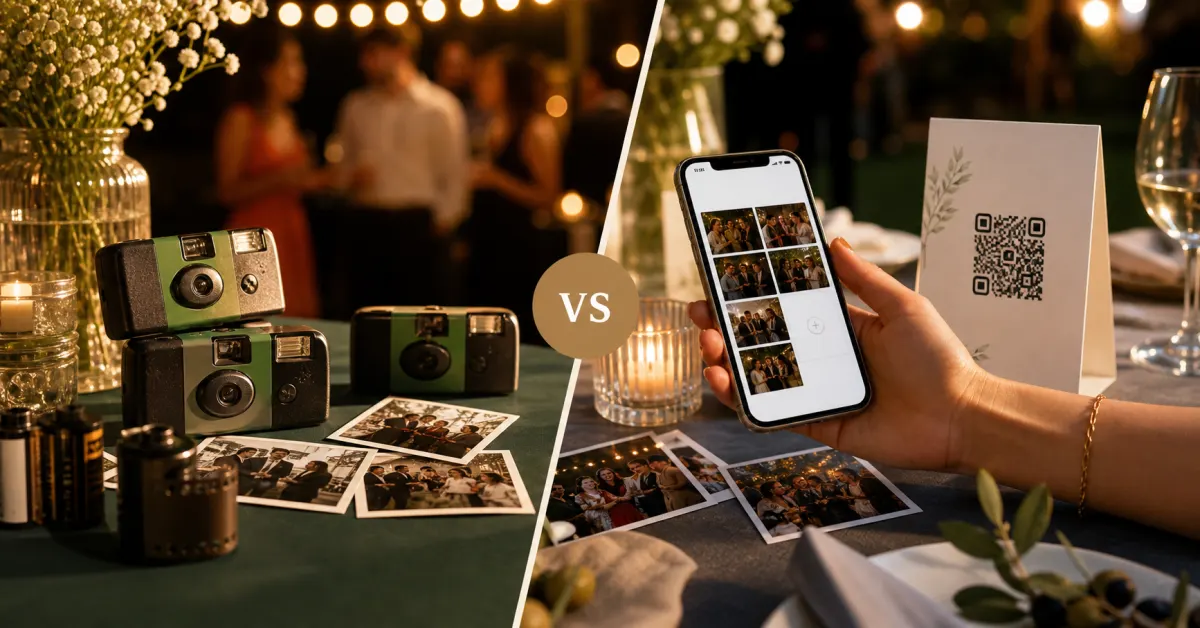
Disposable cameras win on nostalgia and atmosphere, and those are real things worth having. But for an honest comparison of which option leaves you with more memories, lower cost, and a format you can actually share -- it is not close. For a fraction of what you would spend scattering ten cameras across the room, Gathmo captures more photos, more types of moments, and delivers them instantly, in full resolution, in a shareable album you can download in full and keep. The best outcome for most parties: put a disposable on each table for the aesthetic, and a Gathmo QR code everywhere for the actual coverage.
| Feature | Gathmo | Disposable cameras |
|---|---|---|
| Cost per event | from EUR 0 | ~EUR 15 x several |
| Photos captured | Unlimited on paid plans | 27 per camera |
| Instant sharing | ✓ | ✗ |
| Video | ✓ | ✗ |
| Voice notes | ✓ | ✗ |
| Effort for guests | Scan and done | Find it and wind it |
| A lasting album | ✓ | After developing |
| Eco-friendly | ✓ | ✗ |
Choose Gathmo if…
- You want every guest contributing, not just the few who happen to find a camera
- You would like the photos before the night is over, not two weeks later
- Video clips and voice messages matter as much as photos
- You want one shareable album the whole group can access
- Budget is a consideration and you want the most coverage for the least spend
Choose Disposable cameras if…
- The analogue, film-grain aesthetic is the whole point of the exercise
- You love the ritual of a developed roll and the surprise of what came out
- You want a physical, tactile object on every table as part of the decor
- A phone-free moment is part of the evening's theme
For collecting photos at a party, a QR code album beats disposable cameras on coverage, speed and cost. Every guest phone becomes a camera feeding one shared album, there is no 27-frame ceiling per camera, and the photos are ready before the night ends instead of two weeks later. Disposable cameras still win on one thing: the analogue ritual and the film-grain look. Many hosts use both.
What do disposable cameras still do better?
There is a genuine magic to a disposable camera -- the weight of it in your hand, the mechanical click of the wind-on, the slight uncertainty of not knowing quite what you captured until the roll comes back from the developer two weeks later. If that ritual and that aesthetic are what you are after, nothing digital comes close. Buy six cameras, scatter them across the tables, and let the analogue charm do its thing. Some moments are better suited to film grain than a JPEG.
How many photos does each option actually capture?
For most parties, the goal is to end the night with the memories, not just the medium. A typical party table might hold one or two disposable cameras between eight guests, and each camera has 27 frames. Guests take the obvious group shots, burn through the roll in the first hour, and the camera sits there for the rest of the evening while the candid moments -- the speeches, the spontaneous dancing, the conversations at the edge of the garden at midnight -- go uncaptured. The coverage you get rarely matches the coverage you imagined.
A single QR code on the table turns every phone in the room into a camera feeding a shared album. Guests upload in the moment, while they are still laughing about whatever just happened. You see the photos arriving on your dashboard in real time. By midnight, a party of 50 can easily produce a few hundred photos -- many times what a tableful of disposable cameras would generate, including moments from every corner of the room that no single camera placement could have covered.
What does each option cost for a party?
Disposable cameras cost more than most people expect. A disposable camera runs about EUR 15 to buy and another EUR 10 to 15 to develop, so a party where you want decent coverage from ten cameras costs EUR 250 to 300 before you have seen a single image. The results arrive two weeks later and cannot be shared digitally without another round of scanning fees. Gathmo's free plan covers a smaller party at no cost -- up to 20 items -- and the paid plans that remove the cap start at EUR 29. The economics favour digital at every guest count.
Whichever camera the room ends up holding, people still need something to point it at. 55 photo booth poses for solo shots, couples and groups is the prompt list to print, seven interactive photo booth formats with their real costs and space needs covers the setups themselves, and for a birthday, golden birthday party ideas for every number from 1 to 31 has the theme.
Frequently asked
Absolutely -- and many hosts do exactly this. Put a disposable camera on two or three tables for the look and the ritual, and a Gathmo QR code everywhere for actual coverage. You get the analogue charm and the complete album. The two do not compete; they complement each other. Most guests who pick up a disposable will also scan the QR code during the evening.
The free plan covers a smaller party at no cost: photos, video and voice, up to 20 items, with a 30-day retention window. Paid plans from EUR 29 remove the upload cap and extend retention; the live photo wall comes with the EUR 69 plan. Even the most expensive plan works out cheaper than buying and developing a tableful of disposable cameras for a medium-sized party.
Nothing at all. Guests scan the QR code with their phone camera and the upload screen opens directly in their browser. No app, no account, no email address. That matters because every extra step -- app install, login, or email prompt -- gives guests another reason to stop before uploading.
Some guests, particularly older ones, may not want to scan a QR code or upload from their personal phone -- and that is completely fine. Gathmo works alongside traditional approaches: any guest who prefers to email photos afterward, or who would rather leave a disposable camera on their table, can do so. The QR code is an invitation, not a requirement, and having it there typically draws in more than enough guests to build a full album.
For collecting photos, yes -- by most practical measures. A QR code turns every guest's phone into a camera feeding one shared album, removes the fixed 27-frame limit of a disposable camera, and delivers results instantly rather than after development and scanning. Disposable cameras still win on analogue aesthetics and the ritual of developed film. Many hosts use both: a disposable camera on a few tables for the look, and a QR code everywhere for the actual coverage.
A standard 27-exposure disposable camera can produce up to 27 photos before development and scanning, with some frames often lost to blur, flash, or user error. Scattering 10 cameras across a party creates a hard ceiling of 270 exposures before waste. A Gathmo free-tier QR album accepts 20 items from the same event; on a paid plan (Essential, 29 EUR) the upload cap is removed. Key difference: QR uploads are available immediately after the event; disposable camera results take 1 to 2 weeks and cost 10 to 20 EUR per camera for development and scanning.
A single disposable camera (27 exposures) costs 8 to 15 EUR to buy and a further 10 to 20 EUR to develop and scan, totalling 18 to 35 EUR per camera. Scattering 10 cameras across a party costs 180 to 350 EUR for 200 to 270 usable photos, delivered 1 to 2 weeks after the event. A Gathmo Celebrate plan (69 EUR per event) delivers unlimited uploads immediately, with no development wait. The disposable camera has a nostalgia and atmosphere value that a QR album cannot replicate; the QR album has an immediate, unlimited, and shareable result that a disposable camera cannot match. Many hosts use both.
 Guide
GuideGolden Birthday Party Ideas for Every Number From 1 to 31
Your golden birthday is the year your age matches the day you were born. Party ideas sorted by the number you got, plus the sum that dates yours.
 Guide
Guide55 Photo Booth Poses for Solo Shots, Couples and Groups
A photo booth fires four wide frames on one countdown. 55 photo booth poses sorted by how many people are in the booth, with a sequence for each.
 Guide
Guide21 Halloween party themes that actually photograph well
A Halloween theme has to survive dim light and a phone camera, or nobody remembers it. Twenty-one themes sorted by who they are for -- adults, the office, horror fans, families -- each with the one detail that makes it read on camera.