Golden Birthday Party Ideas for Every Number From 1 to 31


Search for golden birthday party ideas and you get the same list eleven times: gold balloons, gold tinsel, gold-rimmed glasses, something with edible gold on it. It is not wrong. It is just the same advice whether the person is turning 6 or turning 31, which is a strange thing to say about the one birthday whose entire point is the number.
Because that is what a golden birthday is. Not a colour — a coincidence. Your age lines up with your date, once, and it cannot happen again. So the number is the brief, and a 6th and a 31st have almost nothing in common.
Below: the sum that tells you which calendar year yours falls in, the three dates where the tradition quietly breaks, and roughly thirty ideas sorted by the number you were actually handed.
Key takeaways - Your golden birthday is the year you turn the same number as the day of the month you were born. - The sum is birth year + day of month. Born on the 14th in 1998? Your golden birthday was in 2012. - If you were born in the first twelve days of a month, yours already happened — before you were a teenager. That is just under 40% of the dates on the calendar. - Everyone born on 29 February has a golden birthday at 29, in a year that never has a 29 February. Not usually. Never. - Plan around the number rather than around gold, and the party stops looking like everyone else's.
What is a golden birthday?
A golden birthday is the birthday on which your age matches the day of the month you were born. Born on the 22nd, you turn 22 on your golden birthday. Born on the 3rd, you turned 3 on yours (Greenlight).
The term is common enough to be listed in the dictionary, where Wiktionary marks it as slang and gives the example "I'm turning 25 on the 25th so it's my golden birthday." You will also hear it called a champagne birthday or a lucky birthday; they mean the same thing, and which one you grew up with mostly depends on where you grew up.
Where the custom came from is less settled than the definition. The story repeated across most of the internet credits the American author Joan Bramsch with inventing it in the 1950s — Mrs. Fields puts it carefully as "said to have originated from author Joan Bramsch in 1955," and the hedge is doing real work. The claim traces back to Bramsch's own account rather than to any contemporaneous record, and her Wikipedia entry does not mention golden birthdays at all. Treat it as a well-travelled attribution, not a documented fact. It has no bearing on the party.
Which year does your golden birthday fall in?
Add the day of the month you were born to the year you were born.
That is the whole calculation.
Born on 14 July 1998: 1998 + 14 = 2012. On 14 July 2012 you turned 14, on the 14th. Born on 2 March 2021: 2021 + 2 = 2023, and it has already gone.
| Born on the… | You are turning | And it lands |
|---|---|---|
| 1st – 9th | 1 to 9 | in early childhood — almost certainly already past |
| 10th – 17th | 10 to 17 | school years |
| 18th – 25th | 18 to 25 | often colliding with another milestone |
| 26th – 31st | 26 to 31 | adulthood, and the only band that gets to plan its own |
Three dates where the tradition breaks
If you were born between the 1st and the 12th, yours is already gone.
Days 1 to 12 fill 144 of the 365 slots in a common year — just under 40% of the calendar. Spread evenly, that puts about two in five golden birthdays before the age of thirteen, and most of the people they happened to had no idea at the time. There is a fix further down.
If you were born on the 31st, your date is genuinely rare.
Only seven months have one. Here is what the calendar actually offers in a common year:
| Your day of the month | Months that contain it | Occurrences per year |
|---|---|---|
| 1st – 28th | all 12 | 12 |
| 29th | 11 (not February) | 11 |
| 30th | 11 (not February) | 11 |
| 31st | 7 — Jan, Mar, May, Jul, Aug, Oct, Dec | 7 |
A golden birthday at 31 draws on 42% fewer calendar slots than one at 14. That is not a statement about birth rates, which are not evenly spread — the Office for National Statistics found 26 September to be the most popular birth date in England and Wales, at roughly 2,000 births against the 1,800 a day you would expect if births were distributed evenly (ONS). It is simply a statement about how many days exist.
And if you were born on 29 February, your golden birthday date does not exist.
Not "rarely." Never.
Work it through. To be born on 29 February you must be born in a leap year, so your birth year divides by four. Your golden birthday is at 29, in your birth year plus 29 — and a multiple of four plus 29 is never a multiple of four. Since leap years are the years divisible by four, with century years skipped unless they also divide by 400 (NASA JPL Education), your golden year cannot be one.
Check it against anyone you like. Born 1996, golden year 2025. Born 2000, golden year 2029. Born 2024, golden year 2053. None of them is a leap year, and none of them has a 29 February in it.
The ONS data notes the same date from the other end: 29 February has the lowest total births of any date over twenty years, for the obvious reason that it only comes round every four years. Leap-day babies get the rarest date on the calendar and a golden birthday they can only celebrate on the 28th or the 1st. That is worth a joke on the invitation, at minimum.
The one rule that makes a golden birthday party work
Use the number. The gold is optional.
Gold decorations are the default because the word "golden" is right there, and the trouble with that default is that it makes every golden birthday identical. Forty gold objects in a room say "we bought the party aisle." A single number, used properly, says someone thought about it.
There are only three ways to use a number, and all of them are cheap:
- Count something to it. Twelve candles is obvious. Twelve toppings, twelve songs, twelve guests, twelve stops, twelve photographs — less so.
- Repeat it. The time the party starts, the table you book, the room number, the track that opens the playlist.
- Find the thing that already is it. A restaurant with your number on the door. A bottle from that vintage. A song from that year. The year you were born plus the number is the year it happens, and that year has its own soundtrack.
Everything below is one of those three.
Golden birthday party ideas for numbers 1 to 9
Nobody in this band is planning their own party, and the guest of honour cannot read a theme. Counting, though, they can do — a four-year-old will notice that there are four of something, and be delighted.
- Exactly N activity stations. Four stations for a 4th: sticker table, bubbles, digging tray, drawing. It caps the chaos and it doubles as the running order.
- The number as the cake, not on it. A cake cut into the shape of the number beats a round cake with a candle stuck in it, and it photographs better.
- N gifts, opened at N points across the afternoon. Spacing them out is the single best defence against the mid-party meltdown.
- A photo line: one picture per year of life. Five photos on a string for a 5th, pegged in order. Grandparents stand in front of it for twenty minutes.
- A treasure hunt with exactly N hiding places, each one marked with a gold star so the smallest guests can find them.
- N toppings on one thing. Six sprinkle bowls, six pizza toppings, six ice-cream sauces. Choice, contained.
- A crown with the number on it, worn by one person only. Small children take this extremely seriously.
- N balloons, in one colour, in one corner. Not sixty balloons everywhere.
Golden birthday party ideas for numbers 10 to 17
This is the band where the number becomes a game the guest of honour can play along with — old enough to find it funny, young enough that a list of tasks is genuinely fun rather than embarrassing.
- The N-item challenge list. Fourteen things to do before the party ends, written out and handed round. Half of them silly, two of them impossible.
- A playlist of N tracks, one from each year of their life. For a 15th, that is a chronological tour from the year they were born to now, and it will be very funny in the middle.
- N-minute rounds. Whatever the games are, run each for exactly N minutes and move on. Momentum is the whole trick at this age.
- N guests, and mean it. A hard cap is a gift to whoever is supervising, and "it's my golden birthday, so eleven people" is a rule that argues for itself.
- An N-question quiz about the birthday person, written by their oldest friend.
- A dessert bar with N options rather than one big cake.
- One gold item each as the dress code. Not gold outfits — one item. Earrings, socks, a tie, a shoelace. Cheap, and it makes the group photo.
- Rank N things, out loud, as a group. Films, snacks, teachers, songs. It starts arguments, which is the point.
Golden birthday party ideas for numbers 18 to 25
This band has a problem the others do not: your golden birthday keeps landing on a birthday that already mattered. Turning 18 on the 18th or 21 on the 21st is two occasions on one day.
- Decide which birthday the party is for, and say so on the invitation. Trying to be both a coming-of-age party and a novelty-number party produces something that is neither.
- N stops, planned honestly. A route of twenty-one venues is a fantasy. Pick the number if it is reachable, otherwise use it somewhere else on the night and go to four good places.
- A playlist of N tracks from the year you were born. For a 21st that is 21 songs from a single chart year, and it will be the most-discussed thing at the party.
- Book table N, room N, or the N o'clock slot. Restaurants find this charming and it costs nothing.
- N guests, one memory each. Everyone arrives with one story about the birthday person, told in under a minute. This is a better speech than a speech.
- Schedule the main photograph for golden hour — the hour after sunrise or before sunset, when the light is warm and low. It is the one joke in this whole article that also improves the pictures.
- N toasts, one sentence each. A sentence limit is what stops toasts becoming a hostage situation.
- A retrospective wall: one photograph per year. Twenty-one prints, in order, on a wall. People stand at it all night.
Golden birthday party ideas for numbers 26 to 31
The adult band, and the hardest, because nobody in it is having a party thrown for them. It is also the band with the most freedom: you can build the whole evening around a number and no one will stop you.
- Dinner for exactly N. A table of 28 is a wedding; a table of 28 people who all know the host is an event. If the number is large, make it a long table and one shared menu.
- A menu of N items. Small plates work best: twenty-nine things, ordered for the table, arriving all night.
- One photograph per year, on one wall. For a 30th that is thirty prints, and it is worth the print shop money. It gives people something to do that is not standing near the drinks.
- A hard end time set by the number. Starts at 8, ends at 1 — or start at N o'clock and let the number set the pace.
- N letters. Ask N people for one line each, in advance, and read them at the table. Whoever collects them gets to hear them twice.
- Cap the gifts at the number. €30 for a 30th, and the constraint produces much better presents than an open budget does.
- Go somewhere that already has the number. A bottle from the vintage that matches your birth year. A hotel room N. A restaurant at number N on the street.
- One gold object, well lit. For adults, restraint reads as expensive and volume reads as a school disco.
Gold decorations that do not look like the party aisle
One gold thing, lit properly, beats forty gold things. A gold finish is mostly a mirror with a warm tint: it hands back the light in the room. Under warm lamps or candlelight it reads as gold. Under cool white LEDs — short on exactly the warm end that gold reflects best — it goes flat and slightly grey, and people compensate by buying more gold, which does not help. The bulbs matter more than the quantity.
Three things worth doing:
- Change the bulbs before you buy more decorations. Warm lamps, or candles, and the gold you already own starts working.
- Mix matte with metallic. All-metallic reads cheap; gold against cream, black, deep green or terracotta reads deliberate.
- Make the number the decoration. One large number — freestanding, on the wall, or in balloon form — plus plain everything else. The number is the theme. It does not need support.
Food, drink and cake for a golden birthday
Count the food. Do not gild it.
Gold-dusted everything is the reflex, and it tastes of nothing. The number is a better organising principle: N canapés, N cheeses on the board, N flavours of ice cream, N cocktails on a written list behind the bar.
For the cake, the strongest move is the simplest one — make the number the entire design rather than an ornament on top of something else. A number-shaped cake, or a sheet cake iced with nothing but the numeral, does more visual work than a tiered cake with gold leaf on it.
If you do want edible gold, buy leaf that is sold as edible and packaged for food use, not craft gilding leaf from an art shop. They are not the same product.
And since the tradition also goes by "champagne birthday," one bottle, opened at the moment the number is announced, is an easy piece of theatre.
How to end up with the photos from a once-only birthday
A golden birthday cannot recur. Whatever happens on the night exists on other people's phones, in a group chat that scrolls away in a week, and that is where most of it stops.
The number solves this too, and it is the neatest use of it in the whole article: ask for the number. Twenty-seven photos for a 27th. It turns collection into a game with a finish line, which is the only way people actually send anything. "Send me your photos" produces four pictures a fortnight late. "We need 27 and we have 19" produces the rest by breakfast.
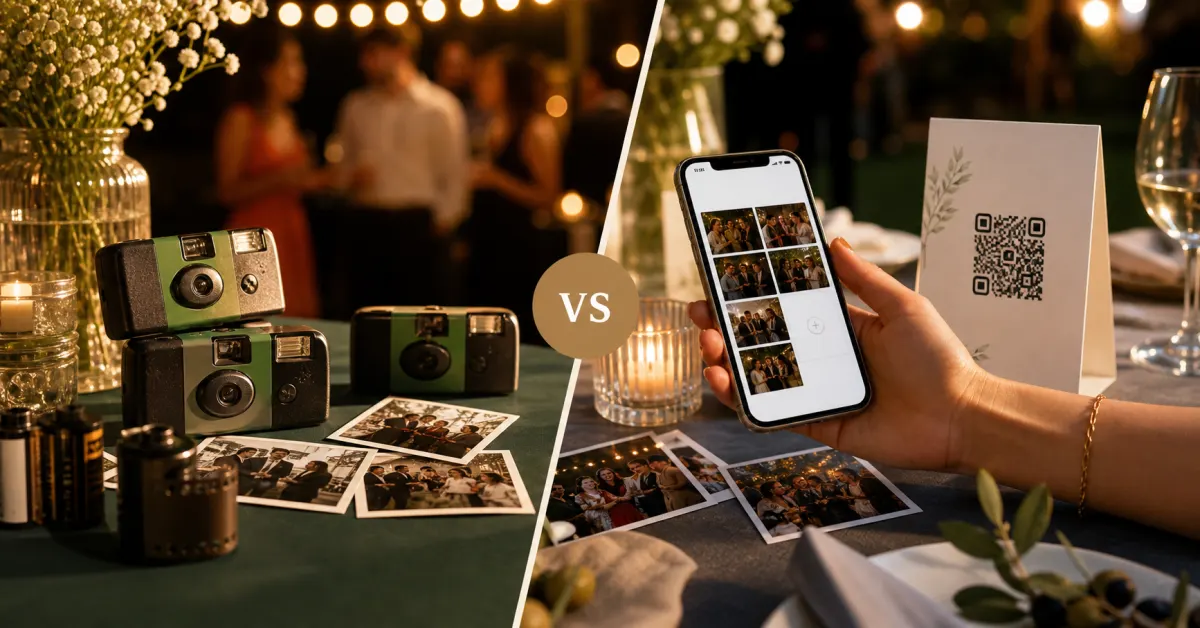
For that to work the photos have to land somewhere that is not a chat thread. Put a printed code on the table, point it at one album everyone adds to, and every guest's camera roll goes to the same place — no app to install, no account, no one left off a list. Photos, video and voice notes all go in, there is no upload limit to argue with, and afterwards the whole thing is a single link you can send to the people who could not come.
Two things worth asking for on the night, because nobody thinks of them the next morning:
- A short video from each guest, N seconds long, filmed against the same wall. Edited end to end, it is the best thing anyone will make from the evening.
- A voice message from whoever is not there. For a golden birthday in the 26–31 band, that is usually someone abroad, and thirty seconds of their voice outlasts every photograph.
What if your golden birthday already passed?
Most people's did. If you were born in the first twelve days of a month, yours went by while you were in primary school, and there is no getting it back. What exists instead is a set of substitutes, and it is worth knowing that they are not standardised.
- Double golden. Twice your date. Born on the 14th, you celebrate at 28. This is the most common substitute and the one people recognise.
- Triple golden. Three times the date, which only works for the first ten days — born on the 9th, that is 27.
- Diamond, platinum, silver. Here the sources genuinely disagree with each other. One page will tell you a diamond birthday is your 60th; the next says it is when your age matches the last two digits of your birth year; a third assigns that same definition to platinum and gives 100 to diamond. There is no authority to appeal to, because nobody agrees. Pick a rule, state it on the invitation, and nobody will check.
The version that always works, whatever you call it: your age matching the last two digits of the year you were born. Born in 1997, you get it at 97. It is a long wait, but the arithmetic is unarguable.
Sources
- Wiktionary — golden birthday — definition and slang classification. Retrieved 2026-08-12.
- Greenlight — What is a golden birthday? — definition. Retrieved 2026-08-12.
- Mrs. Fields — 17 Golden Birthday Ideas — alternative names (champagne, lucky birthday) and the Joan Bramsch attribution. Retrieved 2026-08-12.
- Office for National Statistics — How popular is your birthday? — most and least popular birth dates in England and Wales, expected daily births, 29 February. Published 2015-12-18.
- NASA JPL Education — Doing the Math on Why We Have Leap Day — leap year rule and the length of Earth's orbit. Retrieved 2026-08-12.
Frequently asked
It means the birthday on which your age matches the day of the month you were born. Born on the 19th, your golden birthday is your 19th. It is also called a champagne birthday or a lucky birthday, and it happens exactly once.
Yes — everyone is born on some day between the 1st and the 31st, so everyone has one. Many have already had theirs without noticing: days 1 to 12 fill just under 40% of the calendar, and every golden birthday in that range lands before the age of thirteen.
Whatever the day of the month you were born is. Born on the 5th, it is your 5th; born on the 30th, it is your 30th. To find the year, add the day of the month to your birth year.
The birthday at twice your date — born on the 11th, your double golden is your 22nd. It is the usual consolation for people whose golden birthday happened in childhood. Usage varies and there is no authority on it, so say which rule you are using.
The golden birthday has one settled definition: age matching date. The diamond birthday does not — different sources call it the 60th, or the birthday where your age matches the last two digits of your birth year, and others attach that second definition to a platinum birthday instead. If you are naming a party after one of them, define it on the invitation.
 Guide
Guide55 Photo Booth Poses for Solo Shots, Couples and Groups
A photo booth fires four wide frames on one countdown. 55 photo booth poses sorted by how many people are in the booth, with a sequence for each.
 Guide
Guide21 Halloween party themes that actually photograph well
A Halloween theme has to survive dim light and a phone camera, or nobody remembers it. Twenty-one themes sorted by who they are for -- adults, the office, horror fans, families -- each with the one detail that makes it read on camera.
 Comparison
Gathmo vs disposable cameras: which is better for your party?
Disposable cameras have nostalgia. Gathmo has everything else. A head-to-head on cost, photos, sharing, and what you keep.