Interactive Photo Booth: 7 Formats, Costs and Space Needs

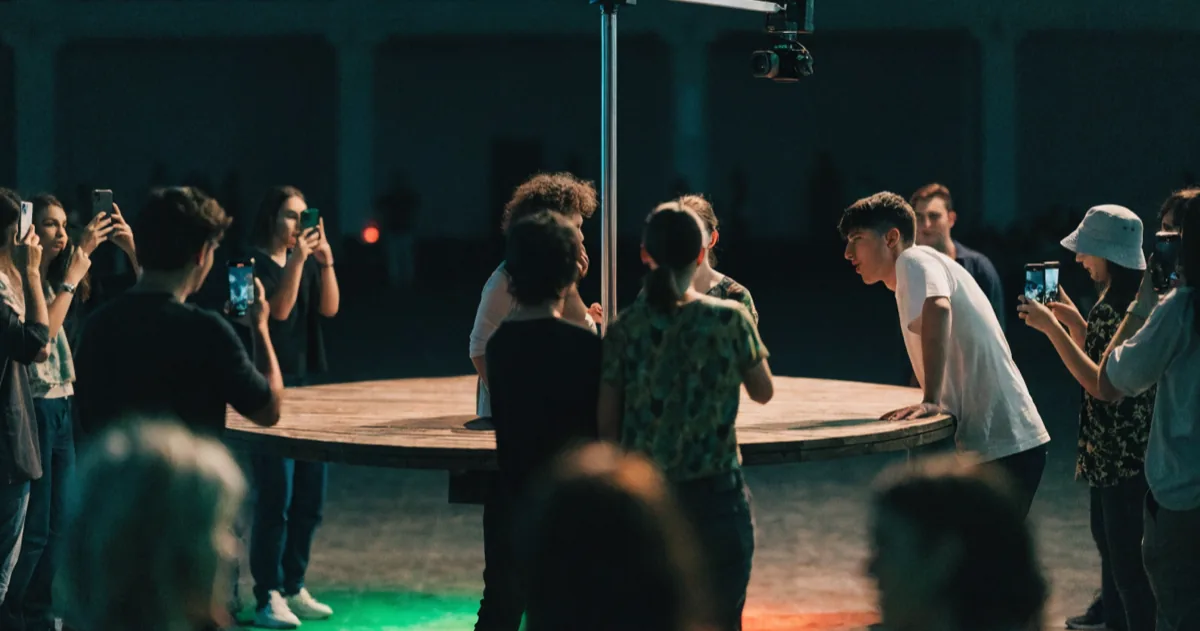
Four different machines are sold under the phrase "interactive photo booth." A mirror you tap. A platform you stand on while a camera swings around you. A tablet on a stick that a host carries to your table. A code on a card that turns every phone in the room into the camera. They all promise the same evening and they want completely different things from your venue — different floor area, different circuits, different staffing, different ceilings.
The pages that come up when you search for one are, almost without exception, written by the people renting it. So this guide does the part they skip: what each format costs, what it demands before it will work, how many of your guests can realistically use it, and what happens to the pictures on Sunday morning.
- "Interactive" describes four separate things — motion, touchscreen, transformation, and delivery. Most booths do two of the four, so ask which two.
- Rental prices spread from roughly $100 an hour for a selfie station to $1,200–$3,500 and up for a 360 booth or glam bot, according to marketplace Bark's 2026 cost guide.
- Do the division before you book. The average US wedding has 117 guests and a standard booking is three to four hours; one booth serves one group at a time.
- The two questions that cancel a booking are floor area and the electrical circuit — not the format.
- Delivery is the weak link. At extreme venue density, one 2026 measurement study recorded 46% image-upload failure over cellular against 3.9% session failure on the venue's Wi-Fi.
What makes a photo booth "interactive"?
An interactive photo booth is one where the guest does something other than stand still and wait for a flash — they spin, tap, swap a background, record a clip, or trigger the shot from their own phone. That is the whole definition, which is why the word covers so much ground and settles so little.
It is more useful to break the term into the four layers a booth can actually offer:
- Motion. Either the camera moves around the guest, as on a 360 platform, or the guest moves and the booth captures a sequence — boomerangs, slow-motion, short video.
- Screen. The guest drives a touchscreen: choose a template, retake, add a caption, pick where the file goes. Mirror booths and open-air tablet booths live here.
- Transformation. The image comes back changed — a green-screen background, a print layout, a filter, an AI restyle.
- Delivery. The guest decides what happens to the file: print it, text it, drop it into a shared gallery.
Most rental booths do two of these four well and gesture at the rest. A 360 booth is nearly all motion and almost no transformation. A mirror booth is screen and transformation with no motion at all. Knowing which two you are paying for is more informative than any product name.
The delivery layer is the one that has changed most, and the reason is unglamorous: 91% of US adults now own a smartphone, measured in a survey run February to June 2025 (Pew Research Center Mobile Fact Sheet, retrieved 2026-08-12). Practically every guest walks in already holding a camera. What a booth sells is not the ability to take a picture — it is the invitation to stop and pose, and the promise that the result goes somewhere.
The seven interactive photo booth formats
Seven formats are in common circulation. The table compares them on the things you have to plan around; the cost column is from a single marketplace source and is discussed honestly in the next section.
| Format | What the guest does | Attendant | Typical output | Rental cost band |
|---|---|---|---|---|
| 360 spin booth | Steps up onto a platform, poses while an arm orbits | Yes, always | Short orbiting video clip | $1,200–$3,500+ |
| Magic-mirror booth | Taps a full-length mirrored touchscreen, signs the screen | Usually | Stills, print layout | Mid |
| Open-air digital booth | Faces a camera and tablet against a backdrop | Sometimes | Stills, GIF, boomerang | $150–$200/hr |
| Enclosed classic booth | Steps inside, sits, pulls a curtain | Rarely | Printed strip | ~$200 first hour |
| Green-screen / AI booth | Poses, then picks a background or style | Yes | Composited stills | $350–$400 |
| Roaming handheld booth | Nothing — the booth comes to them | Yes, it is the attendant | Stills, short clips | $300–$400 |
| Phone-and-QR booth | Scans a code, uploads from their own phone | No | Photo, video, voice, in one gallery | Software only |
Cost bands: Bark photo booth rental cost guide, 2026, retrieved 2026-08-12. Bark is a service marketplace, not a survey; see the caveats below.
The 360 spin booth
is the format people picture when they say interactive. It is also the most demanding: a raised platform, an orbiting arm, a clear circle around it, and an operator who spends the evening helping people up and down. It produces one clip at a time, which matters more than it sounds.
The magic-mirror booth
is a full-length mirrored panel with a touchscreen behind the glass. Guests write on it with a finger. It has a small footprint and a large presence, and it is the format most likely to be described as interactive while never moving.
The open-air digital booth
is a camera and tablet on a stand pointed at a backdrop. It is the workhorse: cheap, fast, no enclosure, easy to relocate mid-evening if the room reorganises itself.
The enclosed classic booth
is the curtained cabinet. It is the least interactive by any definition and the most nostalgic, and it is the only one that reliably produces a physical strip people put on a fridge.
The green-screen or AI booth
replaces the background after the fact. It photographs fastest — no backdrop to build — and it is the format most dependent on lighting being right, because a bad key is visible to everyone.
The roaming handheld booth
is a camera, a light and a screen carried by a person who walks the room. It is the only format that removes the queue entirely, because it goes to the guest who would never have joined one.
The phone-and-QR booth
has no hardware at the event. Guests scan a code and upload from their own phones. It captures the whole night rather than the fifteen minutes someone spent in a line, and it costs nothing per guest — but it produces no spectacle, so it works best alongside one of the others rather than instead of all of them.
360 photo booth vs digital photo booth
The short answer: a 360 booth is a motion format that produces video, and a digital booth is a screen format that produces stills and GIFs.
The practical answer is about what each one takes from the room. A 360 booth needs floor area, headroom for the arm, a stable surface, and a person stationed at it all night. A digital booth needs a table, a backdrop and a socket. If your venue is a barn, a marquee or a living room, that difference decides the question before any of the creative arguments do.
What an interactive photo booth costs
Expect roughly $150–$200 per hour for a mainstream digital booth and $1,200–$3,500 or more for a 360 booth or glam bot (Bark, 2026). Then treat every national average you read on this topic — including that one — with more suspicion than the confident tone of the pages quoting it suggests.
| Format | Bark's stated cost |
|---|---|
| Selfie station | $100/hr, up to $200/hr with filters and add-ons |
| Traditional enclosed booth | ~$200 first hour, ~$150 each additional hour |
| Roamer / wander booth | $300–$400 for a long party |
| Green-screen booth | $350–$400 per event |
| 360 video booth / glam bot | $1,200–$3,500 or more |
| Any booth, hourly | $100 minimum, $150–$200 typical, $300+ top |
Source: Bark photo booth rental cost guide, 2026, retrieved 2026-08-12 (linked above).
Here is the part no competing page will tell you. There is no methodologically disclosed national dataset for photo booth pricing. The Knot Worldwide's 2026 Real Weddings Study is the largest survey in the category — 10,474 US couples married during 2025, average total spend $34,000 (The Knot Worldwide, 2026) — and it publishes no photo-booth line item at all. The four marketplace cost guides most often quoted for this number — WeddingWire, Thumbtack, GigSalad and Fash — each refused every request we made to them on 12 August 2026, so their widely repeated figures could not be checked against the pages they supposedly come from. Bark's guide, the one cost source we could read and quote, gives two different answers within the same document: $250–$550 per event in one place, $400–$1,200 for a wedding in another.
Use the bands above as a shape, not a number. The variables that actually move a quote are hours booked, whether an attendant is included, whether prints are included and how many, idle time between setup and start, travel distance, props, and custom branding on the print layout. Ask for each of those as a separate line before comparing two quotes, because one vendor's "four hours" routinely includes two of them and another's does not.
How many guests can one booth actually serve?
Do the division before you book. One booth serves one group at a time, all evening, no exceptions.
The average US wedding has 117 guests (The Knot Worldwide's 2026 Real Weddings Study, based on 10,474 couples married in 2025), and a standard booking runs three to four hours (Bark, 2026; both sources linked above). For the third input, budget two to three minutes for a full session — walk up, arrange the group, pose, retake the one where someone blinked, collect the print. That figure is an estimate, not a measurement; a 360 booth runs longer, because it shoots one take at a time and cannot overlap them.
So: 180 minutes divided by 3 minutes is 60 sessions. At groups of three or four, that is 180 to 240 guest appearances, which sounds like it comfortably covers 117 people.
It does not, and the reason is that nobody queues during dinner, during the speeches, or during the first dance. Real demand arrives in two windows — shortly after the booth opens, and again late, once the dancing has loosened people up — and in those windows a single booth develops a line that visibly discourages the people at the back of it. This arithmetic is ours; only the guest count and the booking length are sourced. Run it with your own numbers, then decide whether you are buying one booth or one booth plus something that has no queue at all.
Space, power and the things venues say no to
Two questions cancel more bookings than any creative disagreement: how much floor does it take, and what is it plugged into.
Manufacturer specifications are the only trustworthy answer on footprint, and they vary by product rather than by category. As one published example, OrcaVue's XL 360 platform measures 46 inches across and 8.5 inches high, is rated to 1,500 pounds for four to five people, runs on 120–240 VAC, and carries a suggested footprint of 10 feet by 10 feet (OrcaVue XL Automatic 360 Pro Bundle, retrieved 2026-08-12). Smaller platforms are common: one supplier lists 27-inch, 32-inch and 39-inch versions rated for one to two, two to three, and four to five guests respectively (Photobooth City, retrieved 2026-08-12). Ten feet square is a large piece of a small function room and an entire corner of a living room, so measure the actual space rather than reading a category average.
Power is the failure nobody plans for. Under OSHA's wiring rules, a cord-and-plug-connected load on a 15-ampere branch circuit is capped at 12 amperes, and on a 20-ampere circuit at 16 amperes (29 CFR 1910.304(b)(4)(ii)(B), retrieved 2026-08-12). A booth, its lighting, a dye-sublimation printer and the DJ's rig sharing one circuit is how a breaker goes mid-reception. There is no published figure for what a given booth draws, so ask the vendor for the number in amps and hand it to the venue before the day.
Five things to get from a vendor in writing:
- Footprint in feet, including the clearance the operator needs to stand.
- Minimum ceiling height, especially for anything with an arm or a boom.
- Current draw in amps, and whether it needs its own circuit.
- Setup and teardown time, and whether those hours are billed.
- Weight, if the booth is going anywhere other than a ground floor.
Who cannot use the booth
A touchscreen is an operable part, and there is a published reach range for one.
The ADA 2010 Standards for Accessible Design put unobstructed reach — forward and to the side alike — between 15 inches and 48 inches above the floor (§§308.2.1 and 308.3.1), with reach depth capped at 25 inches (ADA Standards, retrieved 2026-08-12). Reaching over an obstruction tightens both. Forward reach drops to 44 inches where the reach depth exceeds 20 inches, and 25 inches is the absolute depth limit. Side reach drops to 46 inches over an obstruction deeper than 10 inches, to a maximum depth of 24 inches, and the obstruction itself may be no more than 34 inches high (US Access Board, Chapter 3: Operable Parts, retrieved 2026-08-12).
Scope matters here and is worth stating plainly rather than implying: self-service transaction machines are still only covered indirectly. The Access Board's rulemaking on them remains at the advance-notice stage, with the comment period closed in November 2022 and no proposed rule since (US Access Board, Self-Service Transaction Machines, retrieved 2026-08-12). Treat the reach ranges as a design floor you can hold a vendor to, not as a rule that automatically binds a rented booth.
Then there are the physical facts that no standard covers. A 360 platform is a step up onto a raised disc — eight and a half inches, in the example above — which excludes anyone unsteady on their feet and anyone in a chair. An enclosed booth is a doorway and a bench. A queue is its own barrier for the guest who will not stand in one.
The rule that solves most of this costs nothing: whatever booth you choose, make sure there is a second route into the same gallery that needs no step and no queue.
How the photos actually reach your guests
Every vendor page promises instant sharing. None of them explain the mechanism, and it is the part most likely to fail, because it depends on something the booth does not own — the venue's uplink.
A measurement study published in July 2026 instrumented Notre Dame Stadium across four game days of the 2025 season, with 77,622 spectators in the bowl. At peak density, image-upload failure over cellular reached 46%. Page-load session failures ran 36.6% on AT&T, 25.0% on T-Mobile and 24.7% on Verizon, against 3.9% on the venue's Wi-Fi 6 GHz network. A WhatsApp image upload that took 1.44 seconds in the empty stadium took 16.91 seconds on AT&T during a game — 11.7 times longer — and on Verizon 1.40 seconds became 14.90, a 10.6-times slowdown. On the venue Wi-Fi the same test slowed by 1.8 times (arXiv:2607.16008, retrieved 2026-08-12).
Two caveats, stated because they matter: this is a preprint that has not been peer reviewed, it covers one venue, and a stadium is far denser than any wedding. The direction is the finding, not the exact percentage. But the direction is emphatic, and it is the single most relevant measured fact about a technology whose entire pitch is "and then it sends it to you."
What to do with it:
- Ask the vendor where files buffer. A booth that writes to local storage first and uploads later loses nothing when the network drops. A booth that uploads live loses whatever failed.
- Ask whether it retries failed uploads, and for how long.
- Ask whether the gallery is reachable on the guest's own connection or only on the venue's.
- If the venue has Wi-Fi, ask whether the booth can be put on it, and whether that network is for staff or for 200 guests.
The format that dodges this problem is the one with no central uplink at all. When guests upload from their own phones, the load spreads across every carrier and every connection in the room instead of funnelling through one machine's modem. That is the mechanic behind a QR code guests scan to upload from their own phones — one album everyone in the room adds to, photos, video clips and voice notes together, no per-guest limit, and a single share link afterwards. Gathmo is our own product, so weigh that accordingly; the reason it belongs in this section is that it is the only one of the seven formats whose delivery does not depend on a single point of failure. The mechanics of getting a code from a sign into a guest's camera roll are covered separately in how to collect photos from your event guests.
The strongest plan for most events is not one format. It is one spectacle format for the room — the thing people talk about and photograph each other using — plus one capture layer that runs from the first arrival to the last taxi and costs nothing per guest.
How to choose, by event
Choose on the constraint that will actually bite, not on the demo video.
- Wedding. The reception room has a ceiling, a floor plan and a dance floor that the venue will not let you shrink. Measure first, choose second. If you are weighing a booth against something else entirely, this guide compares seven wedding photo booth alternatives on setup, cost and keepsake value.
- Corporate event or conference. Throughput and branding dominate, and the queue is the enemy of a stand you paid for. A roaming booth plus a phone layer covers more of the room than any fixed installation.
- Birthday or house party. The room is the constraint. A 10-by-10-foot footprint is most of a living room, so an open-air booth against a wall or a good backdrop plus phones will serve you better than a platform.
- Outdoor event. Power and weather decide it. Anything on a generator needs its draw checked against the generator's rating, and anything with a screen needs shade.
- Tight budget. The honest answer is that a considered backdrop, decent lighting and a shared album get you most of the outcome for none of the rental cost. Add a booth when you want the spectacle, not when you want the photos.
The four decisions that matter
Everything above reduces to four questions, in this order:
- Which two layers are you buying? Motion, screen, transformation, delivery. A booth that does two well is a better booth than one that claims four.
- Does the division work? Guests, hours, one group at a time. If it does not, the answer is a second capture route, not a bigger booth.
- What is it plugged into? Footprint in feet and current in amps, in writing, before you sign.
- Where do the files go when the network is busy? This is the question that decides whether anyone sees the photos.
Get those four right and the format almost picks itself. Get the delivery path settled first — it is the only one of the four you cannot fix on the night.
Sources
- The Knot Worldwide, "The Knot Worldwide Unveils 2026 Real Weddings Study", retrieved 2026-08-12, https://www.theknotww.com/press-releases/the-knot-worldwide-unveils-2026-real-weddings-study
- Bark, "Photo Booth Rental Cost Guide", 2026, retrieved 2026-08-12, https://www.bark.com/en/us/photo-booth-hire/photo-booth-rental-cost-guide/
- Pew Research Center, "Mobile Fact Sheet", 2025 survey, retrieved 2026-08-12, https://www.pewresearch.org/internet/fact-sheet/mobile/
- Nabil, Rochman, Shuvo, Palathinkal and Ghosh, "App-Based Performance Characterization of Cellular and Wi-Fi Networks in Dense Stadium Deployments", arXiv:2607.16008, July 2026, retrieved 2026-08-12, https://arxiv.org/html/2607.16008v1
- US Department of Justice, "2010 ADA Standards for Accessible Design", §§308.2 and 308.3, retrieved 2026-08-12, https://www.ada.gov/law-and-regs/design-standards/2010-stds/
- US Access Board, "Chapter 3: Operable Parts", retrieved 2026-08-12, https://www.access-board.gov/ada/guides/chapter-3-operable-parts/
- US Access Board, "Self-Service Transaction Machines", retrieved 2026-08-12, https://www.access-board.gov/sstm/
- OSHA, 29 CFR 1910.304, "Wiring design and protection", retrieved 2026-08-12, https://www.osha.gov/laws-regs/regulations/standardnumber/1910/1910.304
- OrcaVue, "XL 360 Photo Booth — Pro Bundle", retrieved 2026-08-12, https://orcavue.com/product/xl-automatic-360-pro-bundle/
- Photobooth City, "360 Photobooth — 27/32/39 inch Motorized", retrieved 2026-08-12, https://photoboothcity.com/products/360-photobooth-motorized
Frequently asked
It is a photo booth where the guest does something beyond standing still — spins on a platform, taps a touchscreen, swaps a background, records a video clip, or triggers the capture from their own phone. The term covers at least seven distinct formats with very different space, staffing and power requirements, so ask what the guest actually does rather than relying on the label.
A 360 booth is a motion format: the guest stands on a raised platform while a camera arm orbits, producing a short video clip. A digital booth is a screen format: the guest faces a camera and tablet and gets stills, GIFs or boomerangs. The 360 booth needs floor area and headroom and shoots one take at a time; the digital booth needs a table and a socket.
Marketplace Bark's 2026 guide puts hourly rates at $100 minimum, $150–$200 typical and $300+ at the top, with 360 booths and glam bots at $1,200–$3,500 or more and green-screen booths at $350–$400 per event. No survey with a disclosed methodology publishes a national photo booth average — The Knot's 2026 Real Weddings Study has no photo booth line item — so treat all such figures as indicative.
Not to take the photos, but usually to deliver them. Uploads over congested cellular are where this fails: a 2026 study at Notre Dame Stadium measured 46% image-upload failure on cellular at peak density against 3.9% session failure on the venue's Wi-Fi. Ask whether the booth stores files locally first and retries, rather than assuming a live upload will hold.
One group at a time. At two to three minutes per session, a three-hour booking allows roughly 60 sessions, or 180–240 guest appearances in groups of three or four. That looks sufficient for the average 117-guest US wedding until you account for dinner and speeches, when nobody queues at all, which compresses real demand into two short windows.
It depends on the platform, and manufacturer specifications are the only reliable source. OrcaVue's XL 360 is a 46-inch platform with a suggested footprint of 10 feet by 10 feet; smaller 27-inch, 32-inch and 39-inch platforms are widely sold. Add headroom for the orbiting arm and standing room for the operator, neither of which appears in the platform dimension.
 Guide
GuideHow to make a shared photo album: the three options, and their limits
iCloud, Google Photos, or a link-based album -- how each one is set up, the published limits on each, and which one survives guests who are not on your platform.
 Ranking
Best event photo sharing apps of 2026
We compared the event photo sharing apps people actually use -- on guest friction, what they capture, where your data lives, and price. Our ranked best-of for 2026, weddings to corporate.
 Guide
GuideWhy Google Photos and Google Drive aren't the best way to collect event photos
Google Photos and Drive are great for storing your own photos. For collecting them from guests at a live event, the account walls, silent compression and missing moderation cost you. Here is what to use instead.