Surprise Birthday Party Ideas: 24 That Stay Secret


The reveal is the shortest part of the evening and the only part that cannot be done twice. Everything else at a party can be rescued. The cake can arrive late, the playlist can be wrong, a guest can spill something on the sofa, and by ten o'clock nobody remembers. Get the reveal wrong and there is no second take.
Search for surprise birthday party ideas and you get themes. Balloon garlands, colour palettes, a list of forty-seven things you could buy. None of that is the hard part. The hard part is getting one specific person to walk through one specific door at one specific minute, in the right clothes, in a good mood, with no idea what is behind it.
So this list is sorted by the three decisions that actually exist: how you spring it, what you tell them beforehand, and what kind of party can be assembled in secret. Twenty-four ideas — eight reveals, six cover stories, ten party formats — and then the two things almost no list mentions.
Key takeaways - Ask one question before anything else. 63% of Americans would love or like a surprise party thrown for them. 16% would hate or dislike it. Know which you are dealing with. - The reveal is the idea. Pick it first, because it sets the venue, the headcount and the timing. The theme is decoration. - The best cover story is boring. Elaborate decoys fall apart at the second question, and there is always a second question. - Choose a format by how well it hides, not by how it photographs. Forty minutes of setup is the real constraint. - The reveal is the only moment of the night that cannot be re-staged, and the person it is for is the only one in the building who cannot photograph it.
Before any of the ideas, answer one question
Most people want this. A sixth of them actively do not, and there is polling on it.
Nearly two-thirds of Americans (63%) say they would love or like it if someone threw them a surprise birthday party, while 16% say they would hate or dislike it — YouGov, 1,000 US adult citizens, fielded 23 to 28 November 2022 (How Americans celebrate their birthdays). A separate YouGov survey of 1,000 US adults, fielded 13 to 18 January 2023, found that 59% have attended a surprise party.
Read those two numbers together. Being at a surprise party is an ordinary experience most people have had. Being the subject of one is a different thing, and one person in six would rather you did not.
You cannot ask them. You can ask the three people who would know: whoever they live with, whoever they were closest to at twenty, and whoever they complain to. Ask about the reaction, not the party. "How does she feel about being the centre of a room?" gets a truthful answer. "Should we throw her a surprise party?" gets a polite yes.
If the answer is anything short of a confident yes, use a soft surprise. They know something is happening on Saturday evening. They do not know where, who, or what. You keep almost all of the effect and you remove the part people dislike, which is not the party — it is the ambush. Every idea below works as a soft surprise; you just tell them the date.
Eight ways to spring it
Pick the reveal first. It decides the venue, the guest count and the timing, and every other decision is downstream of it. Choosing a theme before a reveal is how people end up rebuilding the whole plan in week three.
1. Lights off, lights on.
The default, and it works. A dark room, the door opens, the lights come up, the room shouts. What goes wrong: the switch is behind them, or on the wall they reach for. Decide which switch, hand it to one person, and have them stand somewhere the guest of honour will not walk into.
2. The table for two that is a table for twenty.
They arrive at a restaurant expecting dinner with one person. The host walks them past their table and opens a door. This one is the easiest to keep secret, because none of the setup happens anywhere they can see.
3. The handler hand-off.
One accomplice spends the afternoon with the guest of honour — shopping, a walk, an appointment — and delivers them to a doorway at an agreed minute, then peels off. The handler is the most important job of the day and it should not be given to someone who cannot lie.
4. The errand that is not an errand.
They are dropping something off, collecting a parcel, returning a key. It gets them to an address without a story about a party. Best for people who are suspicious of anything social on their birthday.
5. The staggered reveal.
One friend, then a few more, then the room. Nobody jumps out. This is the honest answer for anyone in that 16% and for older guests of honour, and it is far better than it sounds — the surprise arrives three times instead of once.
6. The screen.
A montage plays as they walk in: recorded messages from the people who could not travel, cut together in order. It gives the room something to watch instead of staring, which helps if the guest of honour hates being looked at. Collect the clips weeks in advance — here is how to collect birthday wishes from people who live abroad.
7. The decoy guest of honour.
The party is ostensibly for someone else — an engagement, a housewarming, a colleague's leaving drinks. They arrive relaxed and unbothered because the attention is not theirs. Then it is. Needs an accomplice willing to be the fake reason.
8. The reverse surprise.
They think they are helping to host a party for somebody else. They may even have helped plan it. This is the hardest to pull off and the one people talk about for a decade.
Whichever you choose, name the person whose only job is the door. Not the food, not the music, not the drinks — the door. They watch the street, they text the handler, they cut the music. A reveal fails when everyone assumes someone else is watching for the car.
Six cover stories, ranked by how well they survive one follow-up question
The best cover story is boring. People notice effort. An elaborate decoy invites questions, and the story only has to survive one of them, because the second question is always the one you did not prepare for.
| # | Cover story | Why it holds | The question that breaks it |
|---|---|---|---|
| 9 | Dinner, just us, at the place you like | Requires no explanation and sets the right clothes | "Why did you book so early?" |
| 10 | Come help me with something at my place | The most controllable of all — you own the room | "Can't it wait until Sunday?" |
| 11 | An obligation that is already on the calendar | You are not inventing anything, only moving it | "Since when do we go to that?" |
| 12 | A family lunch that runs long | Covers a whole afternoon without a fixed minute | "Who else is coming?" |
| 13 | Picking up a delivery, a parcel or the car | Explains an address with no social story attached | "Why do I have to come?" |
| 14 | A rescheduled appointment | Puts them in decent clothes without being asked | "Why would they open on a Saturday?" |
Two rules that matter more than the choice.
The cover story has to survive the outfit.
A large share of leaks are simply a person turning up dressed wrong and asking why the plan involves a nice room. If your story is "help me move a bookcase" and the party is black tie, you have not got a story, you have a problem at seven o'clock.
Everyone tells the same version.
Write the cover story in one sentence, send that exact sentence to every guest, and ask them not to improvise. The leak is rarely a person announcing the party. It is two people giving slightly different accounts of the same Saturday.
Ten surprise party ideas that hide well
For a surprise party, a theme's most important property is not how it looks. It is whether the setup can be assembled in forty minutes and whether the shopping is explainable if somebody finds it in the back of a car.
That reorders the usual list completely. Anything requiring a rented installation with a delivery window is out, because delivery windows are not secret. Costume themes are out for the same reason: fifteen adults dressed as pirates walking down a residential street at seven o'clock is not a surprise, it is an announcement.
| # | Idea | Setup | Hides because |
|---|---|---|---|
| 15 | One-colour rule | 20 min | No theme to buy — everything you already own, in one colour |
| 16 | Blacklight / UV | 15 min | Two lamps and a dark room; the cheapest visual payoff there is |
| 17 | Projector on a wall | 30 min | Old photos of them on a loop; the whole theme is a laptop |
| 18 | Backyard or rooftop, string lights | 40 min | Nothing is hidden indoors, so nothing can be found indoors |
| 19 | Restaurant back room | 0 min | Somebody else does the setup, in a building they never enter |
| 20 | Decade night, the year they were born | 35 min | The shopping looks like an ordinary thrift-shop trip |
| 21 | The dinner they think they are attending | 30 min | You commit to the cover story and make it the theme |
| 22 | Their hobby, taken seriously | 45 min | A tasting, a listening session, a tournament — reads as normal |
| 23 | Breakfast party | 25 min | Nobody suspects nine in the morning, and it solves childcare |
| 24 | The trip they are already on | 0 min | The surprise arrives at a destination, not at a door |
A word on the last one. If they already know about the weekend away, the surprise is who is standing in the rented kitchen when they get there. That is a soft surprise by construction, and it is the format with the highest ratio of effect to secrecy risk, because the only thing you are hiding is a guest list.
Two notes on cost, since nobody says them plainly. The restaurant back room looks expensive and stays predictable — you are quoted per head and there is usually a minimum spend, so ask what the minimum is before you ask what the capacity is. A house party looks cheap and drifts, because the food, the drinks and the thing that got broken are all per head underneath.
Ideas by who the party is for
Who it is for barely changes the reveal. It changes the cover story, and it changes the guest list.
For him — a husband, a boyfriend, a brother.
The best cover story is the one that already exists on his calendar: a pickup game, a match, a work thing, a haircut. Pair it with reveal 3, the handler hand-off, and let a friend rather than a partner be the one who delivers him. A partner acting strangely is the single most detectable thing in the house.
For her — a wife, a girlfriend, a sister.
Cover story 9, dinner just us two, is the most used for a reason: it sets the right clothes without being asked, which removes the biggest leak. If she has already guessed that something is happening on that date, stop hiding the date and hide the shape instead.
For a parent.
Reveal 5, the staggered version, almost always beats the ambush. Invite the people, not the theme — at this age the room is the gift. A projector on the wall (idea 17) with photographs going back forty years does more work than any decoration you can buy.
For a teenager.
Be honest about the risk: the guest list is the leak. Thirteen- and fourteen-year-olds tell each other everything, and a group chat with twenty of their classmates in it has no secrets. Keep the number small, tell the guests the day before rather than three weeks before, and consider a soft surprise from the start.
When you live with them.
This is the hardest version. Every plan involves a shared calendar, a shared kitchen and a car they can see into. Move the storage out of the house entirely — a neighbour's garage, the back of a friend's car — and do the ordering from a device they never pick up.
Ideas by milestone
The older the birthday, the more the party is about who is in the room rather than what is in the room. The reveal should get gentler as the number gets bigger.
30th.
The friend group is still intact but scattering. Reveal 2 (the restaurant table) or reveal 8 (the reverse surprise) both land well, and this is the age where an ambitious reveal is worth the risk.
40th.
Half the guest list has small children and a bedtime. That pushes you toward reveal 2, an early start, and idea 23 — a surprise brunch at a 40th is not a compromise, it is the format most of the room can actually attend.
50th.
The largest of the age-qualified searches, and the one where the guest list stops being obvious: colleagues, neighbours, school friends, family. Build the list first and let it choose the venue. A staggered reveal keeps a room of sixty from becoming a wall of sixty.
60th and 70th.
A staggered reveal, or none at all. A seated room, an earlier start, one round of short toasts, and a projector. If you want the photo side of a milestone thought through properly, we have written that up: milestone birthday ideas, from the 50th to the 70th.
80th and above.
Softest of all. Announce that people are coming, hide who. There is a full write-up here: 80th birthday party ideas.
The one thing to fix about photos
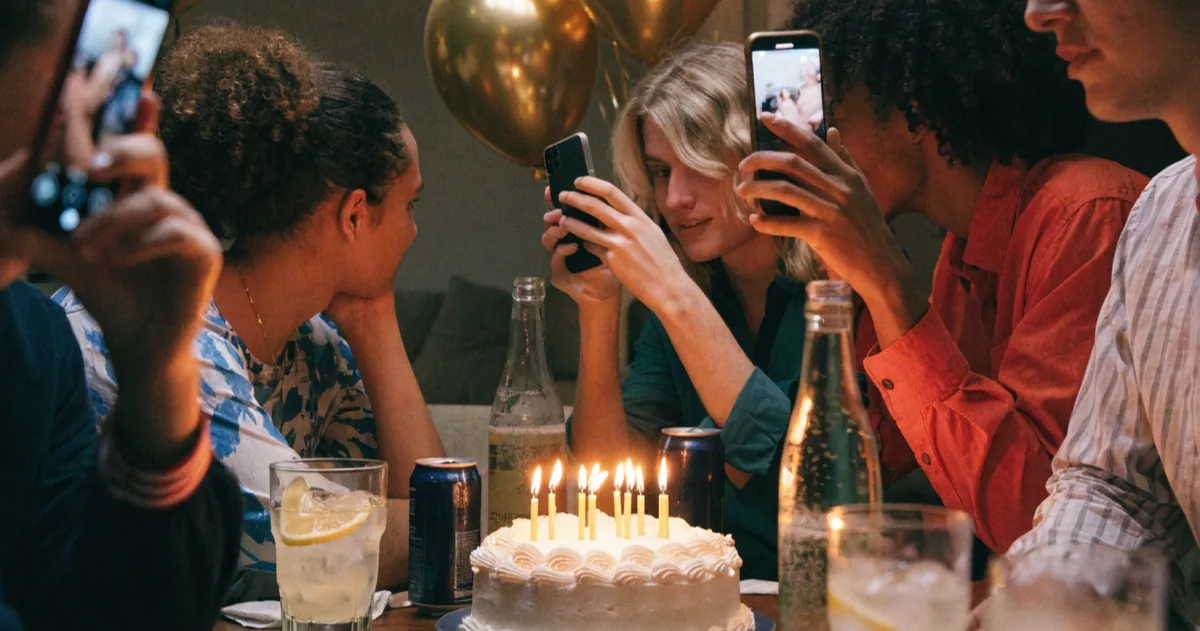
Here is the part every list of surprise birthday party ideas leaves out. The reveal is the only moment of the night that cannot be re-staged, and the person it is for is the only one in the building who cannot photograph it. They are walking through a door with their hands over their face. Whoever happens to be holding a camera at that second decides whether the moment survives at all.
So make it two jobs, given to two named people, told a week in advance:
- One person films the door. Starting thirty seconds before the door opens and not stopping until the hugging is over. The thirty seconds before is the part everyone forgets, and it is where the shot lives.
- One person shoots stills, from the side. Not behind the crowd. From an angle that has the face and the room in the same frame.
Both of them stand in position and stay off drinks duty. Everybody else can raise a phone if they want to, and they will: 91% of US adults own a smartphone (Pew Research Center, 5,022 US adults surveyed 5 February to 18 June 2025). The cameras are not the constraint. Convergence is.
Because this is what actually happens. Forty people film a few seconds each. Those clips sit in forty camera rolls, three group chats and a story that expires the next day. The one person who appears in every single one of them ends up with none of them. Three weeks later somebody says "send me that video" and nobody does.
The fix is one album everyone adds to, opened by one QR code that opens a shared album rather than an app anyone has to install. Guests scan the code, pick their shots and upload — no account, no download, no explaining it twice at the door. Photo, video and voice all land in the same place, uploads are unlimited, and the guest of honour gets one link that holds the whole night, including the moment they could not see.
A note on the obvious free alternative, with the vendor's own numbers. An iCloud Shared Album is a genuine option if every single guest is on an Apple device, but know the limits before you rely on it: a shared album takes a maximum of 100 subscribers and 5,000 items, shared photos are reduced to 2,048 pixels on the long edge, and videos are delivered at up to 720p (Apple Support, *Shared Album limits*, published 27 February 2025). For the reveal clip specifically, 720p is the detail that matters.
Two practical follow-ons: put the code out on the tables rather than at the door, because nobody scans anything during a reveal — how to collect the photos guests actually took covers the placement. And decide before the party what happens to the album afterwards, because what to do with birthday party photos is a decision, not an afterthought. If you would rather work from a shot list than invent one on the night, there is a checklist of the shots people regret missing.
What actually leaks a surprise party
It is almost never a guest deciding to tell them. It is the paperwork.
- The shared calendar. A three-hour block called "Saturday" on a calendar they can see is worse than no block at all. Put it on a calendar they do not have.
- The group chat that already includes them. Started from an old thread, and they are member number fourteen from a holiday two years ago. Start a new one from scratch, then count the members out loud.
- A public event page. Anything indexable, anything a mutual friend can share, anything with an RSVP list a curious person can open.
- The house. Bags, boxes, a cake in a fridge they open twice a day. Store it somewhere else entirely.
- The reply-all. A guest answers a question in the wrong thread. This is the one you cannot fully prevent, so keep the number of threads to exactly one.
And the arrival time. Tell guests 45 minutes before the real thing, tell the chronically late ones an hour, and tell nobody the actual minute except the handler and the person on the door. People are late. The guest of honour, for once, must not be.
A three-week plan
Three weeks is enough. If you want the full sequence rather than the menu, we have a step-by-step plan for organising a surprise party; this is the compressed version.
| When | The one decision | Everything else |
|---|---|---|
| 3 weeks out | The reveal | Ask the three people who would know. Pick the reveal, then the venue that suits it. Write the cover story in one sentence. |
| 2 weeks out | The guest list | Send the invitation with the cover story and an arrival time 45 minutes early. Start a fresh thread. Set up the photo album and put the link in the invitation. |
| 1 week out | The format | Buy for one focal point, not the whole room. Brief the handler, the door and the two cameras. Collect the recorded messages if you are using the screen montage (reveal 6). |
| The day | Nothing | Move the storage in, set up in forty minutes, put the code on the tables, decide which light switch, put the phone on silent. |
The day-of row is short on purpose. Anything larger than that on the day means a decision got postponed, and postponed decisions are what get made badly in front of forty people.
The short version
Most surprise birthday party ideas arrive as a pile of themes. Sort them before you shop. The reveal is the decision that matters and it comes first. The cover story should be boring enough to survive a follow-up question. The format should be chosen for how well it hides, not for how it looks in a photograph.
Then do the two things nobody's list mentions. Ask the three people who would know whether this person actually wants a surprise, because one in six does not. And give two named people a camera and a place to stand, because the moment you are building the entire evening around is the one thing you cannot go back and add.
Sources
- YouGov, How Americans celebrate their birthdays — 1,000 US adult citizens, fielded 23–28 November 2022, published 13 January 2023: https://yougov.com/en-us/articles/44982-how-americans-celebrate-their-birthdays
- YouGov, How often Americans attend — and how they feel about — 20 kinds of special occasions — 1,000 US adult citizens, fielded 13–18 January 2023, published 2 March 2023: https://yougov.com/en-us/articles/45330-how-often-americans-attend-social-occasions-poll
- Pew Research Center, Mobile fact sheet — 5,022 US adults, fielded 5 February–18 June 2025: https://www.pewresearch.org/internet/fact-sheet/mobile/
- Apple Support, Shared Album limits — published 27 February 2025: https://support.apple.com/en-us/108916
Frequently asked
Pick the reveal before anything else. The strongest options are a dark room where the lights come up as they walk in, a restaurant table for two that turns out to be a room for twenty, and a handler who spends the afternoon with them and delivers them to a door at an agreed minute. If they dislike being the centre of attention, use a staggered reveal — one friend, then a few, then the room — instead of an ambush.
A boring one. "Dinner, just us, at the place you like" and "come help me with something at my place" are the two most reliable, because neither needs explaining and both set the right clothes. Avoid anything elaborate: the story only has to survive one follow-up question, and elaborate stories invite several. Send every guest the same one-sentence version and ask them not to improvise.
Tell guests 45 minutes before the guest of honour is due, and tell the habitually late ones an hour. Give the actual minute to only two people: the accomplice who is with the guest of honour, and the one person whose only job is watching the door. Reveals fail when everybody assumes somebody else is watching for the car.
Most do, and a significant minority do not. YouGov found 63% of Americans would love or like it if someone threw them a surprise birthday party, while 16% would hate or dislike it, in a survey of 1,000 US adult citizens fielded in November 2022. A separate YouGov survey found 59% have attended a surprise party. Being at one is common; being the subject of one is not the same experience. Ask the people closest to them about the reaction rather than about the party.
There is no reliable figure, and the averages quoted online generally come from party-supply retailers with no stated method, so this article does not repeat one. Budget by shape instead. A booked room or restaurant is per head, predictable, and usually has a minimum spend — ask for the minimum before you ask for the capacity. A house party looks cheaper and drifts, because food, drinks and replacements are all per head underneath the flat cost. Decorations are the smallest line; food is the largest.
Move everything out of the house. Store the shopping at a neighbour's or in a friend's car, order from a device they never pick up, and keep the date off any calendar they can see. Use a cover story that lives on your own calendar rather than theirs, start one new message thread instead of reusing an old one, and check the member list of that thread by counting the names.
 Guide
Guide90th Birthday Party Ideas: Plan the Room, Then Pick the Theme
Twelve 90th birthday party ideas, five formats to run them in, and the sound, light and print calls that decide whether the guest of honour enjoys it.
 Guide
Guide18th Birthday Party Ideas: 18 Themes and How to Run Them
Eighteen themes for an 18th birthday party, sorted by the format each one needs, plus the one thing a US 18th cannot legally include and what to serve instead.
 Guide
GuideBirthday Party Ideas for Tweens: 22 That Fit 10 to 12
Twenty-two tween party ideas sorted by where it happens and who has to supervise, plus the measured reason a 10th and a 12th birthday are not the same party.