Pros and cons of a photo booth business: the 2026 numbers

Search this question and you will find a wall of encouraging numbers. Margins of eighty per cent. Payback in three months. Six figures part-time.
Look at who published each one. Almost always it is a company that sells photo booths, booth software, or a booth franchise. That does not make the figures false. It does mean nobody has an incentive to publish the disappointing version.
So here is the version built from prices you can look up, and arithmetic you can run yourself. If you want to run it against a real quote rather than an average, the photo booth cost calculator splits one into cost per hour, per guest and per print — which is also how your customers will compare you.
What does a photo booth actually charge per event?
Bark's US rental cost guide reports an average of $250-$550 per event for a standard three-to-four-hour booking. Hourly rates run from $100 at the low end to $150-$200 standard and $300+ premium. Wedding packages sit higher, at $400-$1,200 for the same duration (Bark, retrieved 2026-08-05).
Bark states the figures come from local service providers in the US, but does not publish its method. It is not clear whether these are completed bookings, requested quotes, or listed rates. Treat the range as an orientation, not a survey. The number that matters is what the three operators nearest you actually quote.
The pros, with the arithmetic attached
Gross margin per event is genuinely high. A booking is mostly your labour and your time, and consumables are small. If you take $600 for an evening and spend $40 on prints and fuel, the contribution is $560. That part of the pitch is real.
- Equipment is a one-off against recurring revenue. Every booking after payback runs against a sunk cost.
- Demand is not exotic. Weddings, corporate parties, proms and birthdays all buy the same thing.
- You can start small. One booth, one operator, weekends only, and no lease.
- Cash arrives near the event. Deposits up front, balance on or before the night.
The cons that the guides skip
Saturdays are a fixed inventory. This is the one that decides the ceiling. There are roughly 52 Saturdays, and wedding season does not use all of them. You cannot book your way past the calendar.
- It is seasonal, and the trough is long. Demand concentrates into months; insurance, storage and subscriptions run for twelve.
- The unpaid hours dwarf the paid ones. A four-hour booking is routinely a ten-hour day once you count enquiries, travel, setup and teardown.
- Gear fails on the night. Printers jam at 10pm at a barn wedding, and there is no help desk.
- Depreciation never sends an invoice. If you do not provision for replacement, your margin is borrowing from your future self.
- Low barriers brought you in. They also bring in the person quoting $200 down the road.
About those margin figures
I am not going to quote you a profit-margin percentage. The circulating figures -- 69-85%, or 50-70% net, or 90% for home-based operators -- all trace back to booth and software vendors. None published a sample, a method, or a definition of which costs were included. A margin that excludes your own time is not a margin. It is a day rate wearing a costume.
Run your own instead. Take your quoted fee, subtract consumables, travel, the monthly share of insurance and software, and a replacement provision for the booth. Then divide by the true hours. The answer will be specific to you, and it will be true.
The lever that actually moves the number
Because Saturdays are capped, revenue per booking is where the business is won. That is why so many operators bolt on extras: a second backdrop, a guest album, a prop upgrade, an audio guestbook, prints in a keepsake folder. Each one lifts the same evening total without consuming another Saturday.
Gathmo is my product, and a branded guest album is one of the add-ons operators resell. Our suggested resale figures are EUR 49 for a low-end booth or DJ add-on, EUR 99 as a typical per-event line, and EUR 199 at the premium agency end. Those are suggested resale prices we publish for planning, not observed market averages.
The general point stands regardless of whose add-on you sell: one more line on the same invoice beats one more Saturday. For the mechanics of adding a digital line to a booking you already have, see turn every booking into a digital upsell.
Is it worth starting?
It is a good business if you want weekend income with high contribution per event and a low barrier to entry, and if you accept a hard ceiling set by the calendar.
It is a poor business if you were sold it as passive. It is not passive. It is a service business where you are the service, and the equipment is the smaller half of what you are buying. The operators who do well usually stopped optimising for more bookings and started optimising for what each booking is worth.
Frequently asked
Published startup estimates range from about $3,000 to $25,000 depending on booth type, but every figure I could find was published by a company selling booths. Price your own build from actual quotes for camera, printer, enclosure, lighting, backdrop, software and insurance. Do not plan against someone else’s range.
Take your fixed monthly costs -- insurance, software, storage, listings -- and divide by your contribution per event. That is your break-even count. Everything above it is profit. This is the only version of the answer that is true for you.
No. Setup, operation and teardown all need a person present, and the selling happens during the week. Treat it as weekend service work with good margins.
Your time, followed by depreciation. Neither sends an invoice, and both are missing from most published margin claims.
Many operators do, because the work lands on weekends. The strain is on weekday evenings, when enquiries and quotes need answering quickly to win bookings.
 Story
StoryWhat a white-label event photo app actually means (and what's fake)
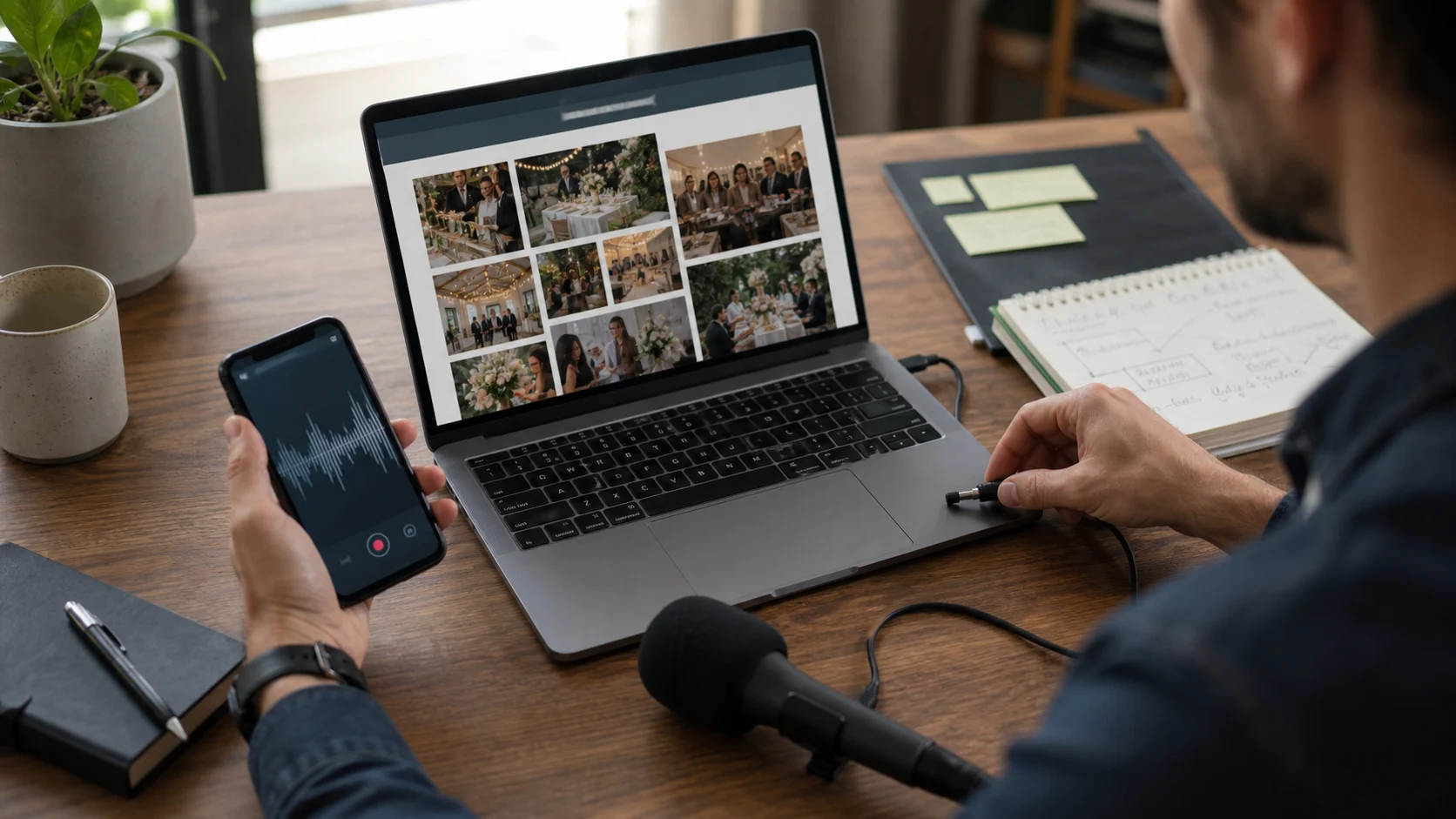
White-label event photo apps range from a cosmetic logo swap to a fully de-branded guest gallery on your own domain. Here is how to tell the real thing from the fake -- and which tier actually unlocks it.
 Comparison
Guestpix alternative with custom domains and voice
Guestpix sells per-event bundles without a custom domain. Gathmo gives resellers a fully branded guest gallery on their own domain, voice notes included -- and you keep 100% of what you charge clients.
 Comparison
Kululu alternative: white-label without the "contact sales"
Kululu puts custom domains behind a "contact sales" Custom plan. Gathmo productizes white-label and your own domain at a published €199/month equivalent Agency tier you can start the same day -- no sales call.