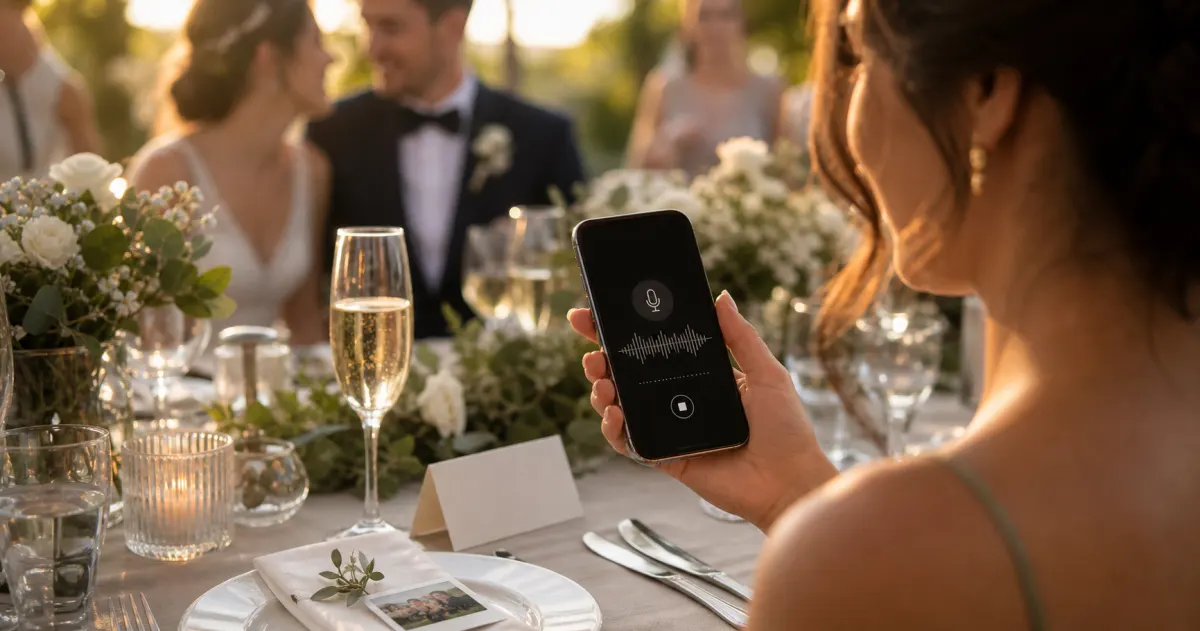

Guest voice messages are the wedding keepsake couples replay most, and almost nobody plans for them. A voice note carries what a photograph cannot: the pause before someone says what they really mean, the accent, the laugh that arrives before the words. Most run ten to thirty seconds. Guests scan a QR code, tap record in the browser, and speak. No app, no account.
Ask any couple a year after their wedding what they replay most, and it is rarely the posed portraits. It is the thirty-second voice note from a grandmother who is no longer here, rambling about the first time she met the groom. It is the message from a college friend who drove eight hours and could only manage 'I love you both so much' before his voice broke. It is the one from the bride's father, recorded outside during the speeches, who said everything he was too nervous to say at the microphone.
What does a voice note capture that a photo cannot?
Photos are extraordinary things. They fix light and geometry -- a face, a dress, the exact angle of the afternoon sun filtering through a marquee. But a voice carries something a photograph cannot: texture. The way a person pauses before saying something that really matters. The accent that only comes out when they are happy. The laugh that arrives a moment before the words do. A photo tells you what someone looked like on your wedding day. A voice tells you who they were.
Why does the paper guestbook fall flat?
The wedding guestbook has not changed much in a hundred years. A leather-bound book, a pen on a string, and a queue of people who want to say something meaningful but end up writing 'Wishing you every happiness!' because that is the only thing that comes to mind when fifteen people are watching. The format does not invite honesty. It invites performance. Most couples read their guestbook once, the week after the wedding, and tuck it away somewhere they will not find it for five years.
A voice note changes the dynamic entirely. It is private -- the guest speaks directly to the couple, knowing no one else is listening in real time. It is quick -- a single tap to record, a single tap to send, and done. And it is oddly easier than writing, because speaking is what we do naturally when we want to tell someone something we actually mean. The constraints of a page and a pen disappear. What is left is just the person, saying what they came to say.
How long is a typical message?
Most notes land somewhere between ten and thirty seconds. That is long enough to be genuinely meaningful, short enough that nearly everyone actually does it. There is no app to install, no account to create. Guests scan the QR code on the table, tap the voice button in their browser, speak, and it is done. The recording lands in the couple's album before the first dance has started.
Picture an 80-guest wedding where the QR code is visible on every table and the prompt is specific. The notes that come in -- a toast, a memory, a grandparent saying your name -- wait in the album alongside the photos by the time the band packs up. Listened to back-to-back the morning after, they do something the photos alone cannot: they let you hear your wedding, not just see it.
What does it sound like the morning after?
Gathmo treats voice as a first-class capture type, sitting alongside photos and videos as something guests are actively invited to contribute. The recording happens entirely in the browser, and what the guest said is exactly what the couple hears -- the same voice, the same pauses, the same ambient sound of the room they were standing in. Years from now, when a face in a photo becomes harder to place, a voice will still be unmistakably the person.
How do you set up a voice guestbook?
Setting it up takes about thirty seconds at the same time you create the event -- our digital voice guestbook setup guide walks through it step by step. Print the QR code, place it on the tables with a small note inviting guests to leave a message, and let the evening do the rest. You will hear things the morning after that you never expected anyone to say -- and you will be glad you made it easy for them to say it.